

A perfume blend can smell strong and still feel flat. You may notice plenty of sweetness or woodiness, yet struggle to find the floral detail you wanted. Or the opening may work well, while the later fragrance feels blurred.
Before adding another ingredient, preserve the original and run a small, controlled comparison. First check how you are evaluating the perfume, then check the formula and stock strengths. Change one thing at a time so the result tells you what to try next.
What do “flat” and “muddy” mean in your blend?
These are useful descriptions, but they are not diagnoses. Give the problem a time and a specific feature: “The rose is difficult to pick out after one hour” tells you more than “This smells muddy.”
Weak: you find little overall odour at the chosen test conditions. Flat: the fragrance lacks the contrast or development you wanted. Muddy: the intended character is difficult to distinguish. Your working definitions can differ; the important part is using them consistently.
A deliberately soft or linear perfume need not be a failed perfume. Decide what you want the blend to do before trying to make it brighter, louder or more complex.
Why individual materials can disappear in a mixture
Recognising a material on its own does not guarantee that you will recognise it in a blend. In a human odour-mixture study, some characteristic qualities became less apparent even in two-component mixtures. Other qualities remained in larger mixtures. The findings support evaluating the blend itself rather than predicting it from separate bottles. Jinks and Laing, 2001.
This is a reason to test proportions, not a rule that complex perfumes are muddy. The study does not establish an ideal number of perfume ingredients or identify the cause of a particular failed accord.
1. Check your smelling session before changing the formula
If you have been repeatedly smelling the trial, put it aside and take a break away from fragrance. In a study using two odorants, sustained exposure reduced perceived intensity; longer recovery periods increased the intensity of a subsequent stimulus. That supports allowing recovery, but it does not give every perfumer a universal reset time. Stuck and colleagues, 2014.
Return in a low-odour space with fresh, labelled blotters. Use consistent application amounts and the same type of strip. Keep the number of samples manageable. If you cannot make reliable comparisons, stop for the session rather than continuing to add materials.
Record the test dilution and carrier. Comparing one formula as a concentrate with another as a diluted trial leaves you with more than one explanation for a difference. For the first comparison, use the same evaluation concentration unless concentration itself is the variable you intend to test.
2. Check what actually went into the bottle
Read the weighing record, not just the intended formula. Check the material identity and grade, supplier, stock strength, carrier, actual mass added and final batch mass. If you changed a supplier or remade a stock, include that in the notes.
A dilution error can be large enough to deserve attention before any creative adjustment. For example, 0.50 g of a 10% w/w stock contributes 0.05 g of its undiluted material. The same mass of a 1% w/w stock contributes 0.005 g. Those are different doses, even if the formula line has the same material name. See how to calculate active material in stock dilutions.
An unusually smelling stock, an undocumented bottle or a trial with unexpected separation needs a separate investigation. Do not try to cover the problem with another ingredient. “Muddy” here describes the smell; visible cloudiness is a different observation. Use the cloudy-perfume troubleshooting record if that is what you see.
3. Choose one question and make a fresh trial
Write a question that the comparison can answer. For example: “Does reducing the sweet accord make the floral heart easier to recognise at one hour?” That is more useful than “How do I improve this perfume?”
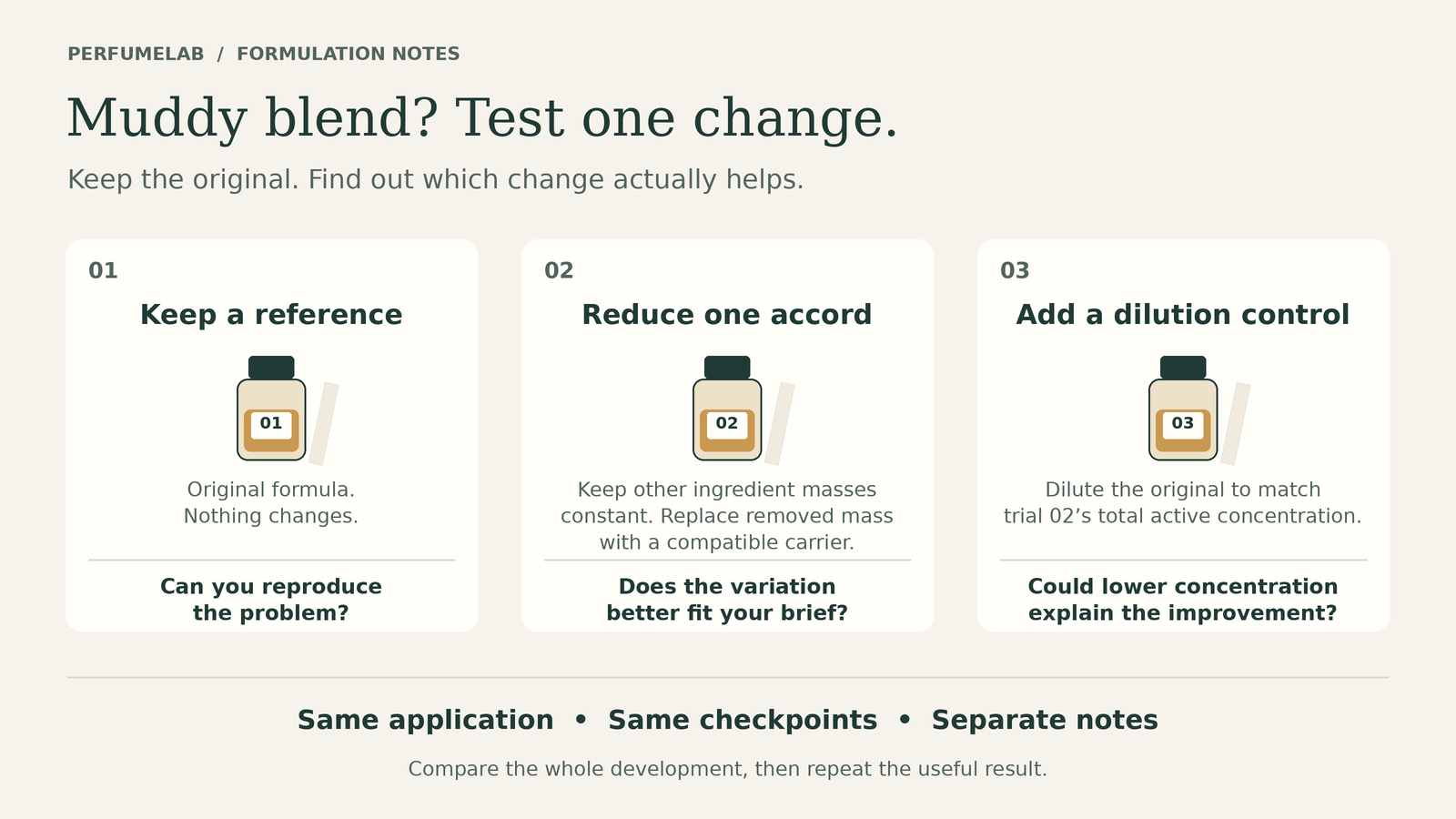
Keep a labelled reference. Prepare a new variation rather than repeatedly adding to the only sample you have. Record the exact change and how you kept the total mass consistent. The formula-trial comparison guide covers the records to keep together.
One practical screen is to reduce a suspected material or accord while leaving the masses of the other ingredients unchanged. If you replace the removed mass with a compatible carrier, document that explicitly. This keeps the other ingredients at the same mass per batch, but lowers the total amount of fragrance material. It is not a comparison at equal fragrance concentration.
If that version is clearer, compare it with a uniformly diluted original as a follow-up. Match the total active fragrance concentration, accounting for the carriers in your stocks. This helps you judge whether a general reduction in concentration could explain the improvement. It does not prove a particular masking mechanism. For the full method, see how to test leaving out a perfume ingredient.
A worked example: the floral heart is hard to find
Hypothetical example: you are developing a soft floral perfume with a sweet background. You like the opening, but at one hour the floral character is harder to recognise than you intended. You suspect one sweet accord. This is a testable suspicion, not a finding about that accord.
| Sample | What changes | What you are asking |
|---|---|---|
| Reference | Nothing. Keep the original formula and documented test conditions. | Can you reproduce the problem? |
| Reduced-accord trial | Reduce the chosen accord; hold the other ingredient masses constant and replace the removed mass with a compatible carrier. | Does this version better meet the floral brief? |
| Dilution control | Dilute the original uniformly to the reduced trial’s total active fragrance concentration. | Could lowering overall concentration explain the result? |
Evaluate at the same elapsed times. Suppose the reduced-accord trial gives you a more recognisable floral heart, while the dilution control mainly smells weaker. That would support testing the lower accord level again. If both versions improve similarly, investigate the overall concentration before deciding that the accord needs to go.
If the reduced trial loses the roundness you wanted, that is useful too. Try a smaller reduction in the next round, or keep the original if it better fits the brief. The aim is a better perfume, not the easiest possible ingredient identification.
4. Judge the opening, heart and later drydown separately
Choose evaluation times before smelling. For example, you might record observations at five minutes, one hour and four hours, adding a next-day blotter check if relevant to your brief. These are convenient checkpoints, not universal boundaries for top, heart and base notes.
At each checkpoint, write three short observations: the character you recognise, the feature that dominates, and how well the sample fits your goal. Keep intensity separate from clarity. “Quieter, but the rose is easier to recognise” is a more informative note than “better.”
Keep preparation age, storage, blotter application and evaluation conditions as consistent as practical. Compare the samples in a different order on another session. If someone can code the samples for you, record your impressions before revealing which is which.
Do not treat a good blotter result as proof of how a finished product will perform on skin. See what blotter and skin tests can tell you. Unassessed trials should stay off skin.
5. Repeat the useful result before making a larger batch
Remake the promising version from its written formula. If the improvement disappears, check the weighing, stocks and evaluation conditions before revising it again. Keep notes on trade-offs: clearer at one hour but less interesting later may or may not suit your brief.
Only move to another variable after the first comparison has given you a useful answer. Otherwise, a change in concentration, an extra bright material and a reduced sweet accord can all become tangled in the same trial.
Should you add a booster or wait for the perfume to rest?
Choose an added material for a specific effect you want to test. An ingredient’s reputation for diffusion, lift or blending is not enough to predict what it will do in your formula. Keep the reference and compare a documented addition rather than treating any material as a universal fix for flat perfume.
If you want to investigate resting time, make it a separate comparison with recorded dates and storage conditions. A freshly made variation and an older reference differ in both formula and age. The guide to comparing rested perfume trials explains how to make that question more useful.
Keep sensory troubleshooting separate from safety assessment
Use documented perfumery materials at appropriate working dilutions and follow each supplier’s safety data sheet, including handling, ventilation and protective-equipment requirements. Do not smell unknown materials or apply neat ingredients or unassessed trials to skin. A better-smelling sample is not evidence that it is safe to wear.
Check the current requirements for the exact ingredients and intended finished product. Quantitative IFRA restrictions apply to the finished consumer product, and an IFRA Certificate of Conformity does not replace a safety assessment. IFRA: Using the Standards.
What to write down for your next trial
Keep the original version, your one-sentence question, exact masses and stock strengths, the change you made, evaluation concentration, preparation date and timed observations together. Finish with a decision: keep, repeat, reject or test a smaller adjustment.
That record is what turns “my perfume smells muddy” into a manageable next experiment. Use a notebook or formulation tool that lets you return to the exact version you evaluated. Explore PerfumeLab on the App Store.