
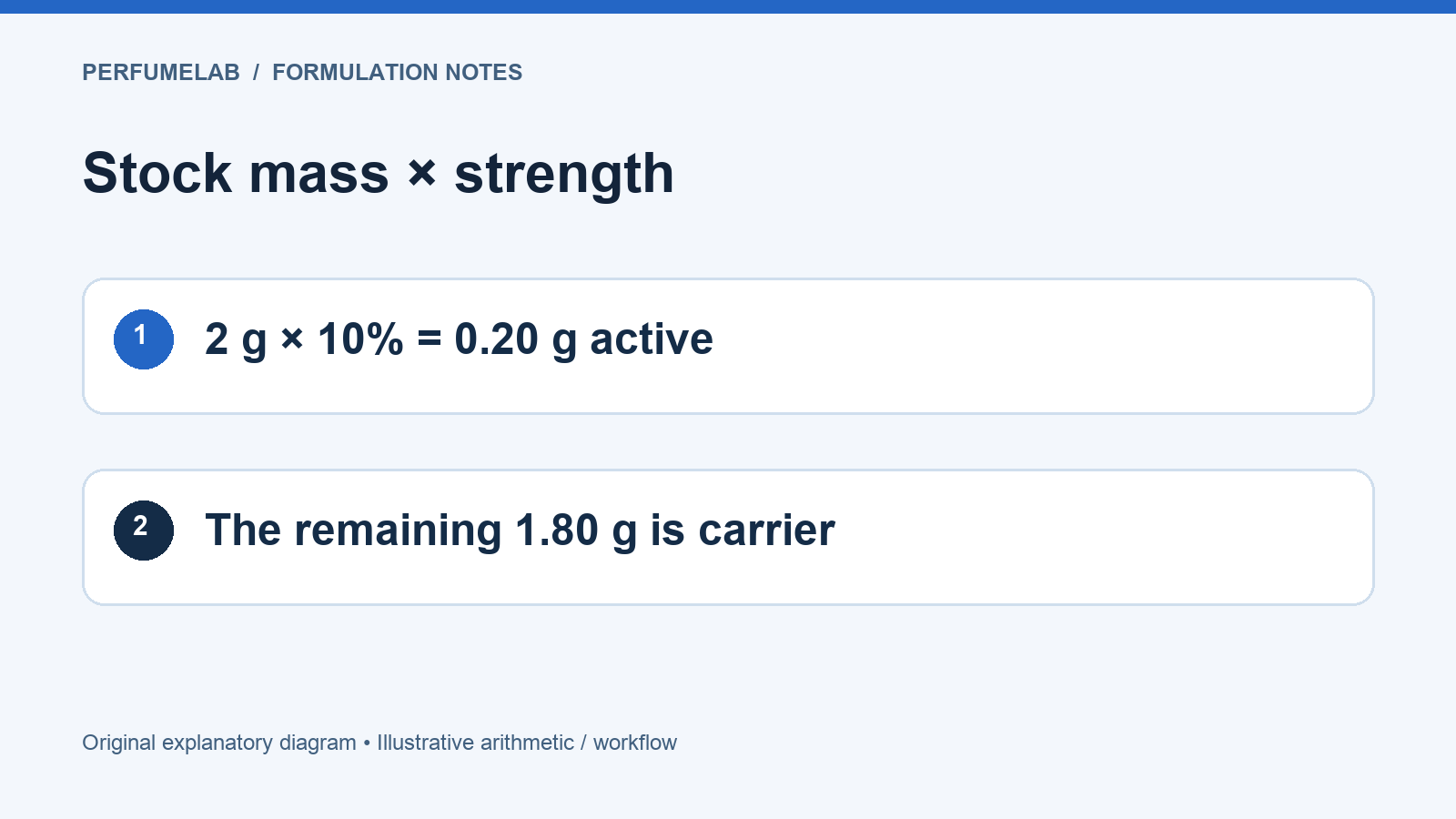

Two grams of a 10% stock contribute 0.20 g of the named aromatic material. The other 1.80 g is carrier. If you record the full 2 g as neat material, your formula analysis will overstate that ingredient tenfold.
Keep two views of the formula
The as-weighed view describes what you add from each bottle. The active-material view separates the aromatic material from the carrier in those bottles. Both are useful, but they answer different questions.
Imagine a 10 g arithmetic example containing 2 g of A at 10%, 1 g of B at 50%, and 7 g of a carrier. A contributes 0.20 g active and B contributes 0.50 g active. The total named active material is 0.70 g, or 7% of the batch by mass. Counting the two stock lines as 3 g of fragrance would give 30%, which describes the purchased solutions rather than their aromatic content.
Follow each dilution stage
If that complete 10 g mixture is then used at 20% in another product, A's final contribution is 2% × 0.20 = 0.4%. B's is 5% × 0.20 = 1%. Every dilution stage matters.
This calculation assumes A and B represent individual materials at known strengths. A proprietary fragrance base may contain several constituents and needs composition or conformity information appropriate to the intended assessment. Do not guess its composition from its name. The distinction between indole and Indolene 50% BB is a practical example of why a percentage in a product name is not enough to calculate a substitution.
Make the distinction visible
Add columns for stock strength, as-weighed mass, active mass and carrier mass. Keep the denominator visible when expressing a percentage: active material in the concentrate and active material in the final product are different values.
This is particularly useful when comparing two trials made with different stock strengths. The weighed quantities may look different while the active contributions match. Conversely, identical weighed quantities can hide a large change in the formula. Compare on the same basis before deciding that an ingredient has become stronger or weaker.
[…] A dilution error can be large enough to deserve attention before any creative adjustment. For example, 0.50 g of a 10% w/w stock contributes 0.05 g of its undiluted material. The same mass of a 1% w/w stock contributes 0.005 g. Those are different doses, even if the formula line has the same material name. See how to calculate active material in stock dilutions. […]
[…] coumarin” is an incomplete record if you cannot say what replaced it. For the arithmetic, see active material in stocks; for the comparison record, see comparing formula […]
[…] both have the same raw-material concentration by mass. If you need help with that distinction, see how to account for material in stock dilutions. Keep stock concentration separate from the supplier’s assay: a minimum GLC purity specification […]
[…] useful when you know the identity and concentration of the material being diluted. Our guide to active material in stock dilutions explains that distinction. Applying the arithmetic to the wrong identity produces a precise answer […]
[…] the general arithmetic, see how to read active-material content in stock dilutions. Here the extra step is establishing whether the number on your tincture or extract label is […]