
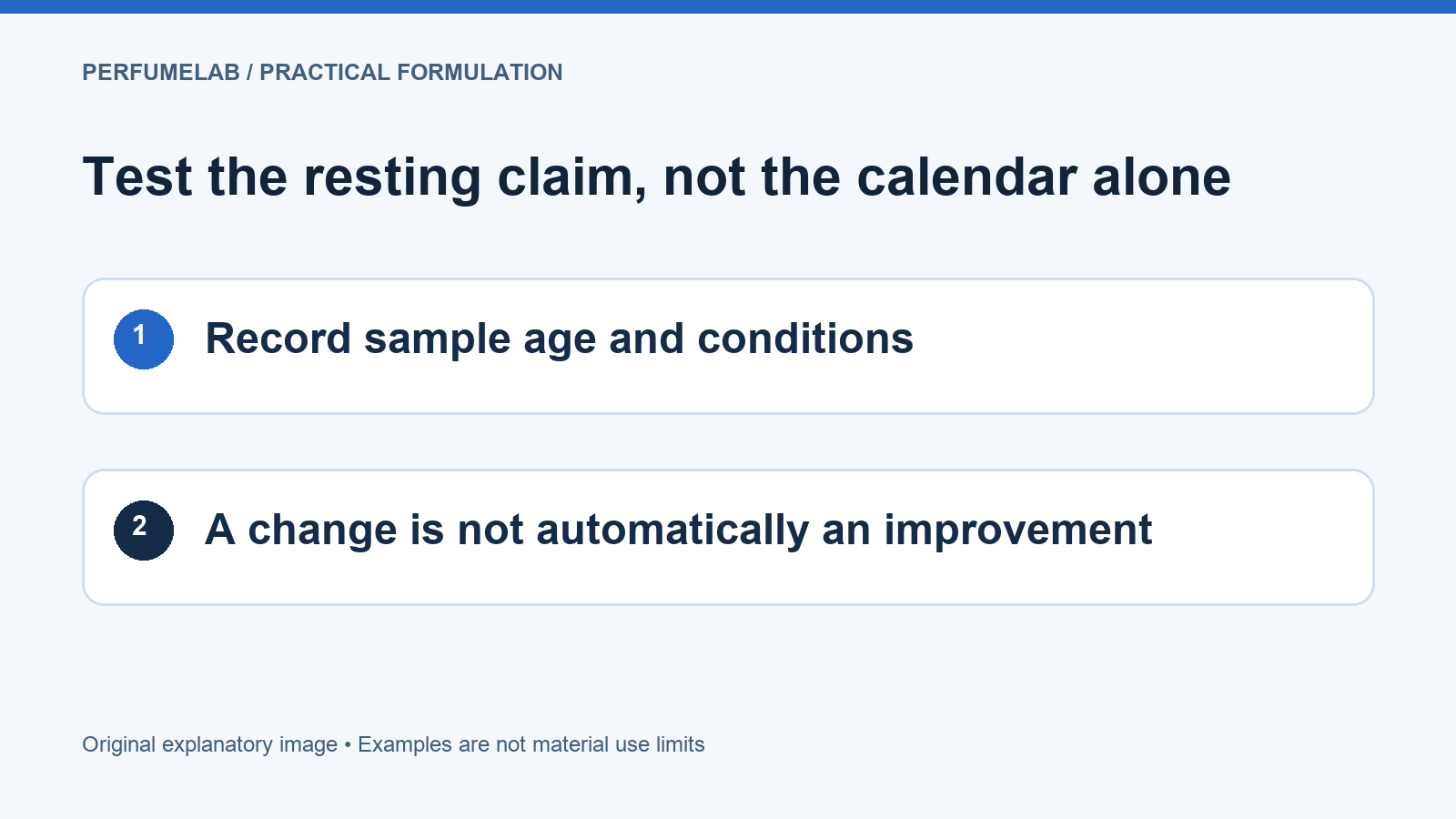

Resting a perfume and improving a perfume are not the same claim. A sample can change over time without moving closer to the character you wanted. If you want to understand the effect, record it as a comparison rather than relying on a universal number of days.
Ask what is being rested
A raw-material tincture, a fragrance concentrate and a finished dilution are different mixtures. Advice for one supplied product should not automatically be transferred to every homemade perfume. Supplier pages can give product-specific guidance; they do not establish one resting period that makes every composition ready.
Record the formula or stock identity, preparation date, concentration basis and carrier. Otherwise, a note saying “better after a month” leaves too much unknown to be useful.
Keep the observations comparable
Write down chosen evaluation times and the conditions in which the sample is held. Use an appropriate procedure and suitable packaging based on the actual materials. Keep the composition unchanged while studying age; unrecorded additions turn the exercise into a reformulation trial.
Compare specific observations: the balance of the opening, the character at a later point, appearance and any relevant changes you are investigating. Do not let a darker colour or a smoother-sounding description substitute for the question you meant to answer.
Be honest about the reference
Comparing today's sample with your memory of its first day is useful as a notebook entry, but it is not the same as a controlled side-by-side comparison. Memory, preparation differences and evaluation conditions can all complicate the interpretation.
If you prepare a fresh comparison batch later, its actual masses and materials must be documented too. It may help investigate the question, but a new batch introduces its own possible differences. State those limitations rather than presenting the result as a controlled experiment you did not perform.
Resting is not a universal repair method
Do not assume that waiting establishes safety, solves every solubility problem or compensates for an incorrect formula. A change in appearance or an unexpected result needs appropriate investigation. Follow the materials' handling information; this article gives no heating, chilling or filtration instruction.
The useful outcome is a dated record showing what changed under the conditions you used and whether you preferred it for the brief. That evidence can guide the next trial far more effectively than a blanket claim that all perfumes become stronger or better after the same waiting period.