
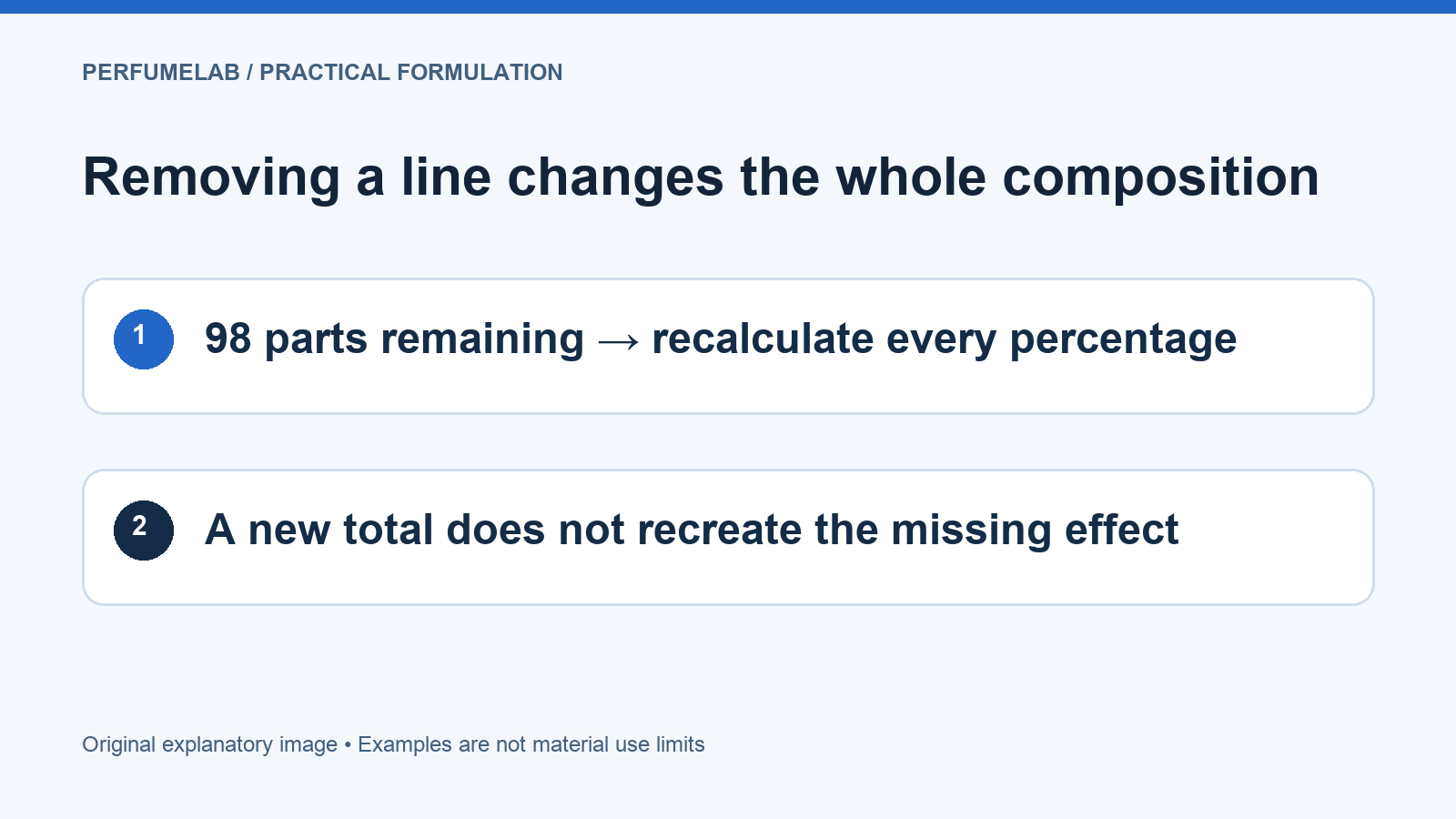

You can make an experimental variation without an unavailable ingredient, but it is a different formula. Removing a line does not tell you that the ingredient was unimportant, and making the remaining figures total 100% does not restore its effect.
Decide what the trial is meant to teach
Perhaps you want to hear the ingredient's contribution by comparing the original with an omission version. Perhaps you simply do not own it yet. Those are different reasons to make the change, and the record should say which one applies.
Preserve the original formula and give the variation its own identity. Do not present the modified version as an exact reproduction or an authenticated original recipe.
Recalculate the proportions honestly
Imagine a fictional 100-part formula containing a 2-part line you omit. If you keep all remaining masses unchanged, the new total is 98 parts. A remaining 10-part line is now 10 ÷ 98 × 100, about 10.204% of that new mixture.
If instead you replace the missing 2 parts with a carrier, the original remaining percentages can be preserved on the as-weighed basis, but the mixture contains a different carrier contribution. Neither method restores the omitted odour effect. These are mathematical examples with unnamed materials, not a usable formula or a safety recommendation.
Do not assume less means automatically acceptable
Renormalising can increase other materials' percentages. A relevant assessment must describe the composition and final product actually being made. An old conclusion about the original formula should not be copied over simply because one line disappeared.
Stock strengths and complex mixtures can also matter. Omitting a diluted material removes its carrier as well as its named active contribution; the new solvent balance may differ from what the shortened ingredient list suggests.
Compare before choosing a substitute
An omission trial can help clarify the question, but it does not identify a perfect replacement. If you later test an alternative, keep that as another version with its own exact material identity and quantity. A similar supplier descriptor is a reason to investigate, not proof of equivalence.
Evaluate under comparable conditions and record what changed in the whole composition. It is useful to discover that the omitted ingredient had a subtle effect, or that you prefer the variation. The important point is to know which version produced that observation, rather than letting an unrecorded omission become the new “original”.