
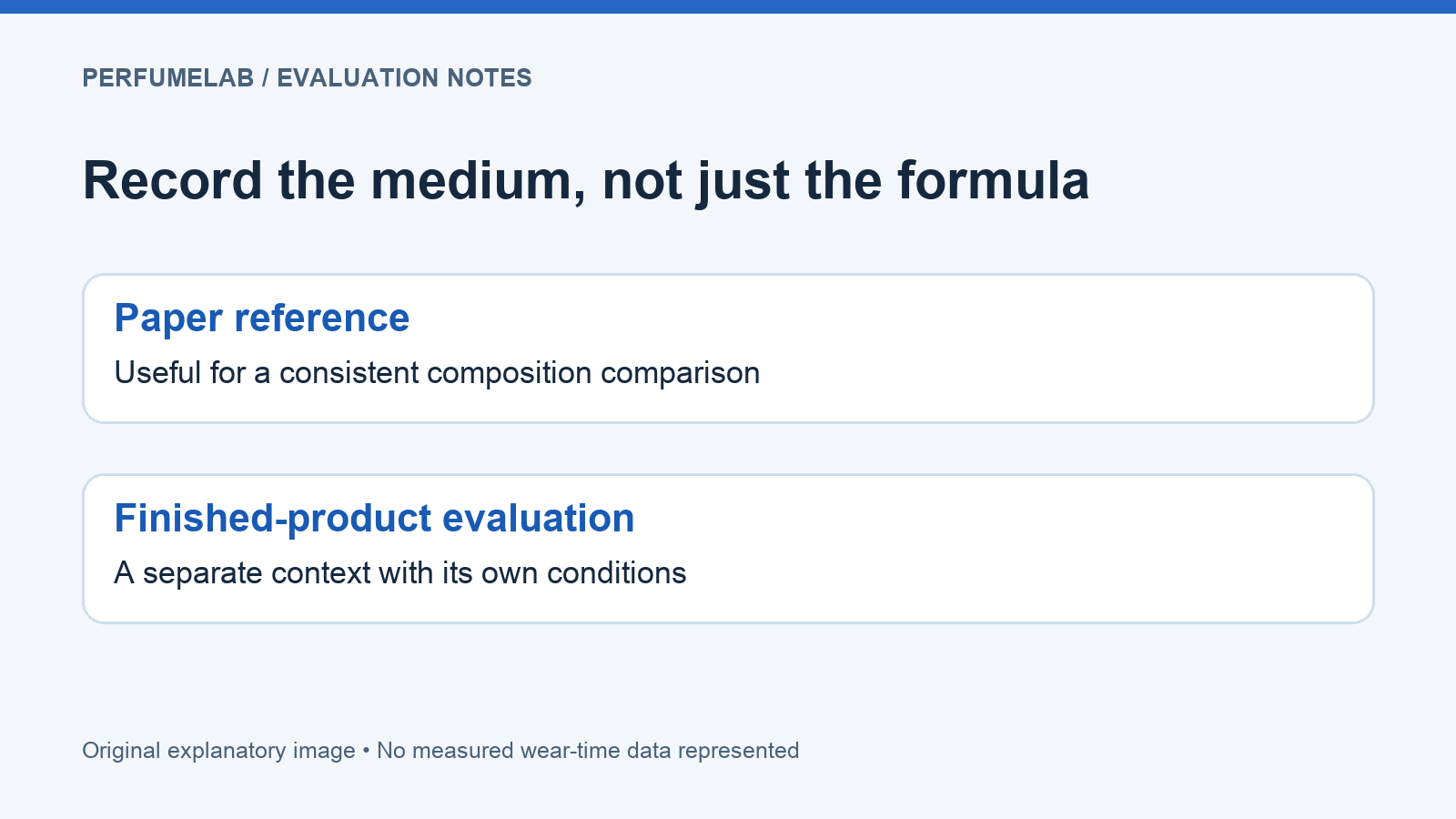

A perfume blotter gives you a convenient reference for a composition. It does not provide a direct prediction of how that perfume will develop on every person's skin. Record the evaluation medium alongside the formula, especially when comparing longevity claims.
Start with the question you want to answer
For an early comparison, you might want to know whether a revision changes a woody effect or makes an opening seem sweeter. A consistent paper-based method can help you organise that work. Keep the paper, preparation, test concentration and observation times comparable.
If your question concerns the behaviour of a finished skin-applied product, that is a different evaluation context. Use an appropriate procedure for a product established as suitable for that use. A raw-material reference or an unassessed concentrate is not automatically suitable for applying to skin.
Skin is part of the conditions
A 2025 study examined fragrance-molecule evaporation on volunteers and investigated relationships with molecular and skin properties. It supports taking the evaluation conditions seriously. It does not supply a universal conversion from hours on a blotter to hours on skin, nor a guarantee for every complete fragrance.
Keep the distinction between a measured research result and a casual sensory observation. Detecting an odour, measuring an evaporated component and deciding whether the perfume still expresses the intended character are related but different questions.
Avoid changing two variables at once
Suppose you compare version A on paper with version B on skin. If they seem different, the formula and the medium have both changed. That comparison cannot tell you how much of the difference came from either one.
Compare A and B under matched conditions for the question you are investigating. Then record any separate evaluation in another medium as a separate set of observations. Keep the sample identity, concentration basis, preparation age, application method and timing clear.
Describe the remaining character
“Still detectable” is a useful note, but it is incomplete. Write down what you can detect: a recognisable part of the opening, the intended drydown, or a persistent background that now dominates. A lasting trace does not necessarily mean the complete original impression has been preserved.
The same discipline helps with a supplier's substantivity figure. Check the stated method and medium before treating the figure as a consumer wear-time promise. A number without its test context is difficult to compare meaningfully with your own trial. For a material-specific example, the Javanol vs Ebanol comparison explains how to use performance figures when planning a sandalwood comparison.
Keep both records
Retain paper-reference notes and appropriate finished-product observations without forcing them into one score. If they disagree, investigate the conditions and repeat the relevant comparison. That gives the next formula revision a clearer purpose than adding more of a persistent material merely to increase an assumed longevity number.
[…] do they establish that the complete fragrance will keep its original character for that period. See what blotter and skin evaluations can tell you before comparing results from different […]