
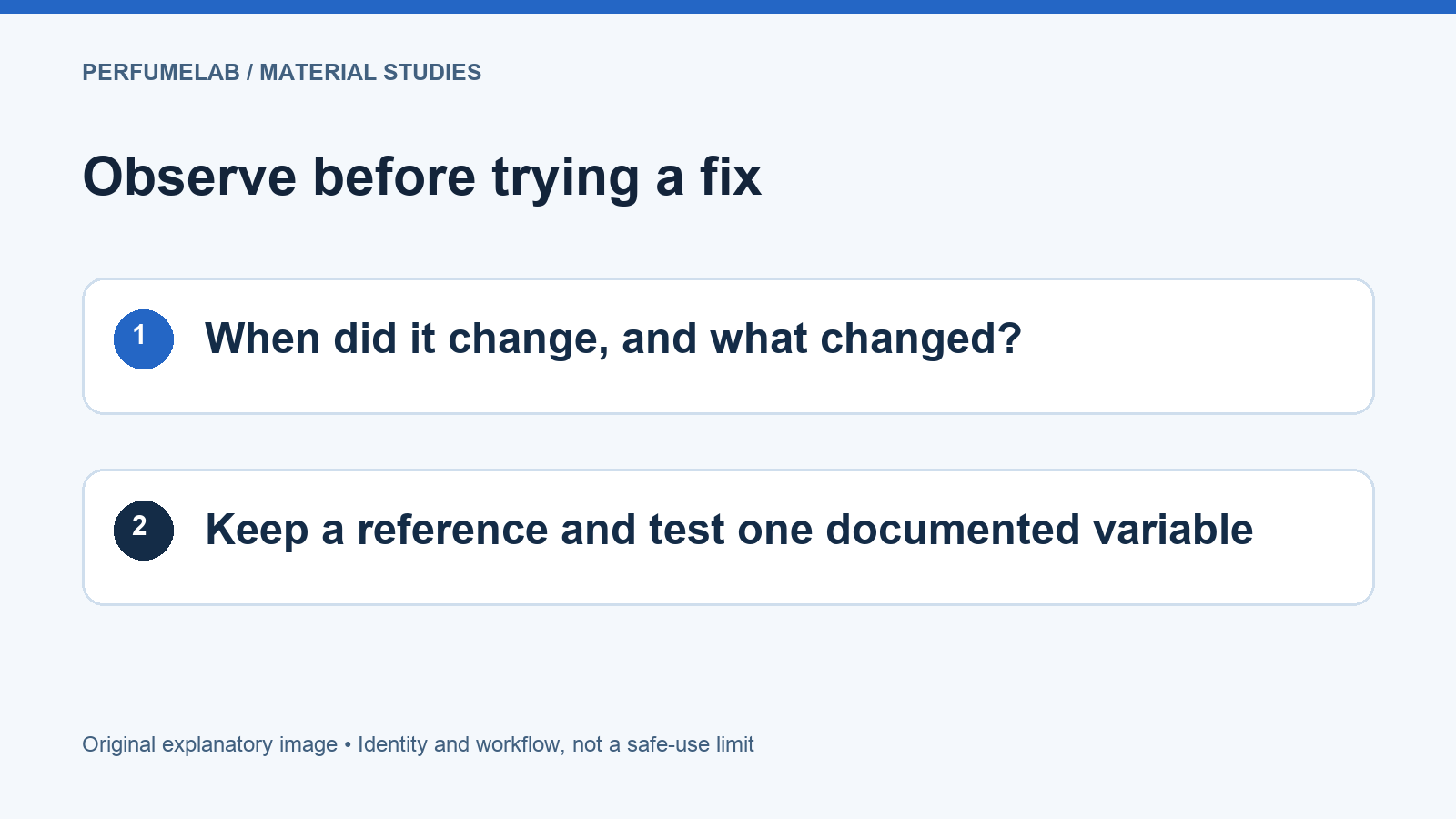

Cloudiness after mixing is an observation, not a diagnosis. Adding more alcohol, a co-solvent or another ingredient before you understand the change can leave you with a different formula and no clear explanation.
Record what you can actually see
Note whether the mixture is uniformly hazy, contains visible particles or shows separate phases. Record when the appearance changed, the preparation method, the materials and stocks used, and the conditions in which the sample was kept.
Supplier information can matter. Fraterworks notes that some supplied materials may contain particles or slight clouding. That is one reason not to assume every appearance change has the same cause. It is not proof that an unknown cloudy finished product is acceptable.
Reconstruct the complete solvent system
Check stock strengths and carriers as well as the separate dilution step. A formula can contain several solvents through its purchased or prepared materials. A substitution, a changed stock or an undocumented addition may have altered more than the headline fragrance percentage suggests.
Compare the actual batch sheet with the intended formula. Were the materials the specified grades? Were the actual masses recorded? Did a product already include a carrier? These questions often provide a more useful starting point than searching for one “cloudiness remover”.
Keep an unchanged reference
Retain the original sample where your procedures allow, then design a small, documented investigation with appropriate technical advice. Change one defined variable at a time and identify each trial separately. If a modification clears the mixture, record the resulting composition and evaluate it as a revised formula, rather than treating it as the original batch repaired invisibly.
Do not use a clear appearance as proof of safety or suitability. Similarly, filtration can change what remains in a product; removing visible matter does not by itself identify its cause or establish that the composition is unchanged.
Ask for help with evidence
A useful supplier enquiry includes the exact material identities, stock and carrier details, concentrations, preparation sequence and observations. Follow the handling information for the mixture; do not improvise heating or place fragrance solvents in an unsuitable domestic appliance.
The goal is a reproducible explanation and a suitable product, not merely a clear-looking bottle. A concise investigation record makes both the technical question and the next formulation trial much easier to assess.
[…] haze, particles, sediment and separate layers independently from hue. If those are present, the cloudiness troubleshooting guide addresses a different part of the […]