
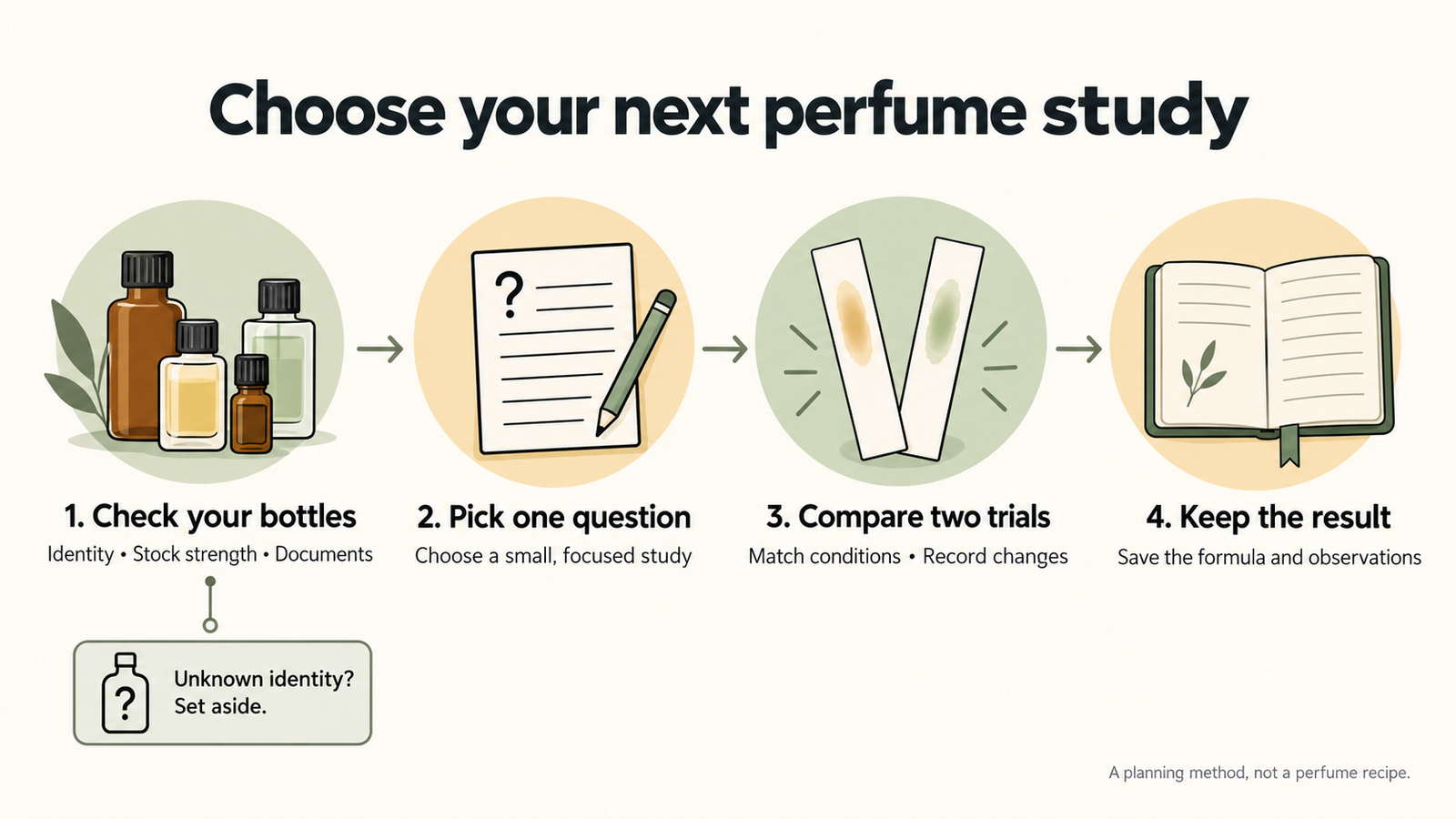

You can choose a useful perfume study without buying another ingredient. Start with the bottles you can identify, check their stock strengths and documentation, then choose a small combination that answers one question. A two-material accord study can teach you more about your collection than a large formula assembled just to use everything you own.
The aim here is to decide what to study next, rather than supply a ready-to-wear perfume recipe. You will make a shortlist, work through a hypothetical inventory and leave with a clear brief for your next trial.
Start with a usable inventory
Write down the exact materials on your shelf, rather than broad notes such as “wood”, “rose” or “musk”. Include the supplier and product name, grade or variant, batch identifier, stock strength, solvent and quantity remaining. Keep the relevant supplier documents with the record.
A bottle you own is not automatically a bottle you can use confidently. Mark each entry as ready to evaluate, needing more information, or unavailable for this study. An unclear label, unknown dilution or missing product identity is a reason to pause that material.
- Identity: can you match the bottle to the exact supplier product and its documentation?
- Stock: do you know whether it is neat or diluted, and what the dilution percentage means?
- Handling: have you checked the product’s safety data sheet and relevant supplier instructions?
- Practicality: is there enough for a small, repeatable trial at quantities your balance can measure reliably?
If the paperwork is confusing, start with the guide to SDS documents and IFRA certificates. When a diluted stock is involved, keep its mass separate from the amount of active material it contributes.
Choose a question your materials can answer
Before naming a finished perfume, write one sentence about the effect you want to explore. “Can I make a floral-woody combination that stays clear rather than becoming sweet?” is a manageable brief. “Make a complete luxury perfume with everything in the drawer” gives you far fewer clues about what to change.
Your own smelling notes are especially useful here. They show what a material smells like to you under recorded conditions, including how it develops. If those notes are missing, a material smell reference is a sensible first project.
- One well-documented material: build or improve its individual smell record.
- Two materials you know individually: investigate their balance in a pair.
- Several familiar materials: choose a pair or small group around one brief; keep the rest for later.
- A formula with missing ingredients: decide whether you want to study that formula or develop a different one. Leaving something out creates a new version to evaluate.
For the last case, see what changes when you leave an ingredient out of a perfume formula. The number of ingredients you own does not tell you whether you can reproduce a particular composition.
Worked example: five bottles, two possible studies
Imagine this collection. The bottle details and documentation status below are invented for the example. They describe an inventory check, not tested formulas or recommended use levels.
| Bottle on the shelf | What the record tells you | Decision for this session |
|---|---|---|
| Hedione, standard grade | Exact product identified; stock strength, solvent and supplier documents recorded | Candidate for a floral study |
| Iso E Super | Exact product identified; stock strength, solvent and supplier documents recorded | Candidate for a woody study |
| Vanillin stock | Exact vanillin product and dilution preparation recorded; documentation available | Candidate when sweetness is part of the brief |
| Bottle labelled “bergamot” | Grade and extraction details missing | Set aside until the identity is clarified |
| Bottle labelled “white musk” | Supplier product and dilution unknown | Set aside until the identity is clarified |
The first three materials suggest directions, not guaranteed results. dsm-firmenich describes Hedione as a transparent floral material with jasmine and citrus aspects. IFF describes Iso E Super as woody and ambery with a soft texture. Syensqo describes its Rhovanil vanillin as having a sweet, creamy vanilla scent. Those manufacturer descriptions help generate the following hypotheses; they do not validate the combinations.
Option one: a floral-woody accord study
Materials to consider: Hedione and Iso E Super. Question: how does changing their relative balance affect the floral and woody character you notice? This is the closer match to the brief above because it investigates those two effects without adding a separate vanilla direction.
Option two: a vanilla-woody accord study
Materials to consider: Iso E Super and the documented vanillin stock. Question: can you find a balance where you still notice the woody character alongside the vanilla? Choose this study if sweetness is part of your goal. It is an exploratory pairing, not a tested amber formula.
For this session, choose option one. Save option two as a later project. Do not add the unidentified bergamot or musk to make the trial feel more complete. A citrus or musk direction can wait until those bottles are properly identified. The full bergamot specification matters more than the short name on the label.
Turn the chosen direction into a comparison
Choosing the pair is only the planning step. Before weighing it, establish appropriate trial conditions from the exact products’ current documentation and the intended evaluation method. Choose trial proportions and evaluation dilutions for the exact products you have; an inventory list alone cannot establish them.
Once that preparation is complete, write the comparison before making it:
- Brief: explore a floral-woody balance without a vanilla note.
- Reference A: record the chosen Hedione and Iso E Super proportions, exact stocks and total batch mass.
- Variation B: change their relative balance while keeping total aromatic-material concentration and solvent composition matched. Record both ingredient changes rather than simply adding more to A.
- Evaluation: use labelled blotters and consistent application and storage conditions. Choose matching observation times in advance, such as after ten minutes, after one hour and the next day. These are example checkpoints, not promised wear times.
- Decision: note which version better matches the brief, what remains unclear and the single change worth testing next.
If either ingredient is supplied as a dilution, account for the solvent it brings into the trial. Matching total bottle mass alone does not necessarily match aromatic concentration or solvent composition. The guide to comparing perfume formula trials explains how to keep the comparison traceable.
Treat these as blotter studies, not permission for skin use. Follow the materials’ handling instructions and do not apply neat materials or unassessed mixtures to skin. Before developing a wearable product, review the complete formula for its intended use. IFRA explains that quantitative restrictions refer to the finished consumer product and that conformity with its Standards does not replace a safety assessment.
What if you still cannot choose?
Prefer the study with the clearest question and the fewest unresolved details. If the choice is between a documented pair you understand and a more exciting idea that depends on three unknown bottles, the documented pair gives you a better starting point today.
You do not need to use every ingredient. Keep a separate list of ideas that need a missing material or better documentation. After a comparison, turn “I need more ingredients” into a specific question: what effect was missing, and what evidence suggests a new material would help? Sometimes the next useful step is a different balance of the materials already in the trial.
Keep the inventory and the formula connected
Use the same exact ingredient names in your inventory, stock labels and formula records. Keep the two trial versions separate so you can return to the one you preferred. Record observations in your notebook or chosen record system rather than relying on memory.
PerfumeLab’s App Store listing includes ingredient ownership tracking, percentage-based formulas, dilution options, and formula duplication and editing. Those tools can help you organise the materials you own and the trials you decide to make. The creative choice still comes from your brief, the available documentation and what you observe when you evaluate the materials.
Start with one question, use bottles you can identify and keep the result. Even if the first pairing is not one you want to develop, you will know more about what your existing collection can do.