
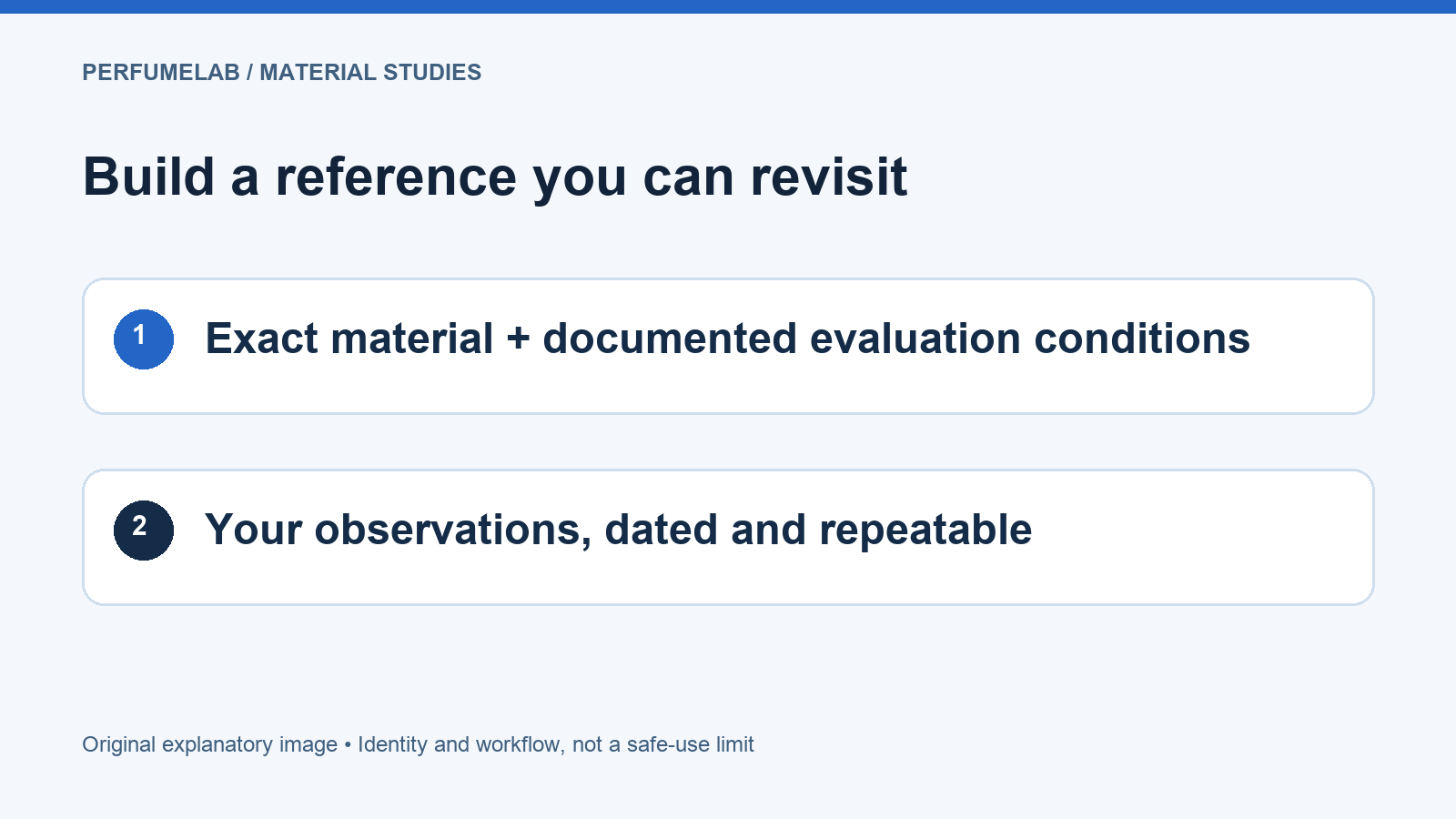

A useful smell library is more than a list of adjectives. It links your observations to the exact material and conditions, so “soft woody” still means something when you revisit the record several months later.
Give each reference a clear identity
Start with the full product name, supplier, grade and relevant lot information. Record whether you evaluated the supplied material or a prepared stock, including the solvent and concentration basis. Different stocks should not disappear behind the same abbreviated name.
Supplier descriptions are useful orientation. Keep them in a separate field from your own observations. That makes it easier to notice an unexpected facet without feeling that you have failed to smell the “correct” answer.
Use a documented evaluation method
Follow the material's handling information and an appropriate procedure for evaluation. Do not put an unknown or neat raw material on skin to learn its character. The specific stock concentration and method must suit the material; there is no single universal dilution supplied here.
Keep the conditions consistent enough that comparisons are meaningful. Note the evaluation medium, preparation age and observation times. You do not need dozens of fields, but you do need the ones that explain what reached the evaluation sample.
Describe more than a family word
Start with a plain association, then add a few useful distinctions: the opening character, changes at later observations, relative prominence under your method, and any feature you want to investigate in a blend. Avoid converting one impression into a guaranteed behaviour in every perfume.
“I noticed a powdery aspect later in this test” is a traceable observation. “This ingredient always makes perfumes last longer” is a much broader claim that the reference test does not establish.
Revisit without rewriting history
When you repeat the evaluation, add a dated note rather than replacing the original. If the supplier, grade, stock or method changed, give the new reference a distinct identifier. A difference can then lead to a useful question instead of an unexplained contradiction.
Keep the reference linked to the formulas in which you use the material. Over time, that creates two complementary kinds of knowledge: what you noticed in a controlled reference and what the ingredient contributed in a composition. Together, these records make future evaluations and formulation decisions easier to compare.
[…] Return to the same labelled strips at recorded elapsed times. Choose practical checkpoints and use the same ones when you later compare trials. These are observation times, not a universal timetable for top, heart and base notes. For a fuller record, see how to build a smell reference for your materials. […]
[…] method, take breaks and compare a small set rather than repeatedly smelling the whole collection. Our smell-reference guide explains how to keep those records […]