
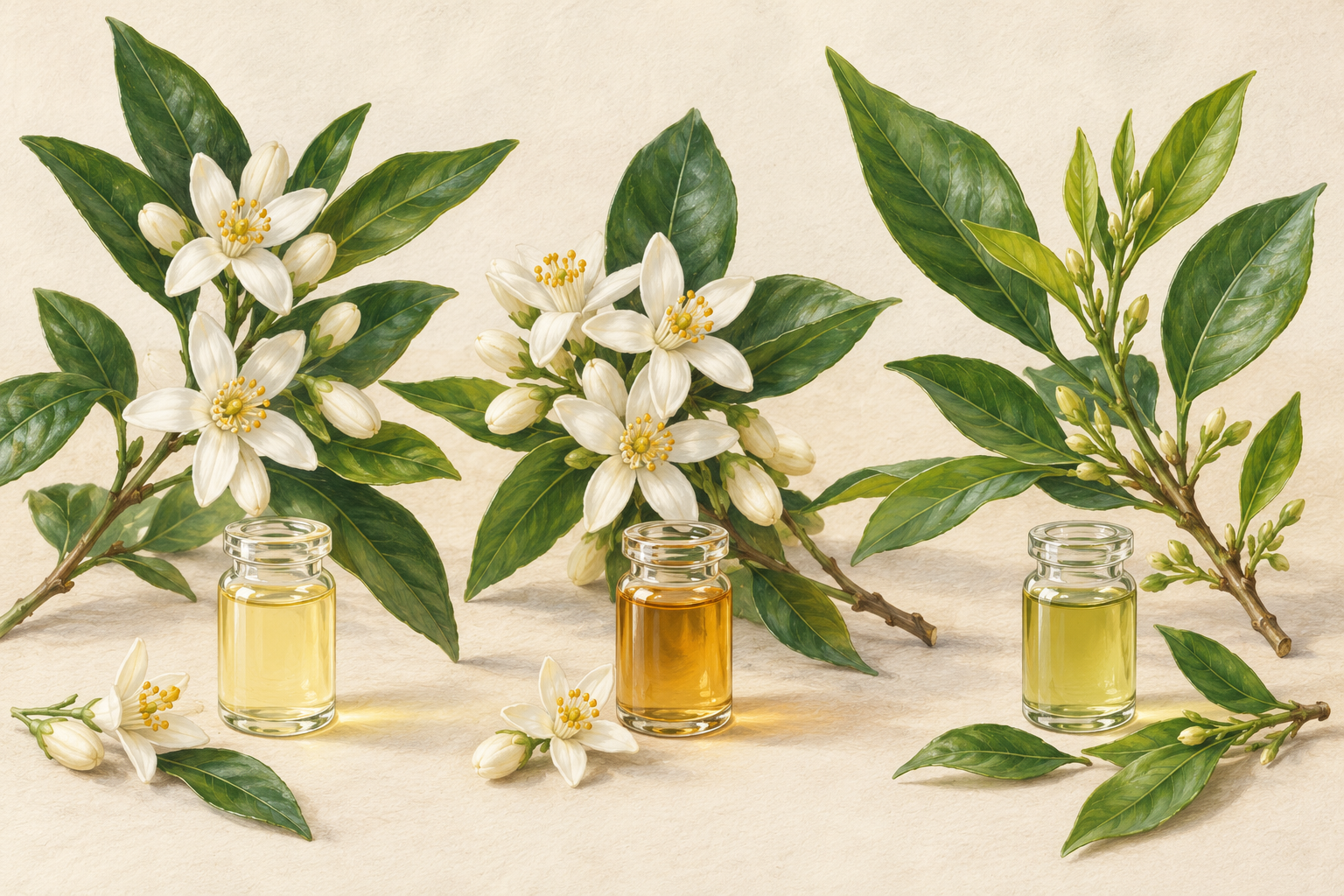

Neroli oil and orange-blossom absolute both come from bitter-orange flowers, but their extraction routes differ. Petitgrain comes from the leafy branches. Those distinctions are the starting point when choosing a material for a perfume, not a promise that every bottle with the same common name will behave alike.
If your formula calls for neroli and you have petitgrain, the useful question is what you want to preserve: the floral impression, a greener direction, or the balance of a particular accord. Start with the exact products, then compare their contribution under controlled conditions.
Neroli, orange-blossom absolute and petitgrain at a glance
The table uses three named manufacturer products so the extraction and scent descriptions have a clear reference. It is not a specification for every supplier’s version.
| Material and reference product | Plant part and process | Manufacturer-described scent direction |
|---|---|---|
| Neroli oil IFF Neroli Oil Tunisia | Blossoms of Citrus aurantium L.; hydro-distillation; essential oil. | Fresh white floral, with an orange-blossom character and green aspects. |
| Orange-blossom absolute IFF Orange Flower Abs Morocco | Flowers of Citrus aurantium L.; solvent extraction, then ethyl-alcohol purification; absolute. | Warm floral, with honeyed, fruity and indolic aspects. |
| Petitgrain oil Givaudan Petitgrain Oil Paraguay | Leafy branches of Citrus aurantium var. amara; steam distillation; essential oil. | Green-floral freshness, with herbal and woody aspects. |
These are paraphrases of the linked manufacturer descriptions, not results from a PerfumeLab smelling panel. Treat them as orientation before evaluating your own supplied materials.
The flower is shared; the extraction is not
The documented neroli oil is distilled from blossoms. The documented orange-flower absolute is solvent-extracted from flowers and then purified with ethyl alcohol. Calling both “orange blossom” loses the process distinction that identifies the materials. IFF’s neroli specification and orange-flower absolute specification make that difference explicit.
An absolute is therefore not simply a stronger stock of neroli oil. If a supplier sells orange-blossom absolute diluted in a carrier, there are two separate facts to record: the identity of the extract and the strength of the supplied solution. Do not collapse those into a single word such as “orange”.
Likewise, an orange-blossom note in a perfume description is not a material specification. It tells you about the intended impression, but does not tell you which extract, blend or other materials were used to create it. A formula needs more precise names than a note pyramid.
Petitgrain brings the leafy side of the tree
Givaudan identifies its Paraguayan product as a steam-distilled branch oil and describes harvesting leaves and twigs. Its page also mentions leafy twigs with unripe fruit. The practical distinction is foliage and branches rather than a flower-only extraction; “petitgrain” should not be read as orange-peel oil. See Givaudan’s plant and process description.
For this guide, petitgrain means the named bitter-orange product, not an assumption about every bottle sold under that word. Ask for the botanical identity and full product specification when a supplier’s label is abbreviated.
Givaudan notes that petitgrain can accompany neroli or orange-blossom absolute in colognes. That suggests a useful trial question: does a little more leaf-like character help the floral idea read more clearly? It does not establish a universal replacement ratio. Givaudan’s petitgrain applications.
Read the full grade, even when the CAS number matches
There is a concrete reason not to identify these materials by CAS alone. IFF lists CAS 8016-38-4 for both its Neroli Oil Tunisia and Orange Flower Abs Morocco, while documenting different extraction routes and product types. A matching number on those pages plainly does not establish that the two products are interchangeable. Neroli product record; absolute product record.
A further example is IFF Neroli Essential Egypt. IFF classifies this as an extract and explains that it combines recovered scented components from post-distillation water with neroli essential oil. That is a specifically documented product, not a reason to treat every material containing “neroli” in its name as ordinary distilled oil.
Keep the supplier’s complete trade name, product code, origin and lot information. If the specification identifies a special process or grade, retain that wording too. The aim is to make a later reorder or trial reproducible, rather than to decide that one category is automatically superior.
Component lists are also incomplete shortcuts to identity. A list of some constituents does not give you their proportions or a finished reconstruction formula. If you are also studying individual materials, the linalool and linalyl acetate guide helps keep those separate ingredient records clear.
Choose a question before choosing a substitute
Use the supplier descriptions to design a comparison, not to announce the result in advance. Here are three different briefs you could investigate:
- Keep the floral idea but change its texture. Compare the two flower extracts in the same accord and record what actually shifts in the opening and later observations.
- Explore a greener version. Introduce the documented petitgrain as a deliberate reformulation, then check whether it supports or obscures the flower impression you wanted.
- Combine rather than replace. Keep the original floral material and vary a separate supporting line. This answers a different question from replacing the original ingredient completely.
“Which one smells best?” is too broad to explain a formulation decision. “Does variant B keep the flower recognisable while reducing the sweet impression at the first observation?” gives you something specific to assess. You might still prefer the original.
Set up a controlled comparison without inventing a dosage
The following is a proposed bench-study structure, not a tested formula or a recommended use level. Choose handling and evaluation conditions appropriate to the exact materials and their current supplier information. It is not a skin-application procedure or finished-product safety assessment.
1. Identify the bottles and the stocks
Create a separate entry for each actual product. Record the full name, supplier, lot, whether it is supplied neat or diluted, the stock strength by mass, and the carrier. If a concentration is unknown, resolve it before claiming an equal-mass comparison.
For a stock with mass fraction s, an added mass m contributes m × s of the named material. The remaining mass belongs to the carrier. Here “named material” means the whole oil or absolute, not a single molecule inside it. See how to calculate the active material in a stock dilution.
2. Separate a reference study from a formula study
First make suitable references for learning the materials individually. Keep the medium, preparation age, application method and observation schedule documented. Use a procedure appropriate to each material rather than assuming one arbitrary dilution suits all three. The material smell-reference guide explains how to preserve those observations.
Then investigate the material in your composition. Choose a documented mass contribution of each named oil or absolute for the comparison and keep the rest of the composition fixed. Matching contribution gives you a controlled mass comparison; it does not make the three odours equally intense.
3. Use a reserved test portion
Build the study around a fixed base plus a reserved test portion. Within that portion, account for both the aromatic material and the carrier introduced by its stock. Keep the total mass and carrier composition consistent across the candidate trials wherever the materials and method allow it. If you cannot, record the extra variable and narrow your conclusion.
| Trial | Purpose | What changes |
|---|---|---|
| R: retained reference | Preserve the current version. | Nothing; keep its original record. |
| N: neroli variant | Evaluate the selected neroli product. | The declared test portion. |
| O: absolute variant | Evaluate the selected orange-blossom absolute. | The same declared test portion, with stock/carrier accounting. |
| P: petitgrain variant | Evaluate the selected petitgrain product. | The same declared test portion, with stock/carrier accounting. |
A carrier-only version can be a separate leave-out control if it answers your question. Label it explicitly. It tests what happens when that aromatic portion is absent; it is not another candidate with an equal aromatic contribution.
4. Describe before you rank
Code the samples so their names are not always reminding you of the expected result. Choose observation times before evaluation, for example an early reading and two later readings suited to your procedure. Those checkpoints are a schedule, not a promise about longevity.
- Identity: Which impression is easiest to recognise?
- Balance: What now feels more or less prominent in the whole accord?
- Development: What changed between the chosen observation points?
- Preference: Which version serves the written brief, and why?
- Uncertainty: Was any difference unclear, or was the preparation inconsistent?
Avoid treating a stronger first impression as proof of better performance. If the equal-mass comparison suggests that one variant overwhelms the accord, run a second, separately labelled optimisation study. Changing its amount may be useful, but it answers a new question. This guide to comparing formula trials covers keeping those decisions traceable.
What to keep in your formula record
A useful entry connects the product identity to the actual preparation. Keep the target formula and actual weighed masses, the stock strengths and carriers, the preparation date, evaluation conditions, and your dated observations. If you make a substitution, write the reason beside it.
Use distinct names such as “Orange-flower study — neroli variant” and “Orange-flower study — absolute variant”, followed by your own version identifier. Keep supplier descriptions separate from personal notes. A later reader should be able to see whether “honeyed” came from the manufacturer or from a particular trial.
You can organise formulas and ingredient records in PerfumeLab for iPhone and iPad. Keep these three materials as distinct records with their full names, then use clearly named formulas for the alternatives. The record supports your evaluation; it does not replace smelling the actual samples or checking the requirements for the intended product.
Frequently asked questions
Is orange-blossom absolute the same as neroli?
No. In the manufacturer examples above, one is a solvent-extracted absolute and the other a distilled essential oil. Shared flower origin does not remove that distinction. Keep the exact product names visible when buying, recording or substituting them.
Can petitgrain replace neroli in a perfume?
It can be investigated as a reformulation, but this guide establishes no one-for-one equivalence. Decide which feature of the original you need to keep and test the change in that composition. Equal added mass alone is not evidence of an equal sensory result.
Which one lasts longest?
The cited product descriptions do not establish a universal longevity ranking for your perfume. The useful answer comes from evaluating the selected products in your formula under the same documented conditions. Do not turn a single blotter impression into a guarantee for finished-product wear.
Does a matching CAS number mean I can use the same record?
Keep separate records when the documented products differ. The IFF examples above share a CAS number but have different product types and processing. Retain the full specification rather than merging them under one convenient identifier.
The practical takeaway
Begin with plant part, extraction and the actual supplied grade. Choose a clear formulation question, account for stock strengths and carriers, and keep a record of what you observed. That gives you a defensible reason to select, combine or replace a material without pretending these three ingredients are interchangeable.
[…] define the purpose and compare the exact supplied products under consistent conditions. The neroli, orange-blossom absolute and petitgrain comparison applies the same caution to related botanical […]