
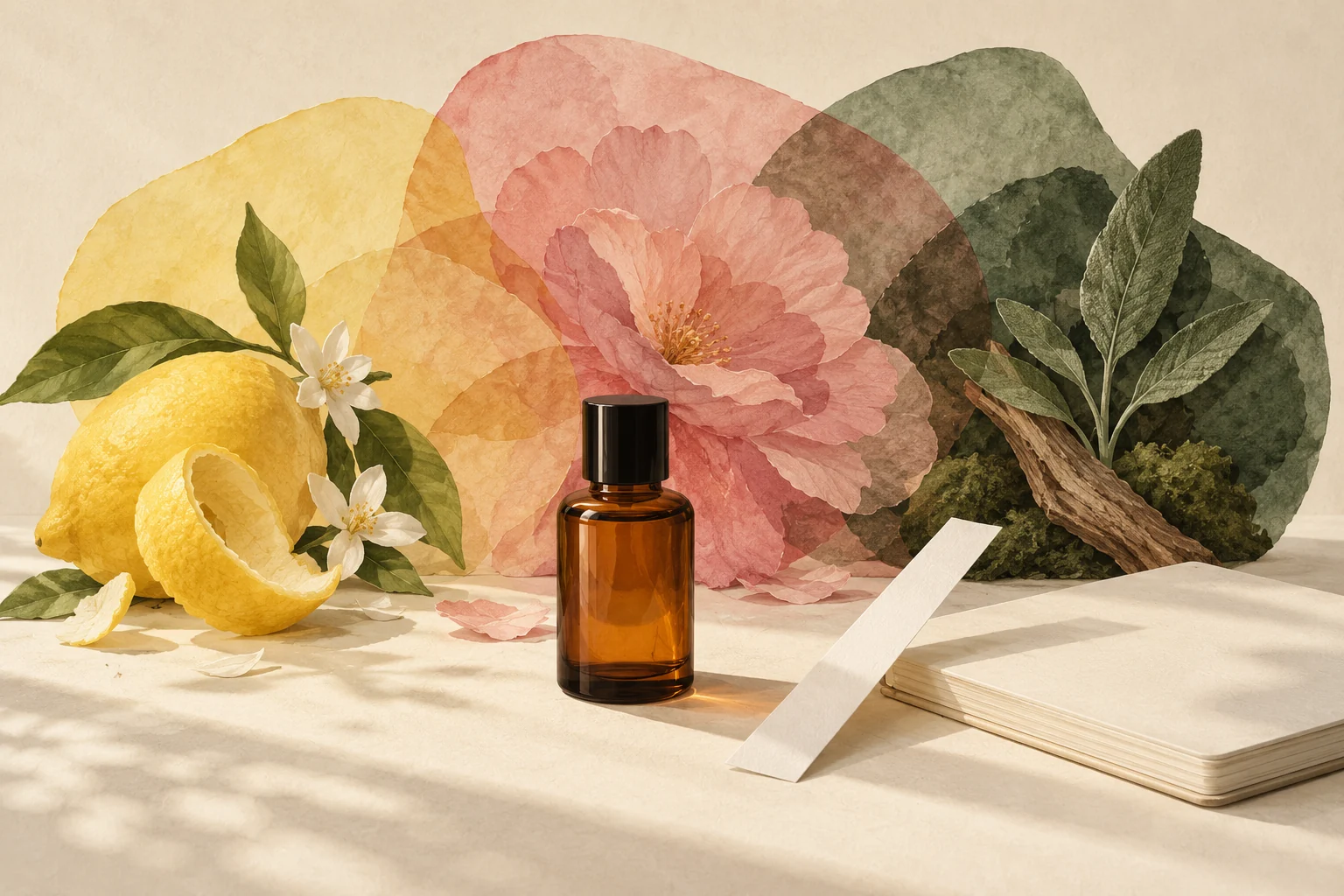

Top, middle and base notes describe aspects of a perfume’s development. They do not tell you which bottle to pour first, provide a compulsory percentage split, or divide every ingredient into one exclusive box. The perfume pyramid is useful language—but it is not a manufacturing instruction.
For a beginner, the most helpful distinction is between what you want to smell, when you notice it and how you prepare the formula. Keep those three questions separate and a note pyramid becomes much easier to use.
What do top, middle and base notes mean?
- Top or head notes: the opening impression you notice when evaluating the perfume.
- Middle or heart notes: the developing central character of the composition.
- Base notes: the character associated with the later, lingering impression.
Treat these as descriptive stages rather than sealed compartments. IFF explains that its ingredient note-impact charts provide a general indication of how a material might contribute to and evolve within a fragrance. They are guides to possible behaviour, not exact schedules for every mixture. Source: IFF’s guide to its perfumery compendium.
Write the time of your own observation instead of assuming that every perfume’s heart starts at the same minute. “Floral character most noticeable at my second observation” is more informative than forcing the sample into a universal timetable.
A material can contribute to more than one stage
IFF lists Iso E Super with medium impact in the top, heart and base. A material associated with a woody-amber effect therefore need not be invisible at the opening simply because you think of it as a base material. Source: IFF Iso E Super.
This is not an isolated naming quirk. dsm-firmenich’s fine-fragrance description for Hivernal Neo also places it across top, heart and base. These manufacturer examples are reasons to allow overlap in your study notes, not predictions that either material will be equally noticeable at all times in your own blend. Source: dsm-firmenich Hivernal Neo.
If an ingredient appears in two columns of your planning sheet, do not count its mass twice when calculating the formula. One physical addition can have several creative roles. The Iso E Super formulation guide explores that particular material without turning the pyramid into a dosage rule.
Does adding a material last make it a top note?
No: a top-note label is not a label for “last addition”. Placing a material later in a written formula or weighing sequence does not, by itself, establish its role in the finished perfume. That role needs to be evaluated in the composition.
However, do not turn this into the opposite blanket claim that preparation order can never matter. Dissolution, mixing procedure, material compatibility and handling are separate practical questions. Follow the documented preparation requirements for the actual materials and formula rather than deriving a procedure from the pyramid.
There is also a difference between creating an accord first and physically adding it first. You might choose to develop a woody foundation before exploring citrus variations because that helps you make creative decisions. That workflow is not evidence that the foundation must be the first liquid in the mixing vessel.
Do I need a 20/30/50 top–heart–base ratio?
A note pyramid does not supply that ratio. A chosen percentage scheme can define an exercise, but it should be identified as your exercise—not as a mathematical rule implied by three note headings.
Before adopting any such scheme, ask what its percentages refer to. Are you counting neat materials, diluted stocks, pre-made accords or the entire finished product? How are ingredients that contribute across several stages assigned? Unless those assumptions are explicit, two people following the same apparent ratio may prepare very different compositions.
A more useful first target is perceptual: “A bright opening with a recognisable floral character that remains interesting later.” Then select a documented small study and ask whether your observations support that brief. The beginner accord-study path helps turn that aim into a manageable comparison.
A named note is not necessarily a single ingredient
A pyramid may describe rose, amber, sea air or another impression. Your formula needs the exact supplied materials used to create that impression. The same descriptive word can appear in different compositions without proving that they contain the same raw material.
This matters when trying to learn from a perfume you enjoy. “Rose in the heart” is a useful observation or creative direction; it does not reveal a particular rose extract, its concentration or the supporting materials. Our limited-palette rose study shows how several material roles can be explored under one floral theme. Likewise, an aquatic note is an impression, not a bottle of seawater.
Turn the pyramid into an observation sheet
The following is a proposed learning method, not a report of testing already performed. Choose an appropriately prepared, documented sample and use a consistent evaluation method. Record the actual times you observe it rather than assigning predetermined expiry times to each note.
- Opening: what is most noticeable, and which words describe it? Separate recognisable character from perceived strength.
- Later observations: what seems more prominent, less prominent or newly recognisable? Note uncertainty instead of inventing a transition.
- Final observation: what remains perceptible under your chosen conditions? Do not convert this automatically into a claim about hours of wear on skin.
- Next question: which single creative change is worth investigating, and which reference will remain unchanged?
Keep the formula version, stock strengths, solvent, sample age, evaluation medium and application method alongside the observations. A material’s behaviour in your individual smell reference and its role in a mixture are related questions, not identical records.
Do not compare an opening observation on a blotter with a later observation on skin as though only time changed. See what blotter and skin evaluations can each tell you.
Keep the safety decision outside the pyramid
Neither “top note” nor “base note” says whether a material is suitable for skin or what use level is appropriate. Follow product-specific handling guidance, use an appropriate evaluation preparation, and assess the complete intended product against current requirements. A pleasing blotter result is not a safety test, and an unfamiliar raw material should not be applied neat to skin.
Use the language without letting it dictate the formula
Keep three separate records: a creative brief, a formula with actual materials and masses, and observations over time. Let the pyramid help describe the brief and observations. Let the formula and its documented procedure tell you what you made. That separation is more useful than trying to make every bottle fit one tier.