
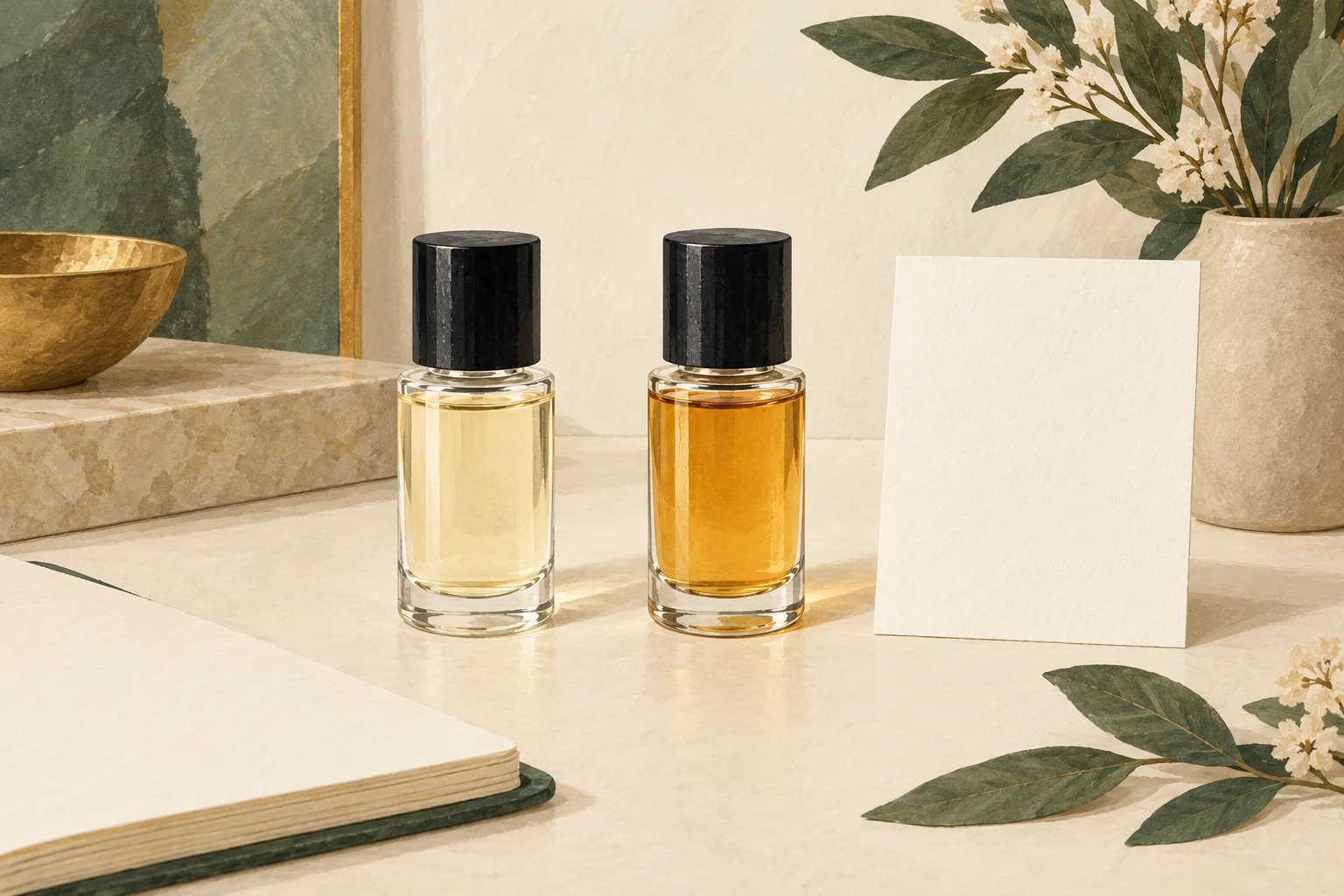

A perfume that looks darker, yellower or simply different deserves a closer look—but colour alone does not tell you whether it has oxidised, expired or become unsafe. Start by separating three questions: Was the colour present immediately? Did one batch change over time? Or does a new batch look different from an earlier one?
Those situations need different evidence. An ingredient with its own colour, a different raw-material lot, formulation interactions and storage or packaging conditions are not interchangeable explanations. The aim is to preserve what you know before changing the formula.
First check whether the comparison is fair
Look at the samples under comparable lighting, against the same neutral background and, where safely available, in equivalent containers. Bottle colour, shape, fill level, surrounding surfaces and camera settings can make photographs look different. A photograph is a useful record, not an analytical colour measurement.
Do not decant or repeatedly open a suspect sample just to improve a photograph. Record the container and viewing conditions as they are. If you lack a reliable earlier image or reference, write “first noticed today” rather than claiming that the change happened today.
Use precise descriptions: pale yellow rather than “off”, uniformly darker rather than “cloudy”. Record haze, particles, sediment and separate layers independently from hue. If those are present, the cloudiness troubleshooting guide addresses a different part of the investigation.
Three timelines, three starting points
- The blend was coloured immediately: check the starting appearance and quantity of each supplied ingredient, including extracts, purchased bases and any colourants. Compare with your actual batch record, not just the intended recipe.
- The same batch changed after preparation: review its documented storage, packaging, opening history and any later additions. Preserve the earlier record and do not assume that elapsed time explains the mechanism.
- A new batch differs from the previous batch: compare material identities, lots, stock strengths, carrier, weighing records and packaging. “Same recipe name” does not establish that all inputs and conditions were identical.
This is a proposed troubleshooting framework, not a set of tests that has been performed on your perfume. A clear timeline narrows the questions to take to a supplier or qualified formulator.
Some materials bring colour with them
A dark ingredient is not necessarily a recently degraded ingredient. For a specific example, Robertet’s technical specification for Encens HT Absolue lists a brown-green colour. That describes that particular supplied absolute; it is not a description of every frankincense material or a prediction of the colour of a finished perfume containing it. Source: Robertet Encens HT Absolue technical specification.
Ask what appearance is expected for the exact product and lot. If you change an extract, grade or supplier, retain the old and new identities in separate formula versions. A colour difference between those batches is not, by itself, proof that one has aged badly.
Vanillin is a possibility, not an automatic diagnosis
Perfumer Penny Williams explains that vanillin, ethyl vanillin and some other fragrance materials can contribute to discolouration of cosmetic products. The outcome depends on their level in the fragrance, the fragrance dosage and the product type. Her technical article also discusses colour from natural materials and interactions involving the formula or packaging. Source: Penny Williams, Fragrance Stability, COSSMA, 2014.
That does not mean all vanilla perfumes turn brown, or that a browning timetable from soap or candles applies to an alcohol-based perfume. Confirm whether the material is actually present and consider the complete formulation. A marketing note of “vanilla” is not an ingredient declaration or a batch sheet.
If you are comparing the two materials themselves, see vanillin versus ethyl vanillin. Changing one for the other is a formulation change, not a guaranteed cure for an unexplained colour problem.
Light and packaging belong in the record
BASF identifies light-induced yellowing, colour fading and degradation of light-sensitive fragrance systems as reasons for product stabilisation, particularly in transparent packaging. This establishes light as a possible contributor; it does not establish what caused the change in an individual bottle. Source: BASF UV Light Stabilizers.
Record whether the sample was displayed in daylight, moved between locations or placed near a heat source. Also record bottle and closure type and any changes to them. Do not deliberately sun-expose or heat a flammable perfume at home to “prove” a theory. A formal stability investigation needs appropriate equipment, controls and interpretation.
Nor should a stabiliser mentioned in a supplier article be treated as an instruction to add it to a changed batch. Compatibility, use level, product requirements and safety still need assessment. Prevention in a designed formulation is different from attempting to rescue an unexplained change.
Darker does not automatically mean oxidised—and clear does not mean safe
Different observations answer different questions. Givaudan describes olfactory and analytical evaluation of its natural ingredients, with additional checks such as colour, oxidation risk or pH according to the material. Colour is one part of that quality picture, not a substitute for the other assessments. Source: Givaudan natural-ingredient quality controls.
Research also cautions against blanket claims about ageing. Kern and colleagues used analytical methods to investigate limonene in fine fragrances and found no indication of the particular hydroperoxide’s formation in the repeatedly opened, half-empty bottles studied over nine months. That result is limited to the materials, conditions and measurement in that study; it cannot certify another bottle or rule out other changes. Source: Kern and colleagues, 2014.
The practical conclusion is not “old perfume is fine” or “dark perfume is unsafe”. It is that visual appearance cannot establish chemical composition or safety. An unchanged smell, visual clarity or a home skin test is not proof either. If suitability is uncertain, set the sample aside and obtain appropriate advice before use. For a purchased perfume, contact its manufacturer with the batch details.
Build a colour-change record before making a correction
For your own formula, keep the following fields together. This is a documentation checklist, not a validated stability protocol.
- Identity: formula version, batch identifier, actual masses, exact material grades and lots, and all stock concentrations and solvents.
- Timeline: preparation date, initial appearance if recorded, first observation of the difference and any intervening additions or transfers.
- Packaging and conditions: container, closure, fill level and known storage history.
- Separate observations: hue, clarity, particles or separation, plus any appropriately obtained odour observations; leave unknowns marked as unknown.
- Next decision: supplier question, professional assessment or a planned controlled comparison using documented materials.
Ask the supplier a specific question: “Is this appearance within the specification for this product and lot, under these conditions?” Attach records rather than asking only whether “brown is normal”. If a new comparison is appropriate, preserve the reference and change one documented factor. See how to compare formula trials without losing track.
Do not hide an unexplained change with dye, dilution, filtration or an improvised additive. Each intervention changes the evidence and may change the product. A later corrective process should follow a diagnosis and be assessed in its own right.
Keep appearance and creative preference separate
You may prefer a warmer-looking perfume, but preference does not explain its chemistry. Likewise, a darker sample does not demonstrate that resting improved the perfume. Record what changed, what remained uncertain and why the next step is justified. That is a stronger foundation than a colour-to-age chart or a universal “still good” rule.