
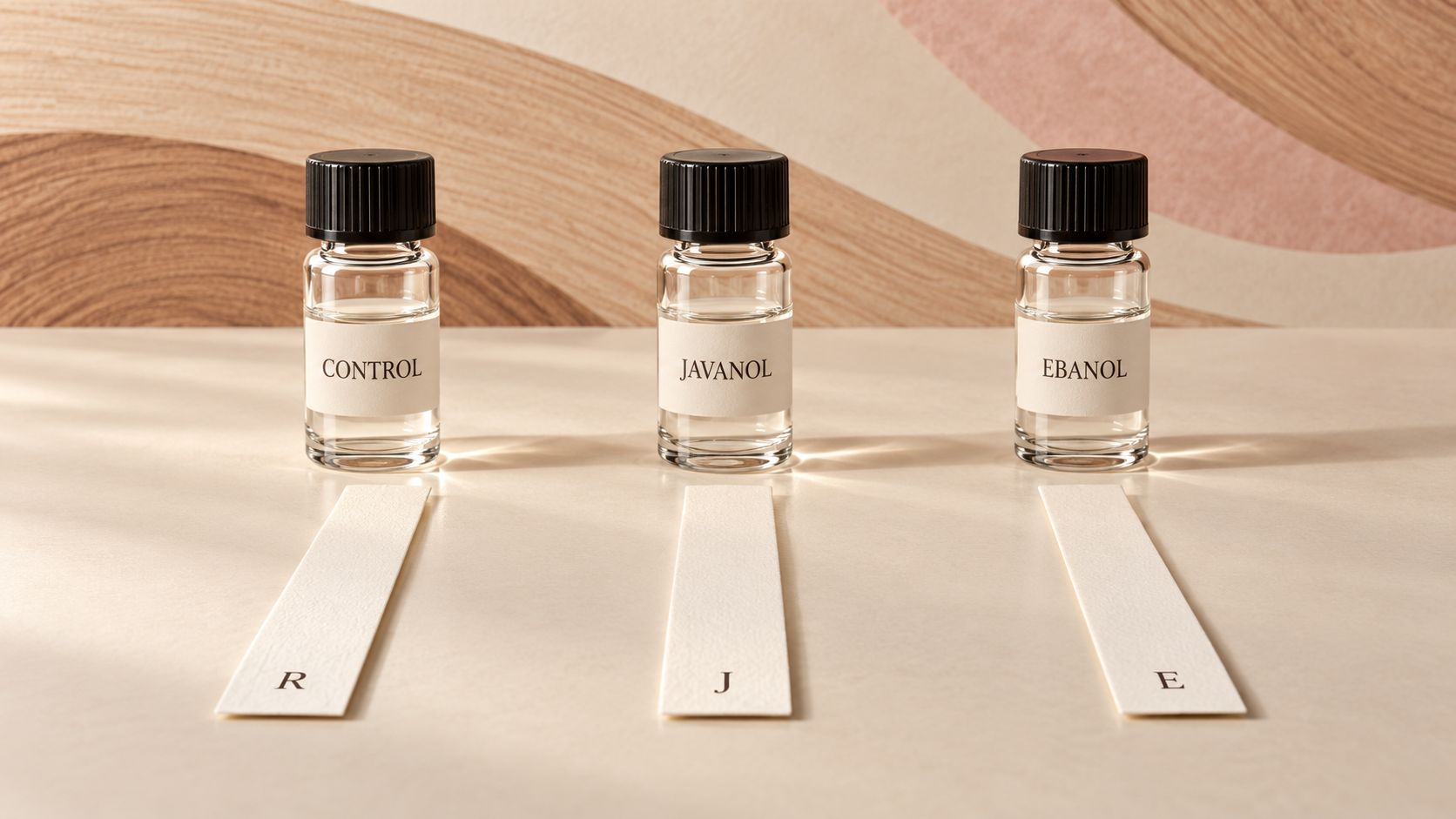

Choosing between Javanol and Ebanol starts with a question about the perfume you are making: what should its sandalwood layer contribute? A material that gives the most noticeable result in isolation may not give the most useful result in your accord.
Use the manufacturer descriptions to choose a direction, then compare the exact materials you own under matched conditions. The study below separates character, active dose and balance, so you do not mistake a stronger stock solution for a better ingredient.
Javanol vs Ebanol at a glance
Both are named Givaudan fragrance materials. The following facts come from Givaudan’s Javanol profile and Ebanol profile, rather than a head-to-head test conducted for this article.
| What to compare | Javanol™ | Ebanol™ |
|---|---|---|
| Manufacturer’s scent description | Creamy sandalwood with rose nuances | Rich sandalwood; the profile also identifies a musky facet |
| Emphasis in the profile | Power, radiance and effects at very low dosage | Volume in woody accords and a diffusive sandalwood effect |
| CAS number on the profile | 198404-98-7 | 67801-20-1 |
| Reported tenacity on a blotter | One month or more | Three weeks |
The scent descriptions suggest useful questions for a study: does Javanol bring the creamy or rosy detail your accord needs? Does Ebanol give the woody section the body you want? These are hypotheses to investigate, not guaranteed outcomes in every formula.
Read the performance numbers in their test context
The blotter figures above are manufacturer-reported paper-test data, not predictions of how long a finished perfume will last on skin. Nor do they establish that the complete fragrance will keep its original character for that period. See what blotter and skin evaluations can tell you before comparing results from different media.
Givaudan’s Javanol page also gives an approximately eightfold effectiveness claim for wash tests. It does not identify Ebanol as that comparison material. Do not turn the claim into “Javanol lasts eight times longer on skin” or an instruction to replace eight parts of Ebanol with one part of Javanol.
A sensible formulation decision needs observations from your own chosen base, concentration and evaluation method. Supplier data helps you plan that work; it cannot select the winner for you.
Check the bottle before comparing the smell
Write down the full commercial name, supplier, lot where available, solvent, supplied strength and concentration basis, such as percent by mass (w/w). A bottle marked Javanol 10% by mass is not the same starting point as neat Javanol. Ebanol supplied in another carrier introduces a second difference before either material reaches the accord.
Keep the supplier description separate from your own observations. The material smell-reference guide explains how to preserve both without turning an expected descriptor into a result you feel obliged to report.
Stock strength changes the arithmetic
For an arithmetic example, 0.20 g of a 10% by mass (w/w) stock contains 0.020 g of the named material. The same 0.20 g of a 1% by mass stock contains 0.002 g. The weighed masses match; the active contributions differ tenfold.
Those numbers demonstrate bookkeeping, not recommended evaluation dilutions or fragrance doses. Calculate the active contribution from the documented stock strength, and count its carrier too. The active-material calculation guide walks through that distinction.
A controlled three-sample sandalwood study
Choose one familiar accord that contains neither material, so their additions are easier to interpret. Set one narrow aim. For example: “Add a clearer sandalwood impression while keeping the floral detail readable.” A second aim, such as reducing sweetness, deserves a separate round rather than an extra change hidden inside this one.
This is a proposed evaluation design, not a finished perfume recipe or a report of measured results. Select suitable stock strengths and handling procedures from the documentation for your actual materials. Do not evaluate neat raw materials or unassessed concentrates on skin.
1. Keep a carrier-matched reference
Set aside a fixed addition slot within each sample. Keep the amount of the original accord and the total sample mass the same. Use the slot for carrier in the reference and for stock plus balancing carrier in each test.
| Sample | Unchanged part | Addition slot |
|---|---|---|
| R: reference | The same amount of the original accord | Carrier only |
| J: Javanol study | The same amount of the original accord | Javanol stock plus balancing carrier |
| E: Ebanol study | The same amount of the original accord | Ebanol stock plus balancing carrier |
For the cleanest first comparison, use compatible stocks of the same known strength by mass in the same carrier and compare equal active additions. This controls the mass of the changed material; it does not promise equal perceived intensity.
If the stock carriers differ, match the carrier composition across samples or explicitly record that limitation. Simply making every bottle weigh the same does not remove a solvent difference.
2. Write observations before choosing a favourite
Use the same blotter type, application method, sample age and room conditions. Assign neutral codes unrelated to the ingredient names and keep the code key out of view while making notes. Pick checkpoints in advance, such as five minutes, one hour and the next day. These are observation times, not promised longevity.
At each checkpoint, answer three questions:
- Character: what changed in the sandalwood impression compared with R?
- Balance: can you still identify the feature you wanted to preserve?
- Usefulness: does the change serve the brief, or is it simply more noticeable?
“J has a clearer woody presence, but the floral detail is harder to follow” is a more useful note than “J is stronger.” It identifies both the gain and the trade-off. That sentence is an example of note-taking, not a predicted result.
3. Refine dose in a separate round
If the equal-active samples differ greatly in prominence, retain the reference and adjust one test material at a time. Record the new active dose and rebalance the carrier. You are now comparing candidate formulas at different doses, rather than conducting an equal-mass comparison.
Keep the best version from each round as a reference for the next. The formula-trial comparison guide provides a useful recording method. A repeat that gives a similar observation is more informative than a growing set of unlabelled revisions.
Can Javanol replace Ebanol?
Treat a replacement as a reformulation experiment, not a calculator conversion. Identify what the original ingredient was contributing, then test whether the candidate preserves that contribution at a documented dose. Matching overall intensity may still leave a different character or balance.
Do not assume a universal 1:1 ratio, and do not derive one from the wash-test claim. The useful result is a version that works in this formula under your test conditions, with a record that lets you make it again.
What about using both?
A combination is worth investigating once you understand the separate additions. Give it a new version code and a clear purpose. Hold the base and total active addition constant for an initial blend comparison, account for the carriers, and compare it with the single-material versions.
No blend ratio is prescribed here. Keep both only if the combined trial contributes something useful that you can describe. A more complicated formula is not automatically a better one.
Keep the successful trial reproducible
Save the full material identities, stock strengths, actual masses and your evaluation notes together. PerfumeLab lets you organise formulas by percentage and set batch sizes, concentrations and dilutions. Use the formula record alongside your observations when preparing the next comparison.
Explore PerfumeLab for iPhone and iPad on the App Store.
Before moving from an evaluation to a finished product, check current supplier handling information and the safety requirements for the intended use. Neither a manufacturer’s performance table nor a pleasant blotter result establishes a safe maximum.
[…] is difficult to compare meaningfully with your own trial. For a material-specific example, the Javanol vs Ebanol comparison explains how to use performance figures when planning a sandalwood […]