
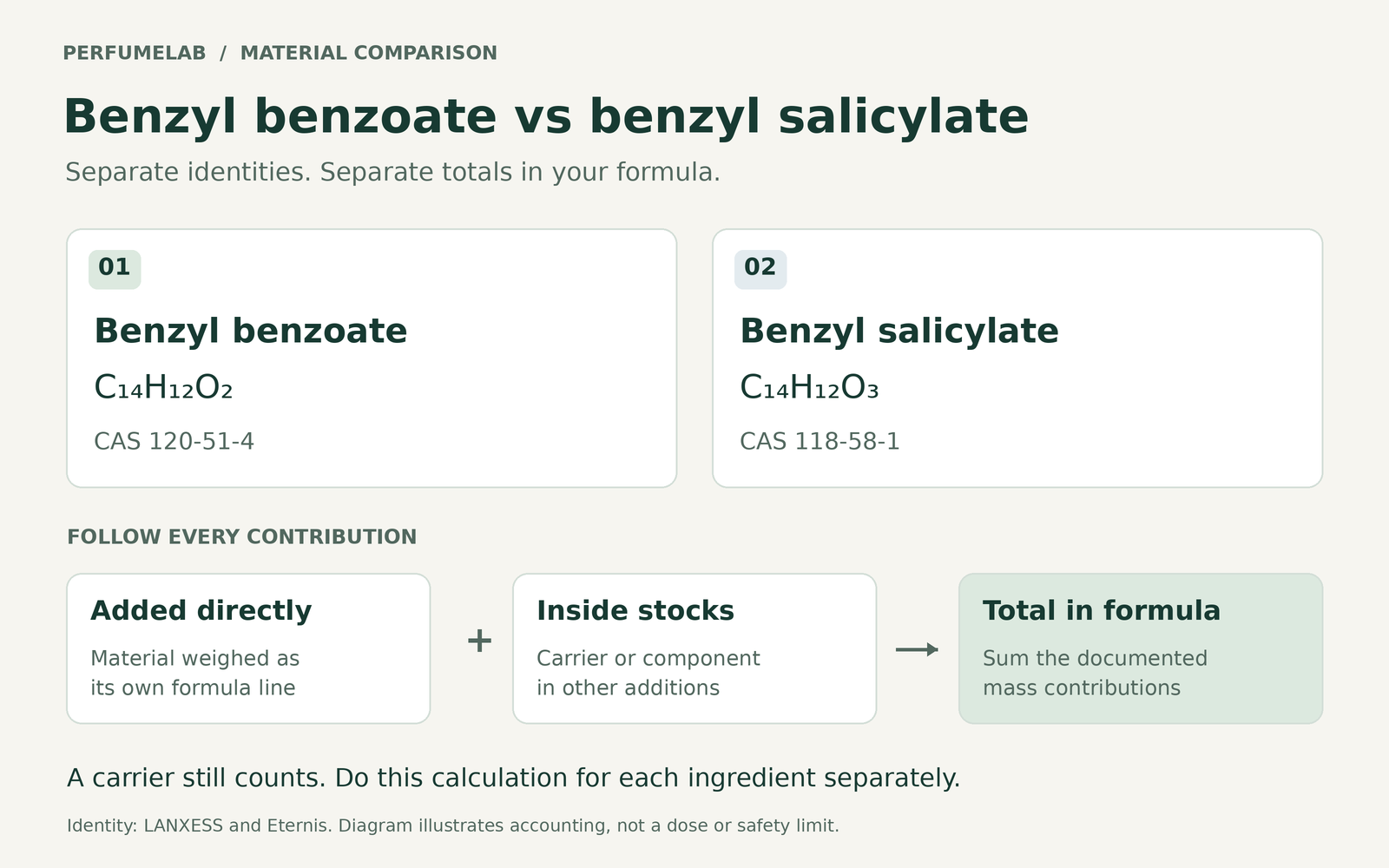

Benzyl benzoate and benzyl salicylate have similar names, but a swap between them changes the ingredient. Before choosing either, ask what you need it to do: contribute a particular smell, carry another material in a stock solution, or change the behaviour of an existing blend. Those are different formulation questions.
LANXESS describes benzyl benzoate as a fragrance solvent with a faint balsamic-type odour. Eternis describes benzyl salicylate through a faint sweet, floral and slightly balsamic profile. These supplier descriptions are useful starting points, not a head-to-head test of the bottles on your bench. LANXESS product page; Eternis product page.
Benzyl benzoate vs benzyl salicylate at a glance
| Check | Benzyl benzoate | Benzyl salicylate |
|---|---|---|
| Chemical identity | Benzoic acid benzyl ester | Benzyl 2-hydroxybenzoate |
| CAS number | 120-51-4 | 118-58-1 |
| Molecular formula | C14H12O2 | C14H12O3 |
| Supplier odour description, summarised | Faint sweet-balsamic, with oily and herbal facets | Faint sweet-floral, with a slight balsamic facet |
| Supplier-described applications | Solvent and fixative in fragrance formulations | Blending material for floral compositions, including heavy florals |
Identity and application information: LANXESS benzyl benzoate and Eternis benzyl salicylate. The shared word “benzyl” does not establish equivalent odour, solvent performance or use conditions.
Check the grade as well as the name
Benzyl benzoate is not represented by one universal odour specification. LANXESS’s October 2023 grade-comparison brochure distinguishes Regular, Performance and Ultrapure grades. It describes Ultrapure as nearly odourless, whereas the other grades retain a sweet-balsamic profile. Record the exact grade before deciding whether a smell comes from your intended aromatic material or its carrier.
The Eternis benzyl salicylate specification, Rev-07 dated 5 March 2015, describes a faint floral-balsamic odour and specifies a minimum purity measured by gas chromatography. A purity specification is different from a stock dilution: a bottle diluted by a reseller still needs its own concentration and carrier information. Use that older document to understand the published product description, and request current documentation for the material you actually buy.
For either ingredient, keep the manufacturer, reseller, grade, batch and dilution together in the formula record. “BB” and “BS” are convenient bench abbreviations, but the full names prevent an expensive transcription mistake.
A carrier still contributes to the formula
Benzyl benzoate may enter a formula as a deliberately weighed ingredient or as the carrier in another purchased material. If a stock is documented as an aromatic ingredient diluted in benzyl benzoate, both components enter the mixture when you weigh that stock. Calling the benzyl benzoate a solvent does not remove its mass from the formula.
For each stock: benzyl benzoate contribution = mass of stock added × its documented benzyl benzoate mass fraction. Add those contributions to any benzyl benzoate weighed directly. Keep benzyl salicylate in its own total rather than combining the two under a “benzyl” or “fixative” line.
Do not infer an undisclosed carrier fraction from a product nickname. A proprietary blend may contain more than the two components you expect. If the supplier has not supplied a usable composition, mark that part of the calculation as unknown.
The same accounting is important for commercially diluted musks; see Galaxolide: stock strength, carrier and formula maths. For the general calculation, use the guide to active material in diluted ingredients.
Keep concentrate and finished-product amounts separate
The total in your concentrate is one number. The amount in a finished perfume made from that concentrate is another. If all of an ingredient comes through the concentrate, multiply its mass fraction in the concentrate by the concentrate’s mass fraction in the finished product. If the same ingredient is also added outside the concentrate, include that contribution separately.
This calculation applies whether the ingredient arrived as an odour material or a carrier. It describes composition, not whether a finished product is suitable for use. The concentrate vs finished-product guide explains the two percentage bases.
How to make a useful comparison
Choose the question before mixing. A blotter study asks what each ingredient changes in the smell of a particular accord. A carrier-replacement study asks whether another material can perform a specified technical job. A pleasant-smelling result does not answer both questions.
For an odour study: reserve one controlled addition
Start with a small accord you already understand and a documented laboratory plan appropriate to the materials. Keep an identical mass of that accord in each coded sample. Reserve an addition slot rather than adding material to an already complete formula.
| Sample | Addition slot | What it helps you assess |
|---|---|---|
| Reference | The selected compatible carrier only | The base accord without either added comparison material |
| BB | Benzyl benzoate, with stock carriers accounted for | The effect of the recorded benzyl benzoate grade |
| BS | Benzyl salicylate, with stock carriers accounted for | The effect of the recorded benzyl salicylate product |
Set the comparison amounts in the study plan; this article supplies no use level. Match total sample mass and balance the common carrier system wherever possible. If your two stocks use different carriers that you cannot balance, record that limitation: the study is comparing two supplied systems, not isolating the aromatic ingredients alone. Equal material mass would still not imply equal odour impact.
- Character: does the floral outline change, or do you notice a different background? Write what you observe before choosing a favourite.
- Balance: does the feature you wanted to preserve remain distinct? A fuller impression may or may not suit the brief.
- Development: compare the coded blotters at the same elapsed times, with the same application method. Keep sample age and storage conditions consistent.
This is a proposed evaluation, not a report of tests performed by PerfumeLab. Keep unassessed trials off skin and follow the current supplier handling documentation. Use the formula-trial comparison guide to retain the codes and observations.
For a carrier replacement: test the actual system
If benzyl benzoate is carrying another ingredient, changing it to benzyl salicylate requires more than correcting the formula total. Preserve the carried ingredient’s amount, identify the changed carrier contribution and assess the resulting stock and finished trial. Record whether the material dissolves, remains clear or develops crystals under your documented storage conditions, as well as what happens to its smell. Do not assume solvent suitability from a shared name or appearance.
Be precise about “fixative”
LANXESS lists fixative use for benzyl benzoate; Eternis’s published specification describes good tenacity for benzyl salicylate. Neither statement demonstrates that adding the material will make every other note in your perfume last longer. A detectable drydown from an added ingredient and improved persistence of the original accord are different observations. LANXESS application information.
If longevity is the goal, write a testable aim such as “retain the recognisable floral character later in the comparison”. Compare the unchanged reference with your variants rather than declaring the longest-smelling strip the best fixative. Treat any replacement as a new formula version, with its own evaluation and current documentation review.
Keep the decision with the formula
Save the full ingredient names, grades, stock strengths, carrier contributions and sample codes alongside the formula. That record lets you explain why you kept benzyl benzoate, chose benzyl salicylate or decided neither change improved the accord.
Neither this comparison nor a supplier’s technical specification establishes a skin-safe use level. Before using either ingredient in a finished product, review its current safety data sheet, relevant IFRA Standards for the intended product category, and applicable local requirements. Include contributions from stocks and other materials in that assessment. IFRA conformity does not replace a product safety assessment.
Use PerfumeLab to organise your formulas and retain separate trial versions. Keep the supplier documents and your evaluation record alongside those versions. View PerfumeLab on the App Store.
[…] Galaxolide 50% BB entry identifies the material in benzyl benzoate and describes a clean musk character. That page concerns a particular supplied grade. A bottle in […]