
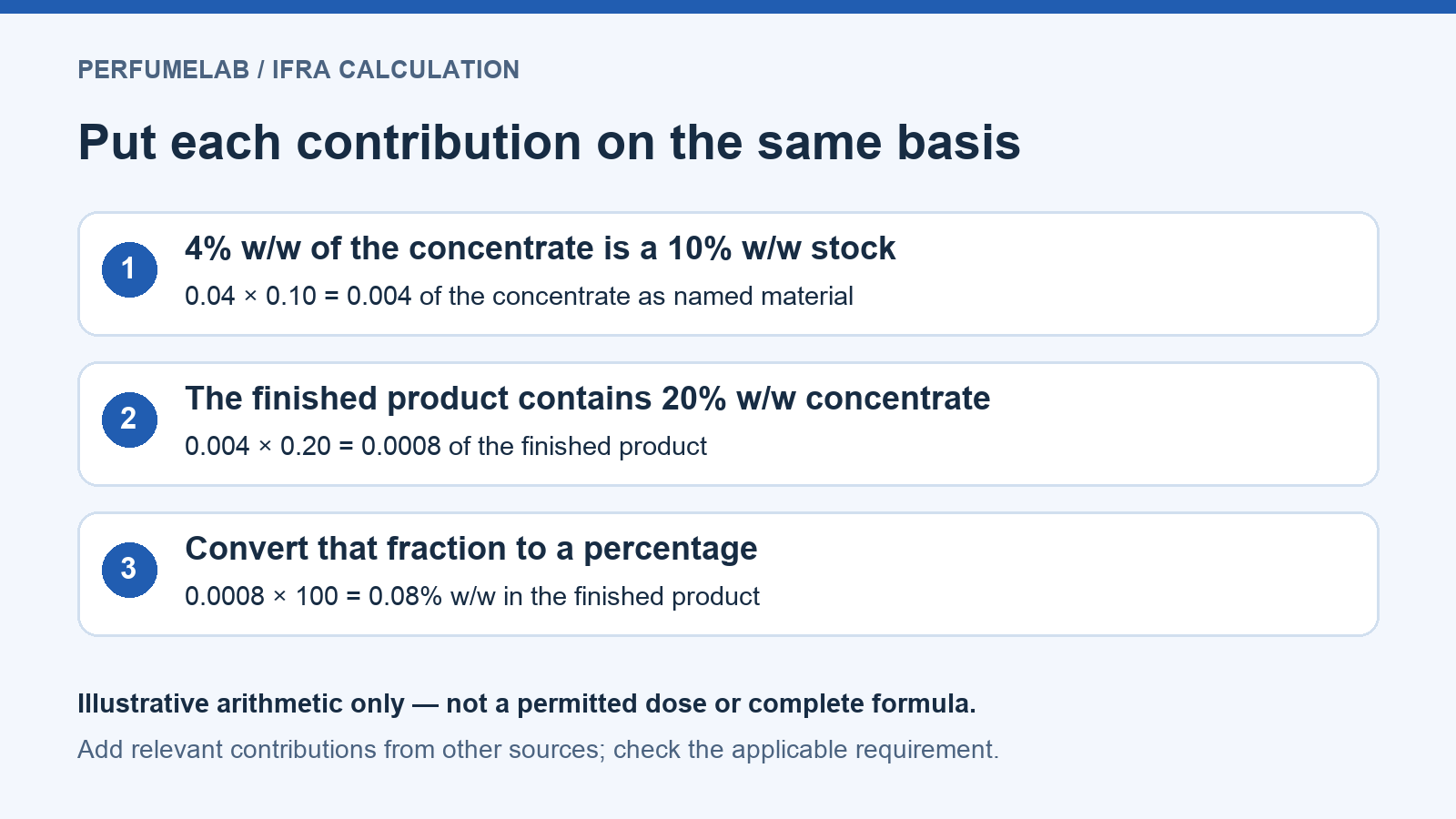

A quantitative IFRA limit and a perfume formula need the same concentration basis before you can compare them. The important number is the restricted material's contribution to the finished product, including relevant contributions from stocks and complex ingredients.
This guide explains the arithmetic. It does not establish a permitted amount for any named material or replace the rest of a product assessment.
Start with the correct requirement
Identify the exact supplied material and the intended finished-product use. Find the applicable current Standard and guidance, recording the document version and date. A prohibition or specification needs a different check from a simple concentration ceiling.
Confirm the product category from its intended and foreseeable use. Do not choose a category because its limit is convenient. A perfume, a body mist and a broad-area body oil should not be treated as interchangeable merely because each has a fragrance.
Calculate a direct material contribution
For a neat material recorded as a percentage of the concentrate:
Finished-product percentage = concentrate percentage × concentrate use fraction.
Suppose fictional material X is 0.50% of a concentrate used at 20% by mass in the finished product. X contributes 0.50% × 0.20 = 0.10% of the finished product.
Now suppose the applicable maximum were 0.08%. This is an invented teaching value, not a real Standard. The 0.10% contribution would exceed that hypothetical maximum.
Convert the available allowance back to the concentrate
If there were no other contributions of X, the hypothetical 0.08% finished-product allowance at a 20% concentrate use level would correspond to:
0.08% ÷ 0.20 = 0.40% active X in the concentrate.
Changing the concentrate use level changes the result. Recalculate rather than assuming a concentrate assessed at one dilution can be used at every other concentration.
Include stock strength and other sources
A line containing 0.50% of a 10% X stock contributes 0.05% active X to the concentrate. At a 20% use level, that becomes 0.01% X in the finished product. The stock's carrier remains part of the composition.
Where relevant, include X arriving through essential oils, other complex materials and direct additions. If those other sources already contributed 0.02% X to the finished product, the remaining hypothetical allowance would be 0.08% − 0.02% = 0.06%. At 20% concentrate use, that leaves 0.30% active X in the concentrate for the remaining contribution.
Use suitable composition evidence; mark missing data as unresolved rather than entering zero.
Keep the calculation reviewable
Record material identity, stock strength, formula version, final use level, intended category, source requirement and all relevant contributions. Keep enough precision in intermediate calculations and document any rounding.
A passing concentration calculation does not establish that every requirement has been met. Check applicable specifications, prohibitions and other product obligations separately. An IFRA conformity declaration also does not replace a safety assessment.
Sources
PerfumeLab’s IFRA information is provided for reference only. Verify requirements against official IFRA documentation and applicable regulations; the app does not replace professional regulatory review.
[…] the maths, use the finished-product contribution guide; for the intended use, see the IFRA category […]
[…] the maths, use the finished-product contribution guide; for the intended use, see the IFRA category […]
[…] the maths, use the finished-product contribution guide; for the intended use, see the IFRA category […]
[…] the maths, use the finished-product contribution guide; for the intended use, see the IFRA category […]