
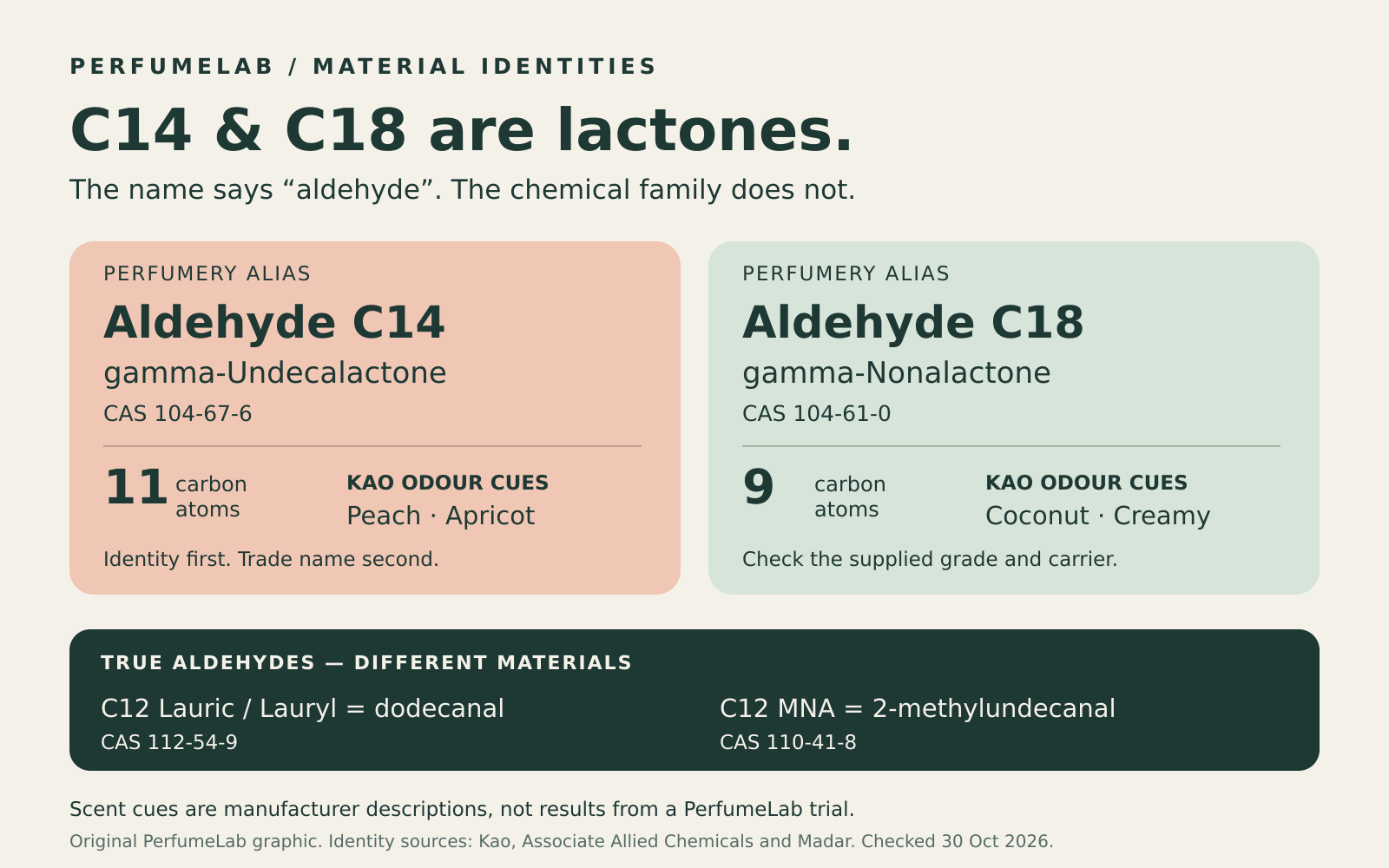

Aldehyde C14 and Aldehyde C18 are misleading perfumery names: the materials discussed here are lactones, not aldehydes. C14 is commonly sold as gamma-undecalactone, while C18 is commonly sold as gamma-nonalactone. The aliases are explicit in Associate Allied Chemicals’ C14 specification and Madar’s C18 technical documents. Always reconcile the name with the documentation for your particular bottle.
That distinction matters when you read an older formula, buy a material or search your ingredient library. A line marked “aldehyde” does not automatically belong with C12 Lauric or C12 MNA. Nor does C18 mean an eighteen-carbon molecule, a stronger version of C14 or a longer-lasting perfume ingredient.
C14 and C18: the identity check
| Perfumery name | Chemical identity | CAS number | Chemical family |
|---|---|---|---|
| Aldehyde C14 | Gamma-undecalactone | 104-67-6 | Lactone |
| Aldehyde C18 | Gamma-nonalactone | 104-61-0 | Lactone |
| Aldehyde C12 Lauric / Lauryl | Dodecanal | 112-54-9 | Aldehyde |
| Aldehyde C12 MNA | 2-Methylundecanal | 110-41-8 | Aldehyde |
The linked Kao product records establish the chemical identities and CAS numbers. The supplier documents above establish the C14 and C18 aliases. Together they resolve the naming problem without assuming that every product carrying an alias has the same purity, origin, additives or carrier.
Why these two “aldehydes” are actually lactones
A lactone is a ring-shaped ester. An aldehyde has a different functional group, commonly written –CHO. This is a structural distinction, not a judgement about how sweet, clean or creamy something smells. See the IUPAC definitions of lactones and aldehydes.
Kao’s specifications give gamma-undecalactone the molecular formula C11H20O2 and gamma-nonalactone C9H16O2. In other words, the material called C14 here contains eleven carbons, and the material called C18 contains nine. The trade-name numbers are not reliable carbon counts. Kao: gamma-undecalactone specification; Kao: gamma-nonalactone specification.
Dodecanal and 2-methylundecanal, by contrast, really are aldehydes. Do not move a C14 or C18 line into a C12 trial simply because the names look like members of one numbered series. For the latter material, read our guide to Aldehyde C12 MNA identity and measurable trials.
Peach versus coconut: useful descriptions, not promises
C14 / gamma-undecalactone: Kao’s specification uses peach and apricot descriptors; its product page emphasises an apricot-like, sweet-fruity character. This makes a peach or stone-fruit direction a sensible question to investigate when assessing that material. It is not evidence that every formula containing it will smell like peach. Kao’s gamma-undecalactone profile.
C18 / gamma-nonalactone: Kao describes a coconut-cream character with a gourmand aspect, while its specification lists coconut and creamy descriptors. A coconut-oriented or creamy-fruit study is therefore a reasonable starting question, not a guaranteed result. Kao’s gamma-nonalactone profile.
These are manufacturer descriptions, not findings from a PerfumeLab smelling trial. They also do not establish where a supplied ingredient came from: a peach-like odour does not prove peach extraction, and a coconut-like odour does not prove coconut extraction. Ask for the supplier’s origin declaration if origin matters to your project.
What to check before buying or substituting
Keep the familiar alias, but attach it to a fuller material record. A useful entry would start “Gamma-undecalactone — Aldehyde C14” or “Gamma-nonalactone — Aldehyde C18”, followed by the exact supplier product name. Then record:
- Identity: chemical name and CAS number, checked against the product documentation rather than inferred from the scent description.
- Supplied form: whether the bottle is a neat commercial material, a dilution or a blend, plus any stated carrier and stock strength.
- Grade and provenance: supplier, product code, batch, specification and any relevant origin declaration.
- Documents: the current SDS and other technical or composition information for that exact product.
A matching CAS number answers an identity question; it does not by itself establish that two bottles are equivalent grades or equally concentrated stocks. If one is diluted, compare the active material contributed by each stock rather than only the mass poured from the bottle. If the paperwork and label disagree, resolve that with the supplier before using the material.
Keep handling information separate from an assessment of the finished product. Our SDS and IFRA certificate guide explains why one document should not be treated as answering every formulation and safety question.
A practical comparison without assuming a winner
First choose a question that matches your brief: “Which of these materials better supports the fruit character I want?” is more useful than “Which aldehyde is better?” The following is a proposed study, not a report of tests already performed.
- Identify both samples. Record the actual supplied grades and any stock preparation. Follow the applicable handling and evaluation procedures for those materials.
- Describe them separately. Record your observations before looking back at the peach and coconut labels. Note the evaluation medium and observation times.
- Keep a reference. If you move to an accord study, preserve the original formula and make separately identified variants. State the question for each variant and how the formula total is kept consistent.
- Compare on a stated basis. Keep preparation and evaluation conditions comparable, and account for carriers. Equal weighed quantities of different stocks need not give equal quantities of the named materials.
- Write the result narrowly. Describe what changed in that formula under those conditions. Do not turn one observation into a universal claim about projection, longevity or preferred use.
Even a comparison based on equal active-material mass does not establish equal perceived intensity. Treat it as one documented comparison, not proof of a one-for-one substitution. For a fuller record-keeping method, see how to compare two perfume formula trials.
Keep the alias and the formula organised
PerfumeLab provides a workspace for organising perfume formulas and managing ingredients. Its App Store listing also describes material-library search using multilingual names and aliases. Keep the identity you have verified in your working record, and check the specific supplied product rather than relying on a familiar search result.
Explore PerfumeLab for iPhone and iPad to keep your formulation work together. Software can help organise the record; it cannot establish what is in an unverified bottle.
Source note: manufacturer and supplier literature checked on 30 October 2026. This is an identity and comparison guide, not a dosage recommendation, safety approval or account of laboratory testing.