
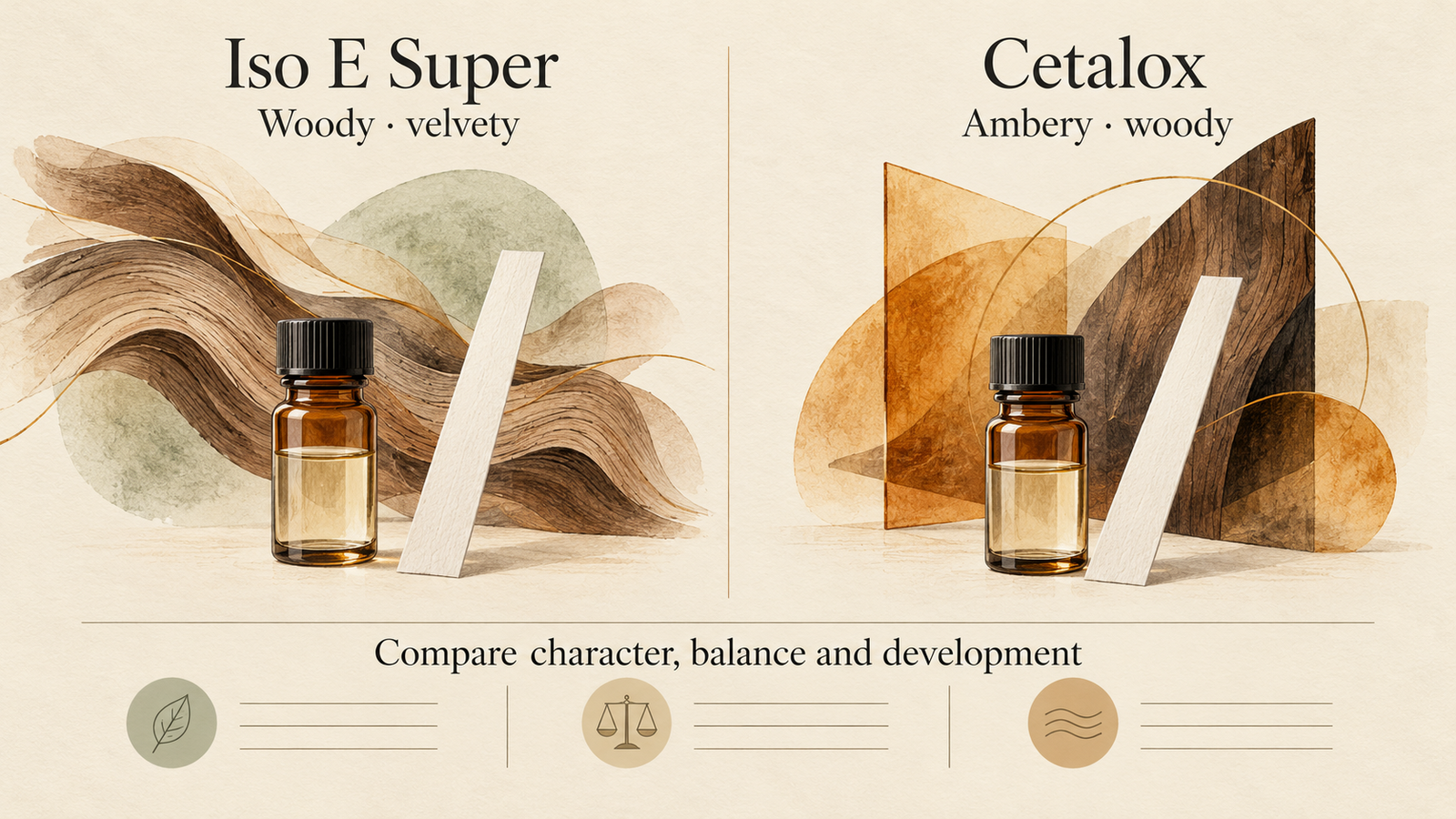

Iso E Super and Cetalox can both take a perfume toward woods and amber, but they give you different starting points. IFF describes Iso E Super through softness, woodiness and a velvety effect. dsm-firmenich describes Cetalox as a powerful ambery material with a pronounced woody character. Those descriptions suggest useful questions to test, rather than a reason to replace one with the other. IFF: Iso E Super; dsm-firmenich: Cetalox.
The practical choice is whether your formula needs a smoother woody setting, a more evident ambery contribution, or a combination you have actually compared. Start by separating the materials themselves from the stock dilutions on your bench.
Iso E Super vs Cetalox at a glance
| What to compare | Iso E Super® | Cetalox® |
|---|---|---|
| Manufacturer | IFF | dsm-firmenich |
| Manufacturer’s scent description, summarised | Soft woody-amber, with a velvety quality | Ambery with a strong woody aspect |
| Published identity | CAS 54464-57-2 / 68155-66-8 / 68155-67-9 | Product 922560; CAS 3738-00-9 |
| A useful question for your trial | Does it give the accord the woody fullness you want? | Does its ambery-woody character improve the accord’s balance? |
Product descriptions and identifiers come from the IFF compendium and dsm-firmenich product page. The trial questions are suggestions for your own evaluation, not promised effects. Neither the scent-family labels nor the CAS references establish a substitution ratio.
Where Cetalox, Ambroxan and Ambrox Super fit
Ambroxan is relevant to this comparison because of its ambergris-type character, but it should not become a catch-all name in your formula. Kao’s AMBROXAN® page identifies its product as CAS 6790-58-5 and describes an ambery profile with woody and musky nuances. Cetalox’s manufacturer lists CAS 3738-00-9. Keep those commercial identities separate.
dsm-firmenich also makes AMBROX® SUPER, product 909158, listed as CAS 6790-58-5. Its official product sheet makes a particularly helpful comparison: AMBROX SUPER leans closer to ambergris and has a more animalic character, while Cetalox leans drier and woodier. That is a comparison between those two named dsm-firmenich products, not a sensory ranking of everything sold under “Ambroxan”.
Cetalox belongs to dsm-firmenich’s ambery family developed from its ambergris research. Iso E Super has a different chemical identity. For buying and formulation, retain the manufacturer, exact product name and supplier specification, even when several bottles occupy a similar part of your smell vocabulary. A shared CAS between two products is also not a complete commercial specification.
For a closer comparison within IFF’s woody-amber materials, see Iso E Super vs Timbersilk.
What should you listen for?
Suppose you are working on a light floral-wood accord. Your aim might be: “Keep the floral detail clear, but give the drydown a firmer woody presence.” That is more useful than asking which material is stronger. A version can become more noticeable while moving further from the fragrance you wanted.
- Character: describe what changed before choosing a favourite. Is the result woodier, more ambery, drier, rounder or simply harder to separate into notes?
- Balance: check whether the floral, citrus or other feature in your brief remains readable. More background material is not automatically more depth.
- Development: compare the same versions at the same elapsed times. Separate what you detect nearby from what remains on the strip later.
These are listening prompts, not a claim that either material always produces a particular result. If a sample seems faint, record that observation and return after a break before changing the dose. The material smell-reference guide can help you keep your own impressions separate from supplier descriptions.
Check the stock before comparing the smell
The Cetalox product profile lists it as a crystalline solid. A bottle of Cetalox solution therefore needs a stock concentration and solvent in its name. “Cetalox 10% in ethanol” and “Cetalox neat” are different things to weigh. Use a documented preparation method and a compatible solvent; do not assume every chosen concentration will stay dissolved. See the guide to DPG, TEC and ethanol for the variables to record.
A dilution calculation, not a formula recommendation: 0.50 g of a 10% stock by mass contains 0.050 g of the named material. The same 0.50 g of a 1% stock contains 0.005 g. The weighed amount is identical, but the material contribution differs tenfold. Equal active mass still does not mean equal perceived strength between different materials.
Before judging one bottle against another, calculate the active material in each stock addition. Count the carrier too, and keep the concentration basis consistent throughout the study.
A practical three-sample comparison
Use a simple accord you already understand. Choose a technically appropriate test level for each material from its current documentation and the intended application. Work on smelling strips, follow supplier handling instructions and keep unassessed trials off skin. This study design does not provide a finished-product safety assessment.
1. Keep the base accord fixed
Prepare three coded samples with the same mass of the same base accord and the same total sample mass. Reserve an addition slot in each sample rather than adding a material to an already complete formula.
| Sample | What fills the addition slot | Question |
|---|---|---|
| Reference | Carrier only | What does the base do without either addition? |
| I | A documented Iso E Super stock, plus carrier as needed | What changes when Iso E Super is added? |
| C | A documented Cetalox stock, plus carrier as needed | What changes when Cetalox is added? |
Where suitable for both materials, you can use the same active-material contribution in I and C and match their carrier system. This holds the input amount constant; it does not equalise smell intensity. If you choose different active amounts, record that clearly and treat the result as a comparison of two candidate formulas, not a direct test of equal-dose performance.
2. Compare without the names in view
Use the same blotter type, application method, sample age and evaluation conditions. Keep the code key out of sight while writing. Choose observation points in advance, such as five minutes, one hour and the next day. These are checkpoints, not expected wear times.
At each checkpoint, write one sentence about character, one about the feature you wanted to preserve and one about the remaining balance. A useful entry might read: “C feels woodier than the reference at one hour, but the floral detail is less clear.” That observation gives the next trial a purpose.
3. Refine the more useful direction
If I and C are very different in apparent intensity, run a second series with smaller, documented adjustments. You are now searching for the amount that fits your brief, rather than trying to prove that the two materials are equivalent. Keep the original reference and avoid changing several other ingredients at the same time. The formula-trial comparison guide explains how to retain a useful control.
Can you use Iso E Super and Cetalox together?
You can investigate a combination, but give it its own comparison. Once you understand each addition, make a fourth trial that divides the chosen addition between them while keeping the total active addition and carrier balance documented. This is a blend experiment, not a recommended ratio.
Compare the combination with both single-material versions. Does it add something you wanted, or does the accord merely become busier? Keeping both is worthwhile only if the result earns its place in this formula. Neither material is a compulsory ingredient in a woody perfume.
Keep the version you can explain
Save the full material names, stock strengths, actual masses and evaluation notes with each version. In PerfumeLab you can organise formulas by percentage and set batch sizes, concentrations and dilutions. Use those records alongside your smelling notes so the preferred trial can be made again.
Explore PerfumeLab on the App Store.
Before using a trial in a finished product, verify the relevant supplier information, applicable IFRA requirements and product safety requirements. A manufacturer’s usage example or a pleasant blotter result does not establish a safe maximum.
[…] specific to judge instead of treating a higher percentage as an improvement by itself. The Iso E Super vs Cetalox comparison offers a way to investigate two different woody-amber […]