
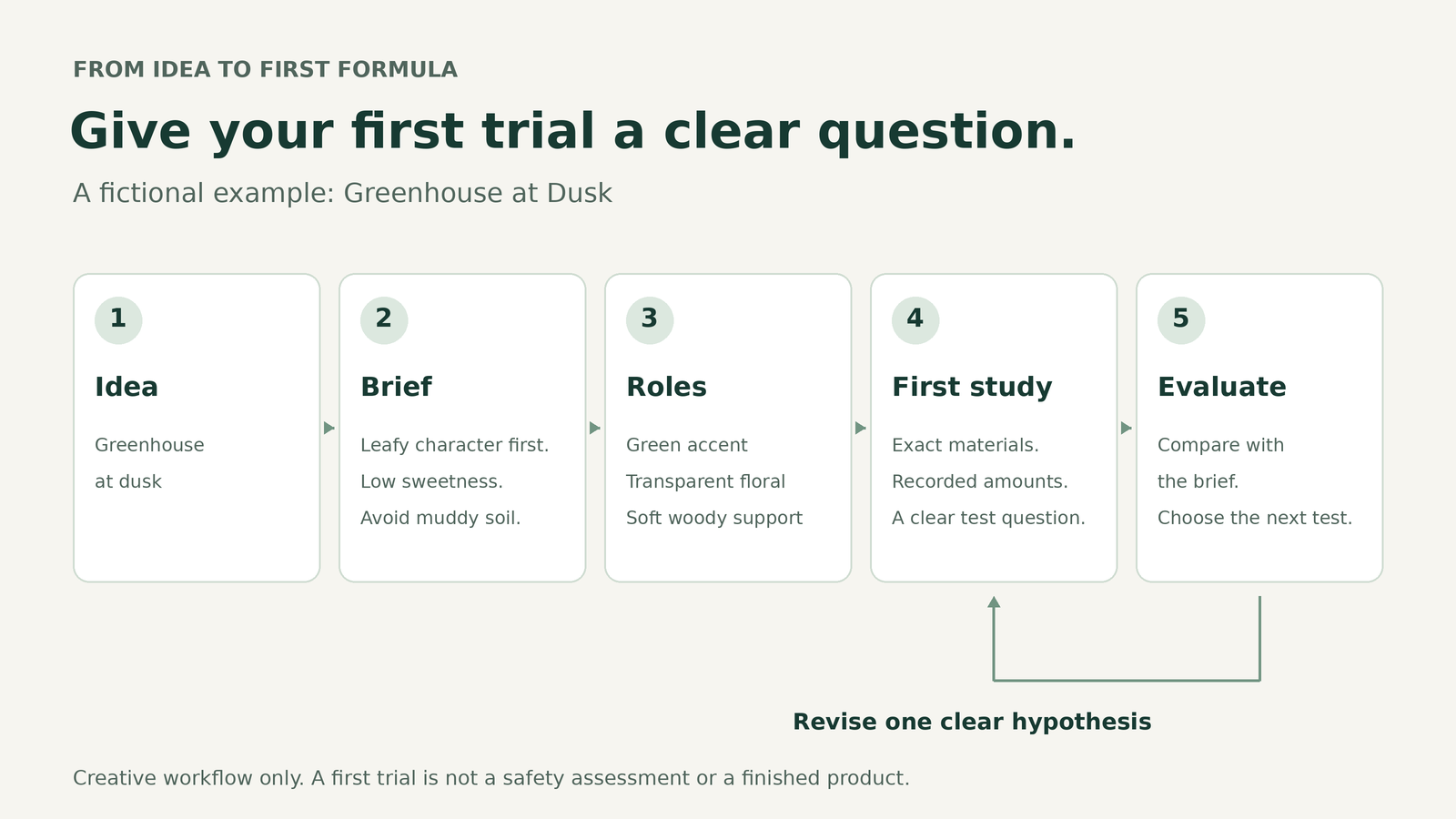

“A greenhouse at dusk” is a promising perfume idea. It is also several different fragrances waiting to happen. You might picture snapped stems, humid flowers, wet soil or the warm wood of a potting bench. Before choosing ingredients, decide which of those impressions the first formula needs to express.
A fragrance brief turns that idea into a direction you can test. It describes the intended smell, the priorities and the boundaries. Your first perfume formula then becomes a practical attempt to answer the brief, with a clear reason for each material and a useful question for the next trial.
The workflow below uses a fictional project, Greenhouse at Dusk. It is a worked creative example, not a tested formula or a dosing recipe.
Start with a brief you can use to make decisions
In its guide to perfume creation, IFF describes the brief as defining the audience, emotional intent and olfactive direction, followed by iterative formulation and evaluation. You can use the same broad approach for a personal project without producing a commercial presentation.
Write down the answers to six questions:
- What is the central impression? Choose one sentence rather than a long list of attractive notes.
- Who is it for, and where will it be used? Include the intended product format, even if the first work is only a blotter study.
- What matters most? Rank two or three characteristics so that you can resolve trade-offs.
- What should it avoid? Name the directions that would pull the project away from the idea.
- What are the practical constraints? Consider the materials you own, their documentation, cost and the equipment available.
- What would make the next trial worth keeping? Set a specific question that smelling can help answer.
Words such as fresh, elegant or comforting can stay in the brief, but give them a practical meaning. For this project, “fresh” means a leafy impression with little perceived sweetness. Someone else could reasonably use the same word for citrus peel or clean laundry.
A worked fragrance brief: Greenhouse at Dusk
| Brief field | Decision for this fictional project |
|---|---|
| Central impression | Freshly cut green stems beside pale flowers, settling towards soft wood. |
| Intended wearer and format | A personal alcohol-based fine fragrance for someone who enjoys restrained green florals. Begin with documented blotter studies; skin use is a separate safety decision. |
| Priority order | Recognisable leafy character first; floral transparency second; a gentle woody finish third. |
| Avoid | Candy-like sweetness, a heavy bouquet, obvious smoke and a literal muddy-soil effect. |
| Material constraint | Use familiar, documented materials already in the working palette. Do not buy an ingredient simply because its description mentions a greenhouse. |
| First trial question | Can a leafy accent remain identifiable beside a transparent floral and a soft woody support? |
The exclusions are useful. Wet earth belongs to the imagined scene, but this brief deliberately leaves it out. A perfume does not need to reproduce every object in its inspiration. Here, adding an earthy effect before establishing the green-floral relationship would make the first trial harder to interpret.
Translate the brief into material roles
Before assigning percentages, write a short job description for each part of the composition. A role describes what you want to achieve; an ingredient is a candidate for achieving it.
| Role in the first study | How to choose a candidate |
|---|---|
| Leafy identity | Choose a green material whose evaluated smell resembles the stem-like effect in the brief. Record why it fits better than the other green materials you know. |
| Transparent floral body | Look for a floral character that supports the leaves without turning the study into a dense bouquet. |
| Soft woody support | Choose a woody candidate that fits the desired finish. Check whether its character still suits the idea when combined with the floral material. |
| Optional detail | Leave extra citrus, soil, spice and sweetness out of the first study unless you can explain which unresolved problem they address. |
Manufacturer descriptions can help you form a shortlist. For example, dsm-firmenich describes Hedione as a transparent floral-jasmine material with citrus facets. IFF describes Iso E Super as a smooth woody-amber material. Those descriptions make them plausible candidates to investigate for two of the roles above. They do not establish a working combination, a suitable dose or a finished perfume.
Use your own material smell references to decide whether the candidates fit. If you cannot describe an ingredient from a documented evaluation, study it before asking it to solve a problem in a mixture. Record the exact supplier and grade, too: a familiar name should not hide a change of material.
Choose a first study small enough to learn from
For Greenhouse at Dusk, the first study could focus on the floral and woody relationship, followed by a separately recorded version that introduces the selected green accent. That sequence gives you something to compare with when the leafy material changes the overall impression.
Another project might start with the green-floral relationship instead. Choose the pair that addresses your biggest uncertainty. There is no required ingredient count or universal top-heart-base percentage split in this workflow. A compact first study is useful because you can explain its parts, not because a short formula is automatically better.
Decide the evaluation question before weighing. “Does the green accent remain recognisable without making the opening feel harsh?” is more useful than “Is this good?” The first question points towards a possible revision; the second invites you to change everything at once.
Turn the plan into an actual formula record
A role plan becomes a formula only when it identifies the exact materials and quantities. Keep a versioned record that includes each material, its supplier or grade, any stock dilution and solvent, the target quantity and the actual mass weighed. Save the first version before revising it.
Label the basis of every percentage. Your fragrance mixture, diluted stocks and intended finished product are different levels of the calculation. The guide to perfume concentrate versus finished product explains that distinction; the formula record template covers the supporting details.
Choose quantities using your knowledge of the exact materials, appropriate technical guidance and the applicable safety requirements. This article deliberately does not assign amounts to the fictional brief. Neither a promising scent description nor a manufacturer’s typical-use suggestion is a complete safety assessment.
Before handling or evaluating materials, review the supplier’s safety information and use an appropriate working procedure. Do not apply raw materials or an unevaluated mixture directly to skin. Check the current IFRA requirements for the intended use and finished-product composition, alongside applicable regulations. IFRA explains that quantitative restrictions concern the finished consumer product and that a Certificate of Conformity does not replace a safety assessment.
Use the brief to decide what changes next
Evaluate appropriately prepared, labelled blotters under consistent conditions, with the same evaluation dilution and observation schedule for comparable versions. Keep the brief beside your notes. The following observations are invented to demonstrate the decision process, not results from a real test.
| Fictional observation | Useful next decision |
|---|---|
| The floral-wood study is pleasant, but the green version smells mainly of flowers after the opening. | The priority is leafy identity, not general pleasantness. Test a controlled change to the green-floral balance before adding unrelated notes. |
| A revision reads more clearly as leafy, but the opening is uncomfortable to smell. | Stop the evaluation rather than smelling through discomfort. Review the material’s safety information and the preparation and evaluation conditions before deciding whether a further trial is appropriate. |
| A sweeter version is preferred, but no longer resembles the brief. | Save it as a separate creative direction. Decide explicitly whether to keep the original brief or begin a new project. |
| Two versions are difficult to distinguish. | Repeat the comparison before making a confident claim. Keep the simpler explanation open: the change may not be useful under these test conditions. |
Keep the original study available and record exactly what changed, including any adjustment needed to maintain the chosen formula total. “One change” should mean one clear hypothesis, with all associated quantity changes documented. For a fuller comparison workflow, see how to compare perfume formula trials.
Know what the first formula has achieved
The first formula has done useful work when you can say which part of the idea it expresses, which part it misses and what the next trial will investigate. It does not need to be ready to wear or sell. Creative progress, safety assessment and product readiness are separate questions.
For Greenhouse at Dusk, a good first result might simply be a believable green-floral relationship worth developing. The woody finish can be refined afterwards. Keep the brief short enough to guide that decision, and keep the formula record detailed enough to reproduce it.
PerfumeLab for iPhone and iPad provides a workspace for percentage-based formulas, batch sizes and dilutions, with PDF formula exports. Use it to keep the composition organised while your brief and smelling notes guide the creative decisions. Its IFRA information is reference material, not a replacement for professional regulatory review.
[…] a broader starting framework, see turning a fragrance idea into a first formula. A focused brief helps you decide what to leave out as well as what to […]