
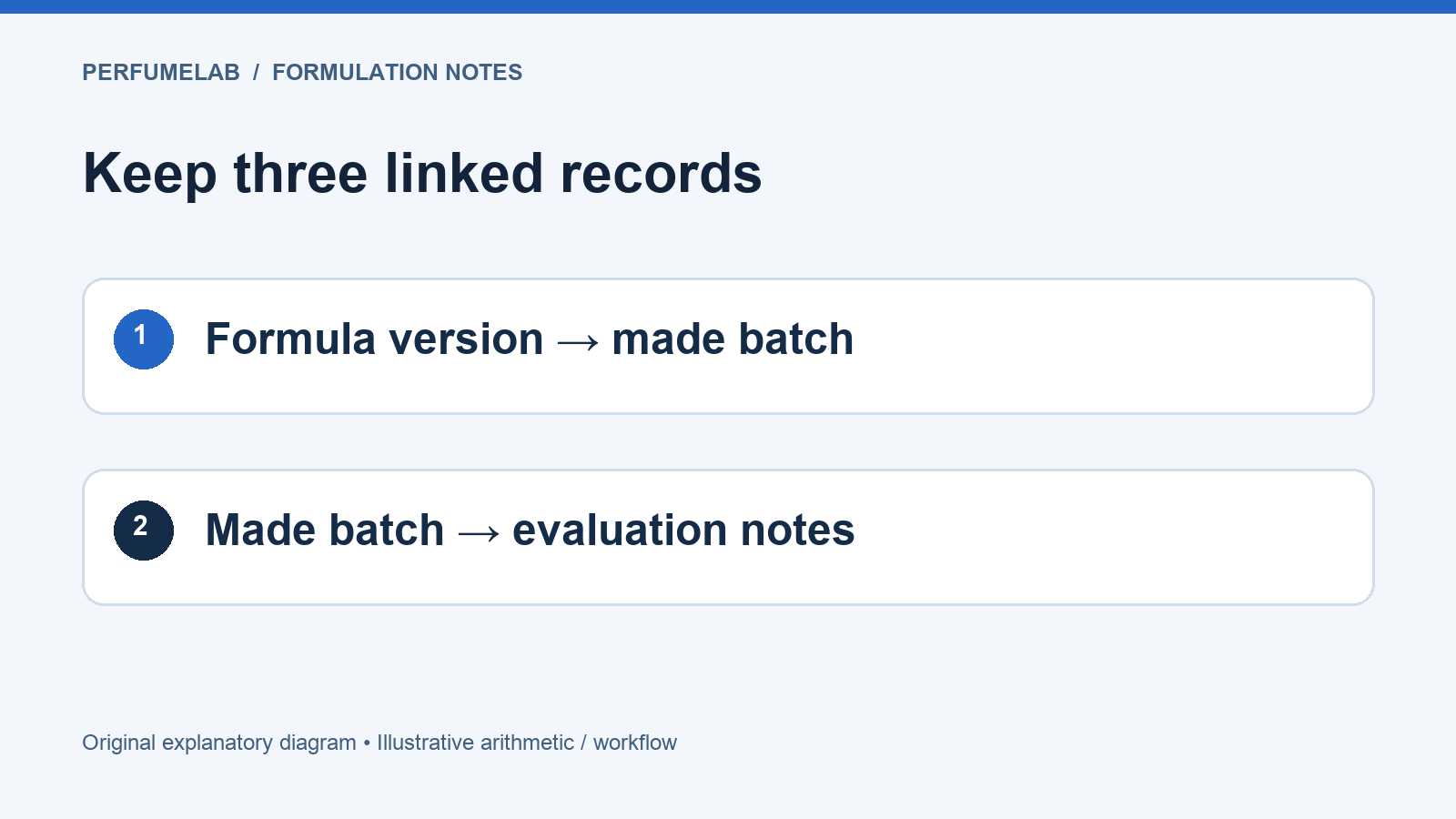

A perfume notebook needs to answer three questions: what you intended to make, what you actually made and what happened when you evaluated it. Keeping those records linked is more useful than putting everything into one undated ingredient list.
The formula record
Give the composition a stable name and a version number. State whether it describes a concentrate or a finished product, and whether the figures are percentages, parts or masses. For every line, keep the material identity, supplier or grade where relevant, and stock strength with its carrier.
Record the total. Add a short reason for the version: “reduced sweetness” or “replaced unavailable stock” is more useful than “improved”. Link to the preceding version so the change can be reconstructed later.
The batch record
Assign a batch identifier and preparation date. Copy the targets from the chosen version, then record actual masses in a separate column. Note source lots where needed, the final mass, preparation method and any deviation from the plan.
A simple record could read: formula F-012, version 3; batch B-028; 12.00 g target; 12.03 g actual. Those identifiers are examples. The important feature is that an evaluation of B-028 points back to the actual weighed batch, not just a similarly named formula.
The evaluation record
Include the sample identifier, test concentration, preparation age, evaluation medium and observation times. Separate what you noticed from what you think caused it. Keep clarity or storage observations alongside scent notes when those are part of the trial.
A compact template
Use these headings: formula/version; purpose; basis and units; material/stock/target/actual; batch/date; method/deviations; evaluation conditions; observations; next action; supporting documents.
You can keep this in a paper notebook, spreadsheet or formulation application. The format matters less than preserving the links and keeping an independent backup. Before adopting a new system, try retrieving an old trial using only its bottle label. If you cannot find its complete record, change the identifiers or filing method before the collection grows.
If you’d rather keep your formulas in an app, PerfumeLab lets you save and duplicate a formula and export a PDF for the bench. Get PerfumeLab for iPhone and iPad. Free to download, with in-app purchases.
[…] A short nickname can help you search, but it should not replace the full identity. “Musk”, “bergamot” or “10% stock” can each describe several different bottles. Link each formula to the specific material record and, where useful, the lot used. See what to record in a perfume formula notebook. […]