
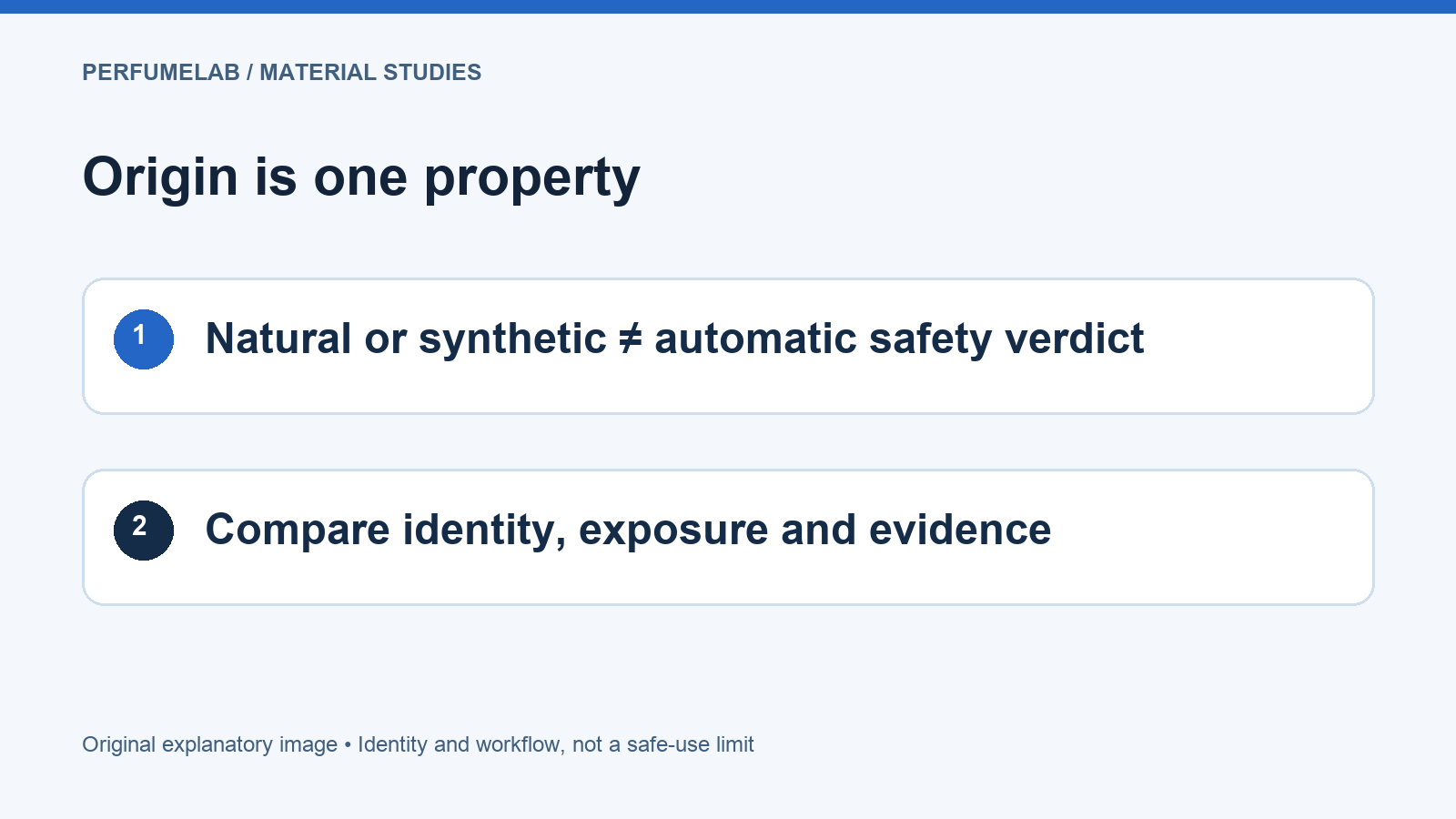

Natural and synthetic describe aspects of an ingredient's origin or manufacture. They do not, by themselves, tell you whether a particular finished perfume is suitable, safe or creatively successful.
Both can belong in a perfume
IFRA describes fragrance creation as work combining natural ingredients and synthetic molecules. A formulation decision can involve either, or both. Treating the choice as a contest between “real scent” and “chemicals” obscures the fact that natural materials also contain chemical compounds.
The useful question is more specific: what does this supplied material contribute, and what information supports using it in this product? That includes its identity, specification, intended application and the amount at which people will encounter it.
Avoid a safety ranking based on origin
IFRA's fragrance questions page says essential oils are not necessarily safer alternatives to synthetic ingredients; dose and exposure matter. That is a better starting point than assuming that a plant-derived material needs less scrutiny.
It is equally unhelpful to assume every synthetic material is interchangeable or every natural material is unusually variable in a way that makes it unusable. Look at the exact product and evidence. General labels cannot do the work of a material-specific assessment.
Ask what an origin claim means
If natural origin is important to your project, request the supplier's definition and supporting documentation. Do not infer it from a botanical-sounding trade name, a product photograph or an odour descriptor such as cedar or ambergris. The patchouli oil vs Clearwood comparison shows why the exact production route and product identity matter.
For environmental or sourcing questions, ask for evidence appropriate to that claim. “Natural”, “renewable”, “biodegradable” and “responsibly sourced” answer different questions. None should be used as a substitute for the others or as proof of a complete product's environmental impact.
Choose for a clear formulation purpose
Write the brief first. You may need a particular odour effect, a defined sourcing policy, a cost constraint or a material that works in a specific application. Evaluate candidate products against those requirements, then document the choice. For a material-specific example, compare oakmoss extracts with Evernyl and Veramoss before choosing a mossy ingredient.
A disciplined comparison leaves room for creativity. It also makes product communication more honest: describe the ingredients and evidence you actually have, rather than promising that a single origin label guarantees everything a reader might hope it means.
[…] Record the supplier, product code, extract type, relevant processing description, lot and supplied concentration. The word “natural” does not settle suitability or safety; natural and synthetic labels answer different questions. […]