
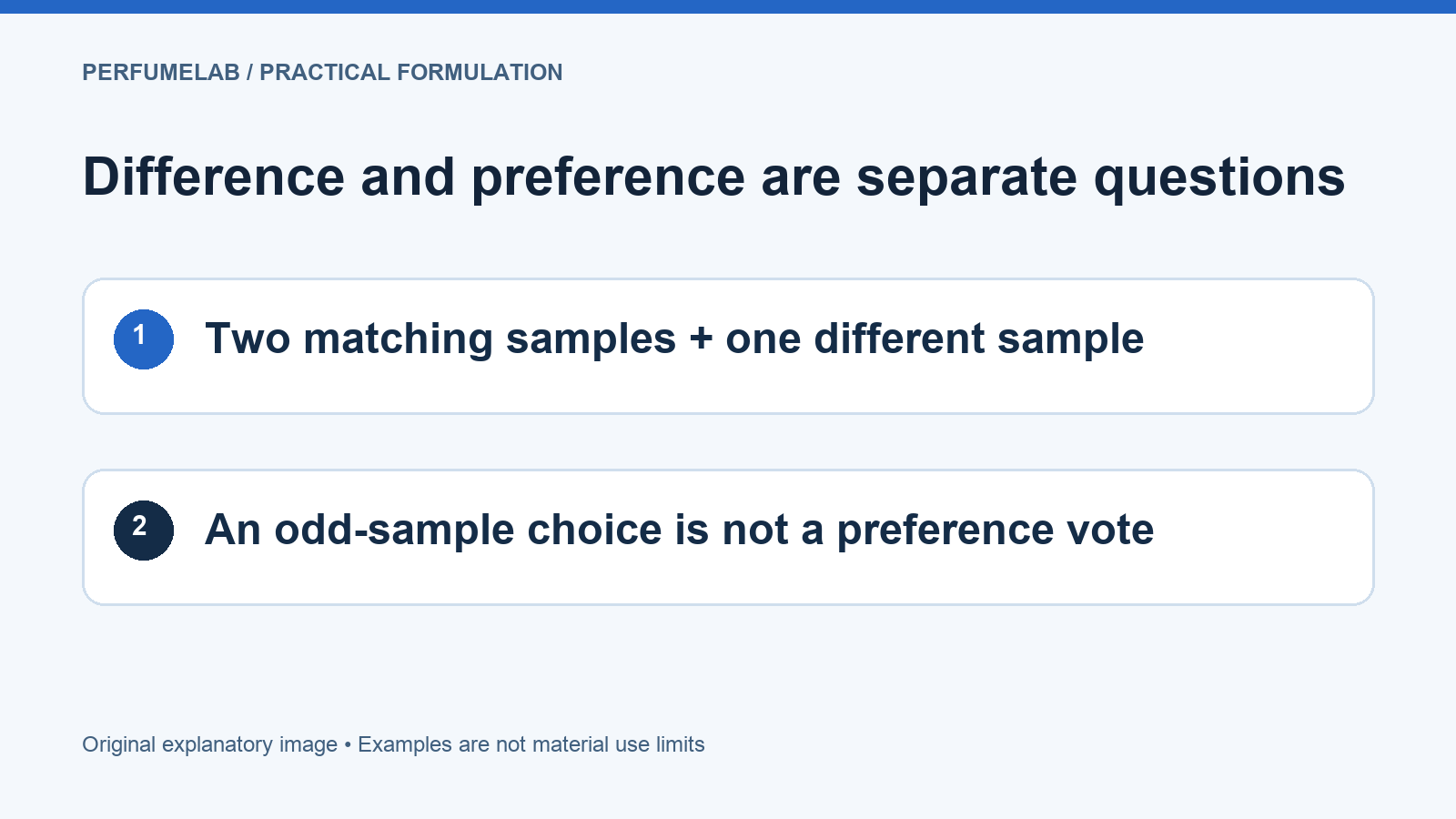

A triangle test asks whether a person can identify a different sample among three coded presentations. It does not ask which perfume they prefer. Keeping those questions separate makes a comparison easier to interpret.
What the three samples represent
In the basic arrangement, two presentations come from one product and the third comes from another. The evaluator selects the one that seems different. University sensory guides describe this structure, while ISO 4120 addresses a formal forced-choice method for examining sensory difference or similarity.
That is a different question from a paired preference test. A person might distinguish two versions reliably yet have no preference, or prefer one for reasons that a difference test does not identify.
Why one correct answer proves little
With three options, an unsupported guess has a one-in-three chance of selecting the odd sample. One correct choice therefore does not demonstrate that a substitution is perceptibly different for a relevant population. Nor does one incorrect choice establish that the products are equivalent.
A formal study needs an appropriate design, participants, presentation control and analysis. This article does not reproduce the full ISO standard, provide a significance table or certify a casual workshop exercise as an ISO-compliant test.
Control the question before the samples
For a fragrance comparison, identify the two actual formula or batch versions and their tested concentrations. Keep preparation and presentation conditions suitably controlled. Codes should not reveal the identity, and handling should not introduce obvious non-odour clues that answer the question instead.
Use an appropriate, safe evaluation procedure for the products. The fact that many published sensory examples involve food does not make perfume materials suitable for tasting, ingestion or direct neat skin application.
Record the result without overclaiming
Keep the sample-code mapping separate from the evaluator's response until the chosen procedure calls for revealing it. Record the selection and any relevant observations, rather than converting the response directly into “better” or “worse”.
If your question is whether an ingredient change makes the fragrance more appealing, plan a suitable preference evaluation. Use descriptive evaluation separately to investigate which attributes changed. A difference test can indicate that something was detected under its conditions; it does not identify every changed attribute, establish safety or guarantee a commercial preference.
For ordinary early formula development, a clearly documented paired comparison may be enough to guide your next trial. Choose a formal method when its question and level of evidence match the decision you need to make.
Sources
ISO 4120:2021: Triangle test abstract
[…] If another appropriately informed evaluator compares the same suitable preparations, record their observations separately. Agreement or disagreement is useful context, not a contest over whose nose is correct. More formal sensory comparisons require a defined method and an interpretation suited to that method; see triangle tests and the difference between detecting a change and choosing a favourite. […]