
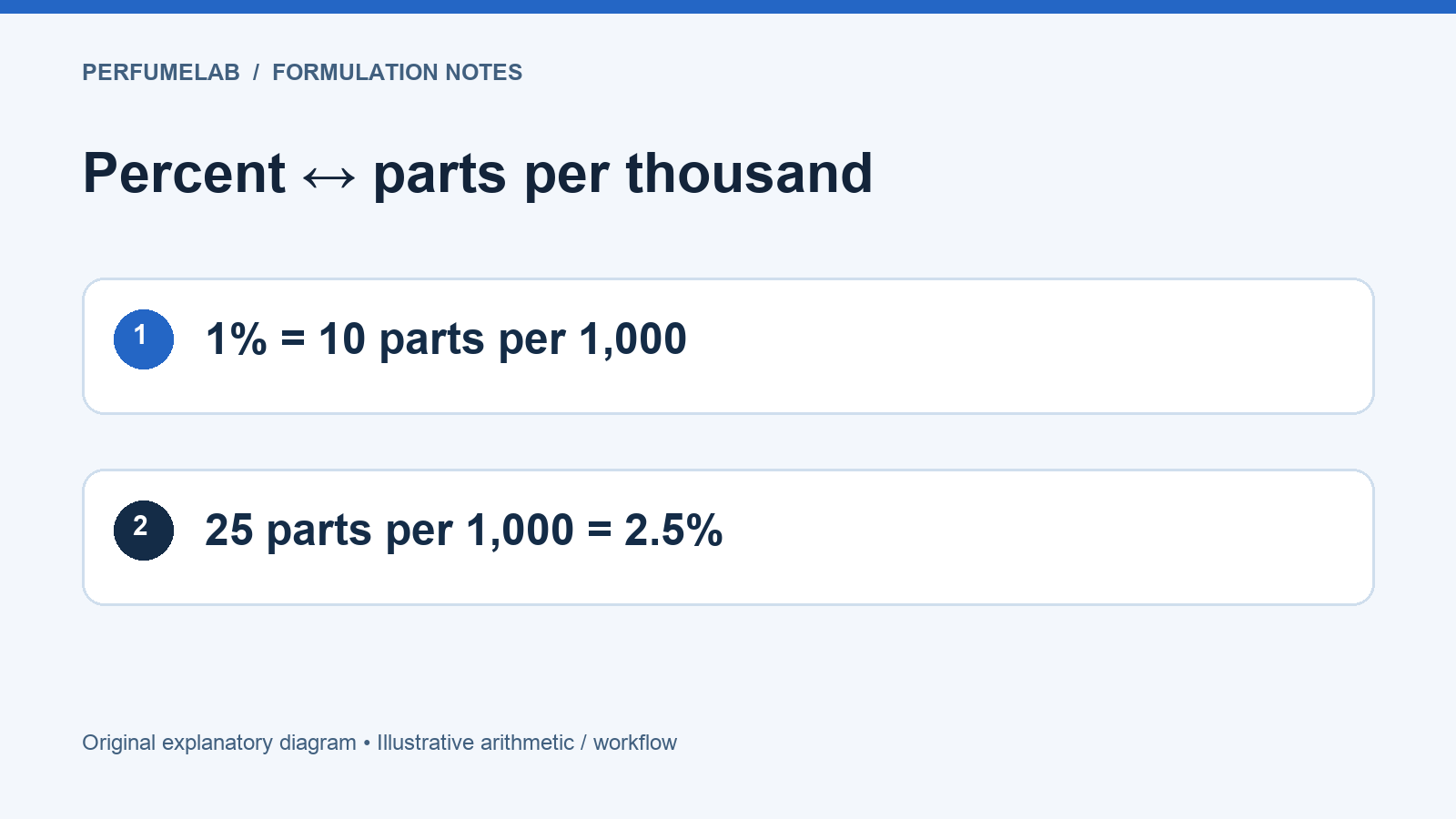

A formula written to 1,000 parts is a ratio sheet. If an ingredient occupies 25 of those parts, it is 2.5% of the total. It does not mean you must weigh 25 g unless you have chosen a 1,000 g batch.
The examples below use parts by mass; confirm that basis before converting a formula to grams.
Read the total first
Add the parts before converting. A list totalling 1,000 uses a convenient denominator, but some working formulas total 100, 300 or another number. The general equation is:
Ingredient percentage = ingredient parts ÷ total parts × 100.
For a true 1,000-part formula, divide each part figure by ten to obtain its percentage. Going the other way, multiply a percentage by ten. Thus 0.2% becomes 2 parts per thousand, and 17.5% becomes 175 parts per thousand.
Turn the ratio into a batch
In a 12 g trial, a 25-part line from a 1,000-part formula requires 12 × 25 ÷ 1,000 = 0.30 g. The same line in a 40 g trial requires 1.00 g. The ratio has stayed constant; the batch mass has changed.
These are mathematical examples using unnamed ingredients. Before weighing a real formula, check the identity and stock strength on every line. “25 parts of A at 10%” contains one tenth of the active material in “25 parts of A neat”. The unit conversion does not remove that distinction.
Avoid a notation trap
Write “parts per thousand” or use the per-mille symbol ‰ with a clear heading. The percent sign % has a different meaning. A handwritten 25 next to an unclear symbol can turn a modest line into a tenfold error.
When exporting or sharing a sheet, include its total and unit basis at the top. Keep an unrounded working version, and check the total again after any rounding needed for the weighing sheet. A second reader should be able to reconstruct the percentages without asking what one “part” meant.