

You cannot convert a perfume's millilitres to grams from volume alone. You need its density under the relevant conditions. Treating every liquid as 1 g per millilitre can make a formula or filling calculation wrong.
Keep the units visible
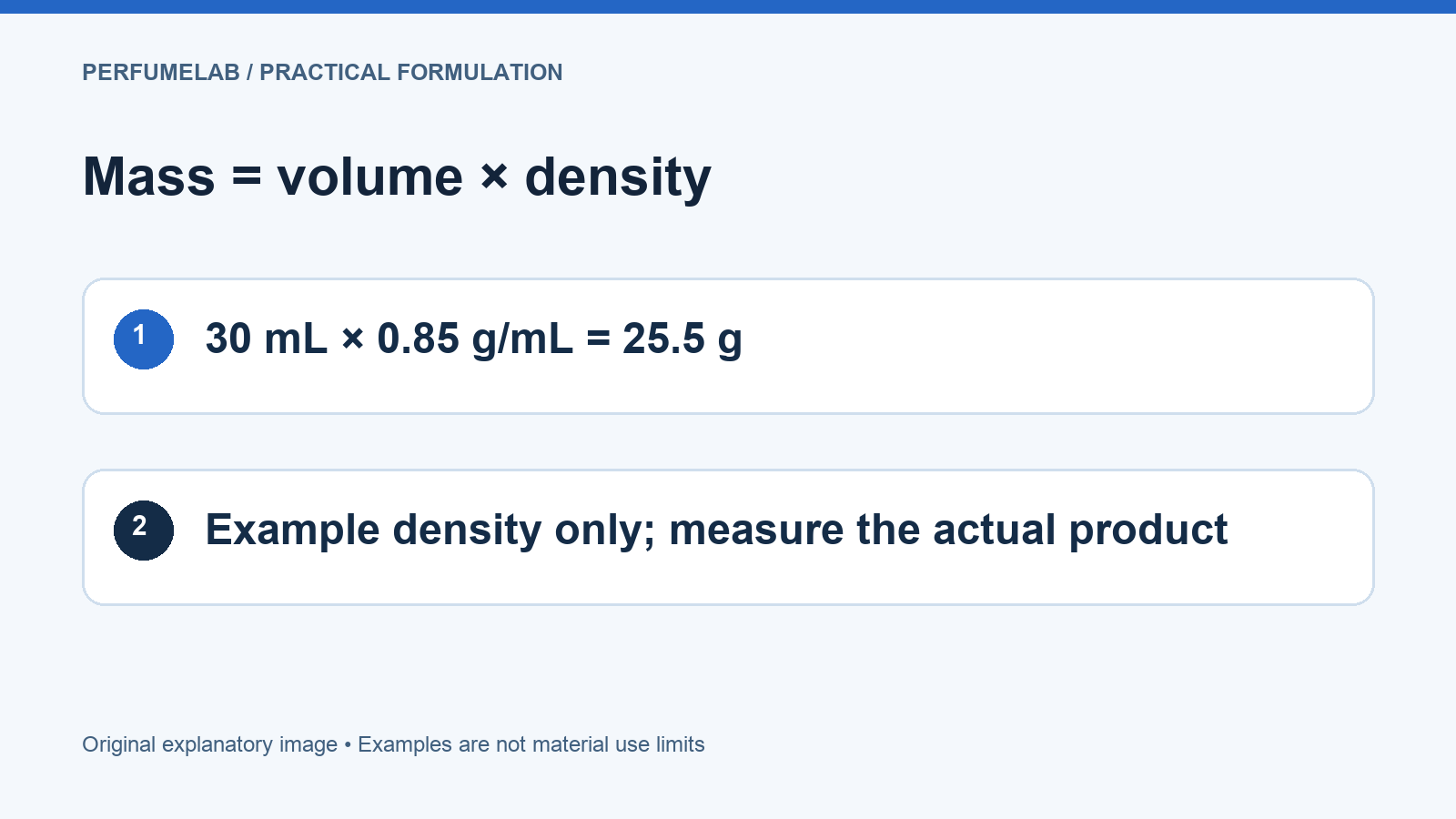
Density relates mass to volume. If a hypothetical liquid has a density of 0.85 g/mL, then 30 mL has a mass of 30 × 0.85 = 25.5 g. Conversely, 30 g of that same hypothetical liquid occupies about 35.29 mL.
The density is invented to show the equation. It is not a reference density for PerfumeLab users' formulas, ethanol, a particular carrier or commercial perfume.
Mass in grams = volume in millilitres × density in grams per millilitre.
Volume in millilitres = mass in grams ÷ density in grams per millilitre.
Use information for the actual liquid
A fragrance concentrate, a stock solution and a finished perfume are different mixtures. Do not take a density for one raw material and assume it describes the whole finished product. Temperature and measurement conditions also matter to a meaningful density value.
Use appropriate specification or measurement information for the task. A material name and a volume are not enough to establish a precise mass, especially when the actual supplied product includes other components.
Do not switch bases halfway through a dilution
A 20% mixture by mass and a 20% mixture by volume are not automatically the same composition. If your formula is mass-based, keep the calculation in masses unless you deliberately convert using suitable information.
For example, “20 g concentrate plus 80 g carrier” defines a mass basis. Replacing those figures with 20 mL and 80 mL changes the preparation method. It does not preserve the stated mass percentages merely because the numbers still add to 100.
Separate formula quantity from bottle capacity
A nominal bottle size and a batch mass answer different questions. For practical filling, understand the actual product and packaging specifications rather than assuming a container description supplies the density or the correct fill procedure. Commercial quantity declarations require the applicable current requirements; this article is not a filling-compliance guide.
A good worksheet states the unit beside every input and records the source and conditions for any density used. That small amount of detail prevents a volume shortcut from quietly changing the composition you intended to make.