
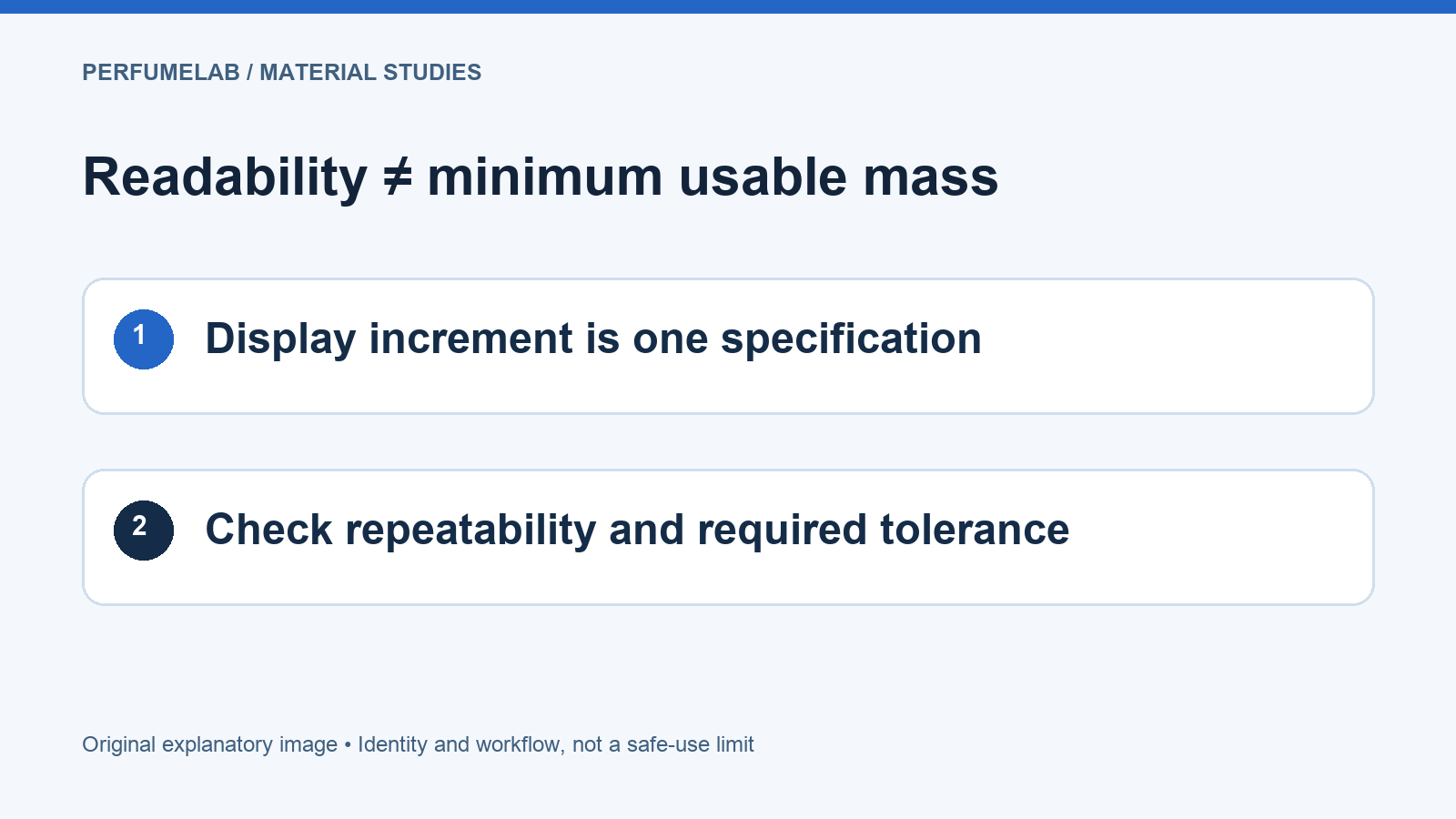

A balance displaying three decimal places can show 0.001 g. That display increment alone does not prove that a 0.001 g addition is a dependable measurement for your formula.
Readability answers a limited question
Readability describes the smallest displayed increment. Other properties, including repeatability and trueness, affect how useful the result is. METTLER TOLEDO's weighing guidance distinguishes these concepts, particularly at low loads.
A useful purchasing or bench question is therefore more specific than “How many decimals does it have?” Ask whether the equipment and method can meet the uncertainty or tolerance appropriate to the smallest addition you intend to weigh, under your working conditions.
Start with the smallest formula line
Suppose a 10 g trial includes a line at 0.01%. The target addition is 0.001 g. That is an arithmetic result, not evidence that your balance can reliably deliver it. Increasing the trial to 100 g makes the target 0.010 g, but you still need to establish that this is within an appropriate working range.
Do not turn those examples into recommended batch sizes or a universal minimum weight. The answer depends on the instrument, conditions, procedure and required performance.
Understand what minimum weight means
USP's weighing FAQ describes minimum weight as a calculated value tied to the balance's performance at the time of repeatability testing. That illustrates why a specification cannot be reduced to the final digit on the screen. It does not mean that every perfumery trial is governed by pharmaceutical USP requirements.
Use relevant manufacturer guidance and an appropriate verification procedure for your work. A tare container's mass does not make an extremely small net addition automatically reliable. The addition itself still has to be measured adequately.
Change the method deliberately
If the required addition is too small for the method, possible formulation-workflow options include a larger trial or a suitable documented stock dilution. Those options change the practical weighing task, and the dilution introduces carrier that must be included in the record.
Preserve target and actual masses separately. Do not add decimal places to a spreadsheet to make uncertain measurements appear more precise. A useful batch sheet shows what the equipment and procedure could support, making the next trial easier to reproduce and its differences easier to interpret.