
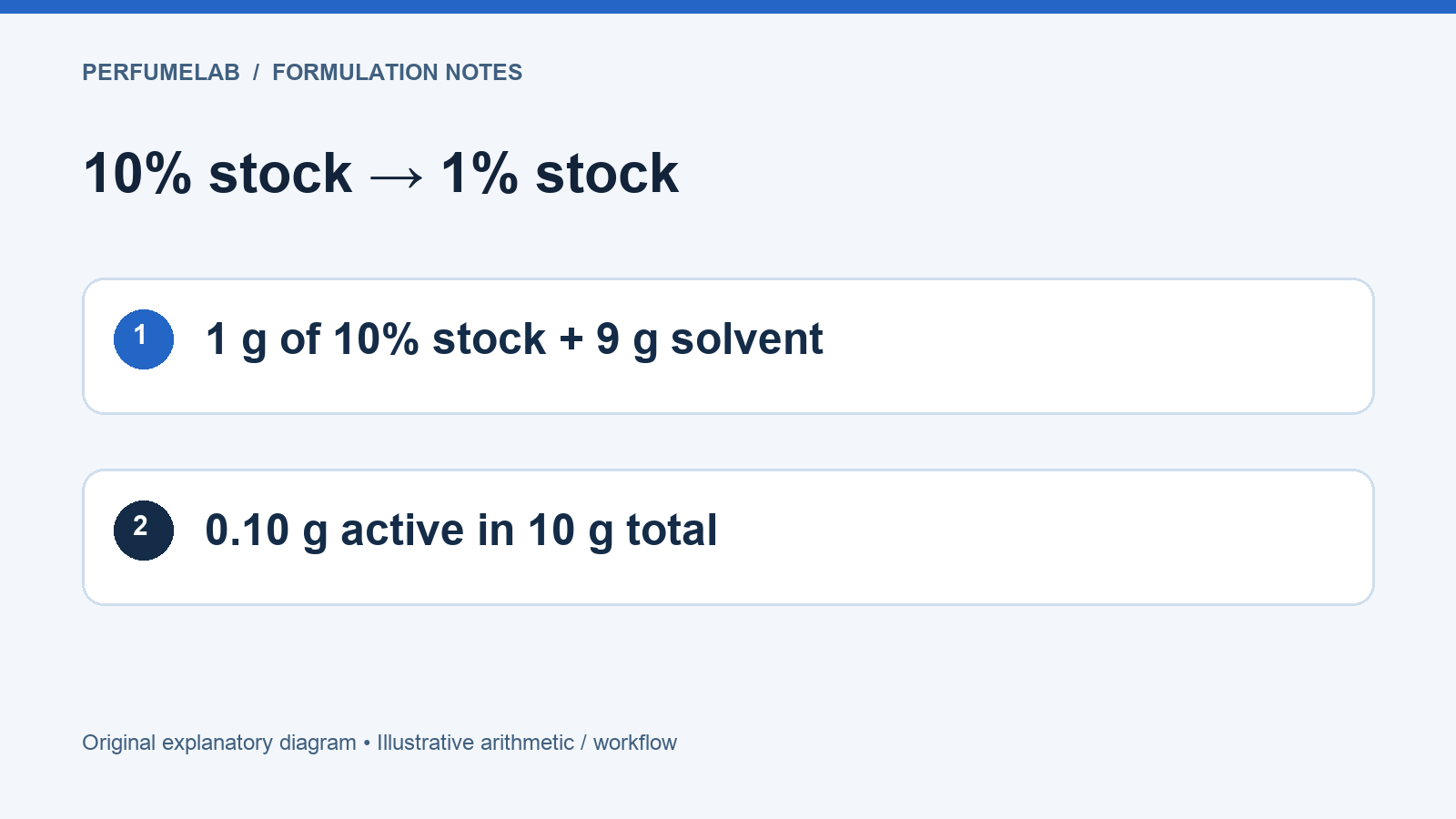

You can make 10 g of a 1% solution from 1 g of a 10% stock and 9 g of additional solvent. The 1 g portion of stock contains 0.10 g material; after dilution, that 0.10 g is spread through 10 g total.
Use the concentration ratio
Keep all concentrations on the same mass basis. The required stock mass is:
Final mass × desired concentration ÷ starting concentration.
For 10 g at 1%, starting from 10%, calculate 10 × 1 ÷ 10 = 1 g stock. Subtract this from the final mass to get 9 g added solvent. For 30 g final stock, the corresponding amounts are 3 g stock and 27 g solvent.
The equation does not care whether you write the concentrations as 1 and 10 or 0.01 and 0.10, provided you use the same convention in the ratio. Mixing 1 with 0.10 would produce the wrong answer.
Remember the carrier already present
If the original stock uses the same solvent as the new dilution, the bookkeeping is straightforward. If you add a different solvent, the final bottle contains a mixture of carriers. Record that mixture rather than naming only the newly added solvent.
The calculation assumes the starting stock really is at its stated strength and is suitable for use. An old stock with an uncertain composition is not a reliable reference simply because the next calculation is correct.
Label the second bottle independently
Give the new stock its own preparation date and identifier, linked to the parent stock. Include “1% w/w” and the complete solvent information. A bare “1:10” can be misunderstood as one part stock plus ten parts solvent; writing the final percentage avoids that ambiguity.
Serial dilution is useful when a direct preparation would require weighing an impractically small amount. It also carries forward uncertainty in the first stock. Keep the chain short, record the actual masses and verify the arithmetic before using the new bottle in a formula.