

There is no single correct Iso E Super percentage for every perfume. IFF lists a typical use level of up to 10% for its own grade. The public listing does not specify the percentage basis, so don’t read that figure as 10% of your finished perfume, a safety maximum or a target. Iso E Super adds a smooth woody-amber character. To decide how much works in your formula, compare a small set of documented blotter trials and calculate how much active material each one contributes.
Start with a clear creative goal and compare documented trials. A general usage suggestion cannot tell you which version will smell best in your composition or establish a safe maximum.
Decide what you want to change
Are you looking for a subtle woody-amber background or a more prominent woody character? Write down that goal before adjusting the formula. It gives you something specific to judge instead of treating a higher percentage as an improvement by itself. The Iso E Super vs Cetalox comparison offers a way to investigate two different woody-amber directions.
Make the percentage basis clear
Record whether your ingredient is supplied neat or as a diluted stock. Keep the stock’s percentage in the concentrate separate from the amount of undiluted material it contributes. Also record the concentrate’s use level in the finished perfume.
When all quantities are measured by mass, the calculation for a stock added through the concentrate is:
Finished-product material percentage = stock percentage in the concentrate × stock-strength fraction × concentrate-use fraction.
Worked example, not a dosage recommendation: If an ingredient stock is 10% active by mass, makes up 5% of the concentrate, and the concentrate makes up 20% of the finished perfume, the stock contributes 0.10% active material in the finished perfume (5% × 0.10 × 0.20). Include any other sources of the same material before comparing the total with an applicable limit.
Use fractions for the two dilution factors and include any other relevant sources of the restricted material. The stock’s carrier remains part of the formula. Do not compare a concentrate percentage directly with a finished-product restriction.
Prepare a controlled comparison
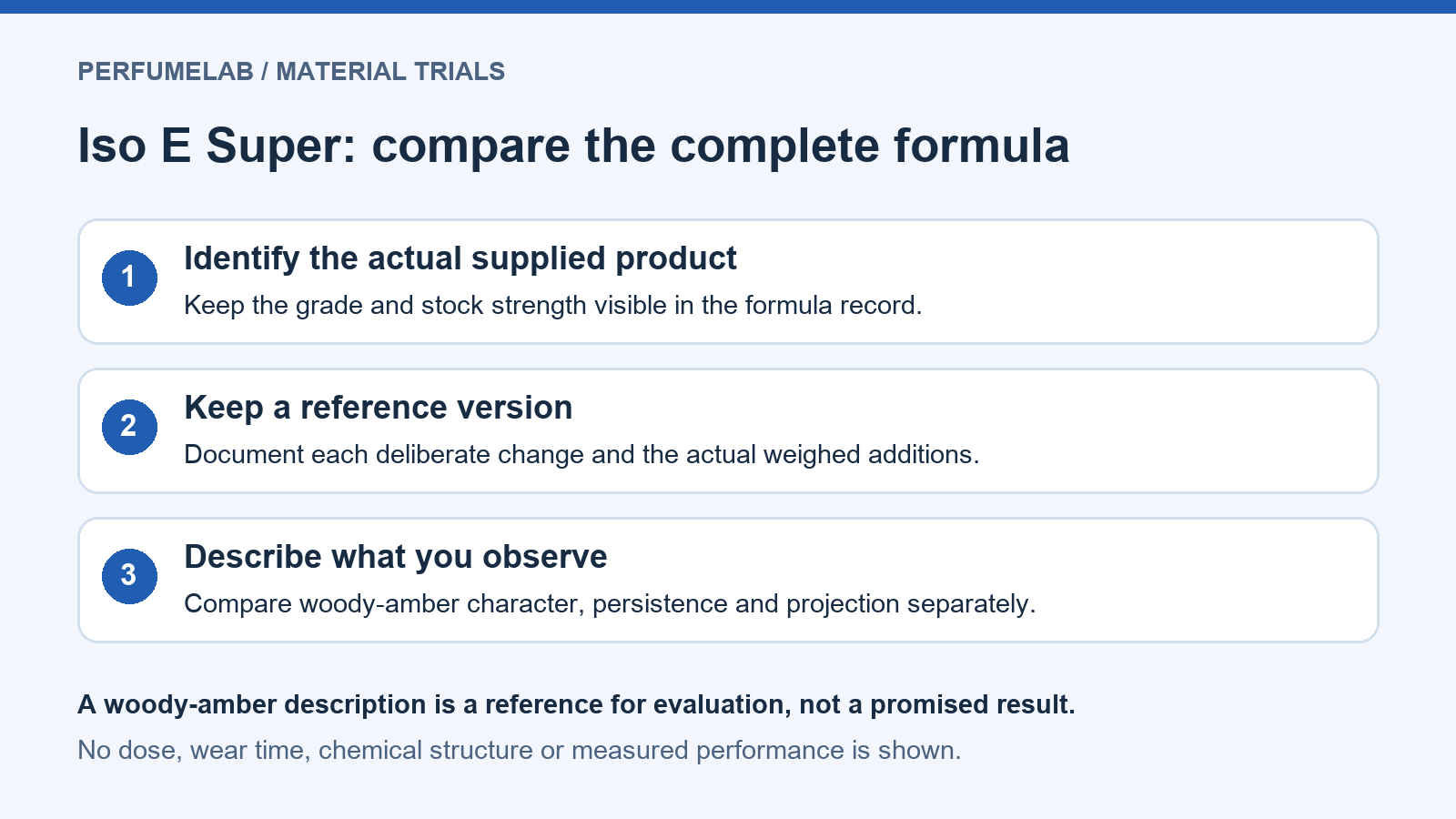
Choose trial levels using the exact product’s current technical documentation and the assessment of the intended finished product. Keep a reference formula, then make a small series of labelled variations. Record the change in Iso E Super and what you reduced to keep the formula total constant.
Compare the versions at the same finished fragrance concentration. Use consistent blotters, application amounts, preparation intervals and evaluation conditions. Record your impressions at the same elapsed times. Do not apply undiluted materials or unassessed trials to skin.
Evaluate the result
Note whether the woody-amber character fits your brief, which other notes remain clear and whether the overall balance improves. Evaluate projection and persistence separately: check what is detectable at a consistent distance as well as what remains later. If the sample is difficult to detect, read why Iso E Super or Ambroxan can be hard to smell before increasing the amount.
IFF lists medium note impact at the top, heart and base. That description does not predict the wear time of your finished perfume. A persistent woody background also does not prove that the opening notes last longer. Choose the version whose observed development best fits your goal.
Keep the result reviewable
Save the supplier and product identity, stock strength, ingredient masses, formula version, final concentration and evaluation notes together. PerfumeLab can help you organise formulas by percentage and record concentrations and dilutions.
Explore PerfumeLab on the App Store.
Before use, check the applicable IFRA requirements, supplier information and regulations for the complete finished product. PerfumeLab’s IFRA information is for reference only and does not replace professional regulatory review or a product safety assessment.
[…] mass twice when calculating the formula. One physical addition can have several creative roles. The Iso E Super formulation guide explores that particular material without turning the pyramid into a dosage […]