
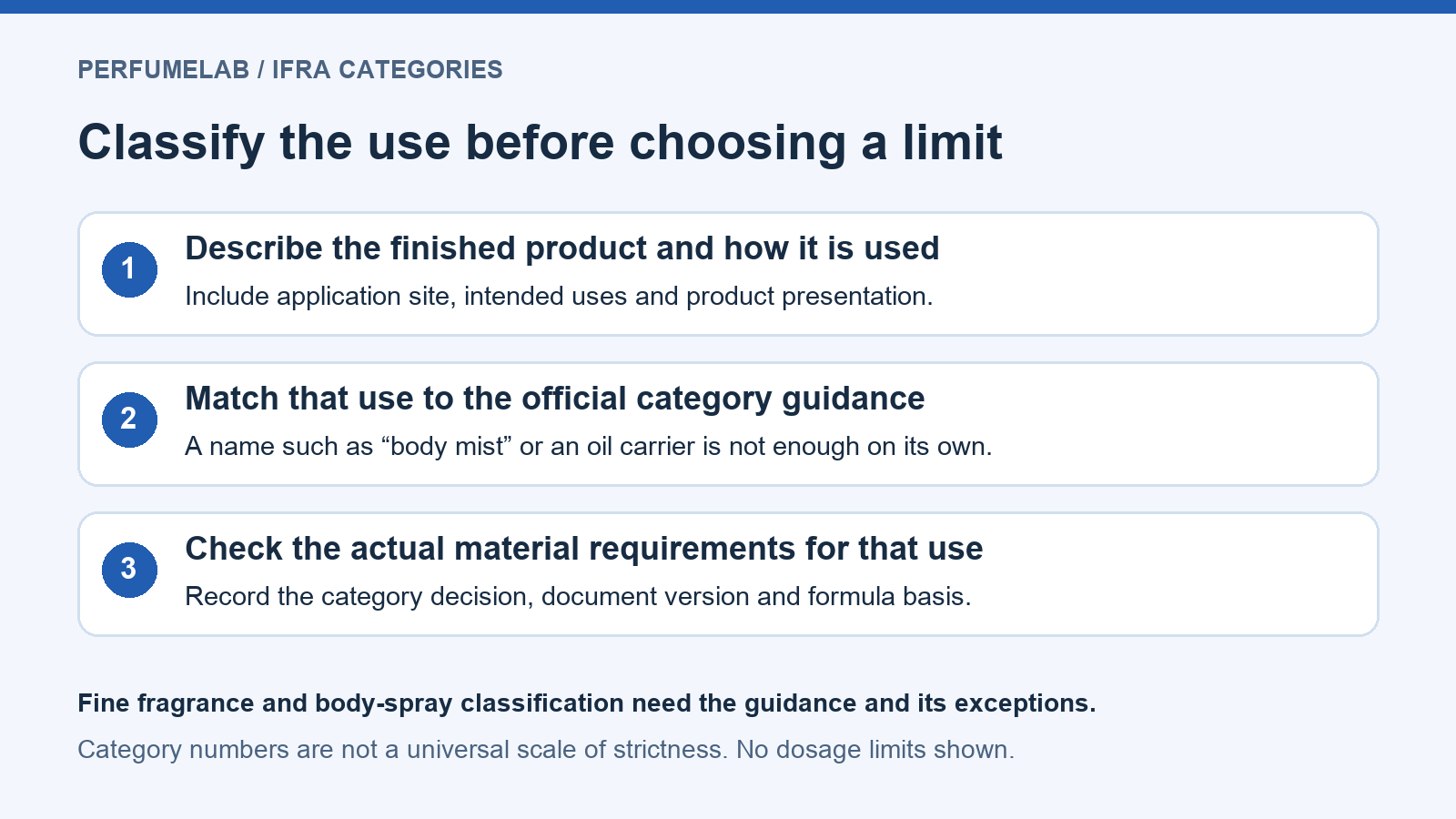

Fine-fragrance products are generally associated with IFRA Category 4, but “it contains perfume” is not enough information to classify every fragranced product. Intended use, foreseeable application and the official category guidance matter.
A category identifies the relevant exposure context. It is not an approval of a formula and does not establish a universal safe percentage for its ingredients.
Begin with the product brief
Write down how the finished product will be marketed and used: where it is applied, how it is dispensed, whether it remains on the skin, and any additional intended uses. Make the description specific enough for a supplier or reviewer to understand the actual product.
Then match that description to the current IFRA guidance. If the product does not fit clearly, resolve the classification with appropriate advice rather than selecting the most generous-looking column.
Category 4 and the body-mist qualification
Ordinary fine fragrance belongs in the Category 4 context. A hydroalcoholic base alone, however, does not establish that category for every spray.
Section 6.5.6 of the 51st Amendment guidance generally places body sprays and body mists in Category 2 because foreseeable use may include the underarm area. It allows Category 4 consideration where the product is clearly labelled against axillary/deodorant use, with consultation between the fragrance supplier and customer about the specific product.
This qualification matters. A blanket list placing all body sprays under Category 4 omits information a formulator needs to make the classification properly.
Alcohol-free does not decide the category either
The guidance also discusses attar-type products by their uses. The fact that a product uses an oil carrier does not automatically make it a different category from fine fragrance, or automatically keep it in the fine-fragrance category.
Describe the application first. A small-area personal fragrance and a product intended for broader body application can involve different exposure scenarios even when their ingredients or carrier names appear similar.
Do not rank categories as universally strict or permissive
A larger category number is not a general permission to use more material. Check the actual requirement for each relevant substance or mixture and the intended use. “No restriction” in a particular context is not a declaration that the complete product needs no further assessment.
For products with multiple intended uses, review the official multiple-use guidance rather than choosing one convenient category and ignoring the others.
Keep category and calculation connected
After classification, compare the appropriate requirements on the specified basis. For a quantitative ingredient restriction, that means calculating its relevant finished-product contribution, including applicable indirect sources. A supplier's fragrance-mixture conformity document is a different input from a raw-material composition line.
Record the category decision, product description, source documents, formula version and final use level together. Revisit the decision when the intended use or product presentation changes. For the arithmetic itself, use the companion IFRA calculation guide.
Sources
IFRA 51st Amendment guidance, especially sections 6.5.6, 6.5.16 and 6.5.17
PerfumeLab’s IFRA information is provided for reference only. Verify requirements against official IFRA documentation and applicable regulations; the app does not replace professional regulatory review.
[…] For the maths, use the finished-product contribution guide; for the intended use, see the IFRA category guide. […]