
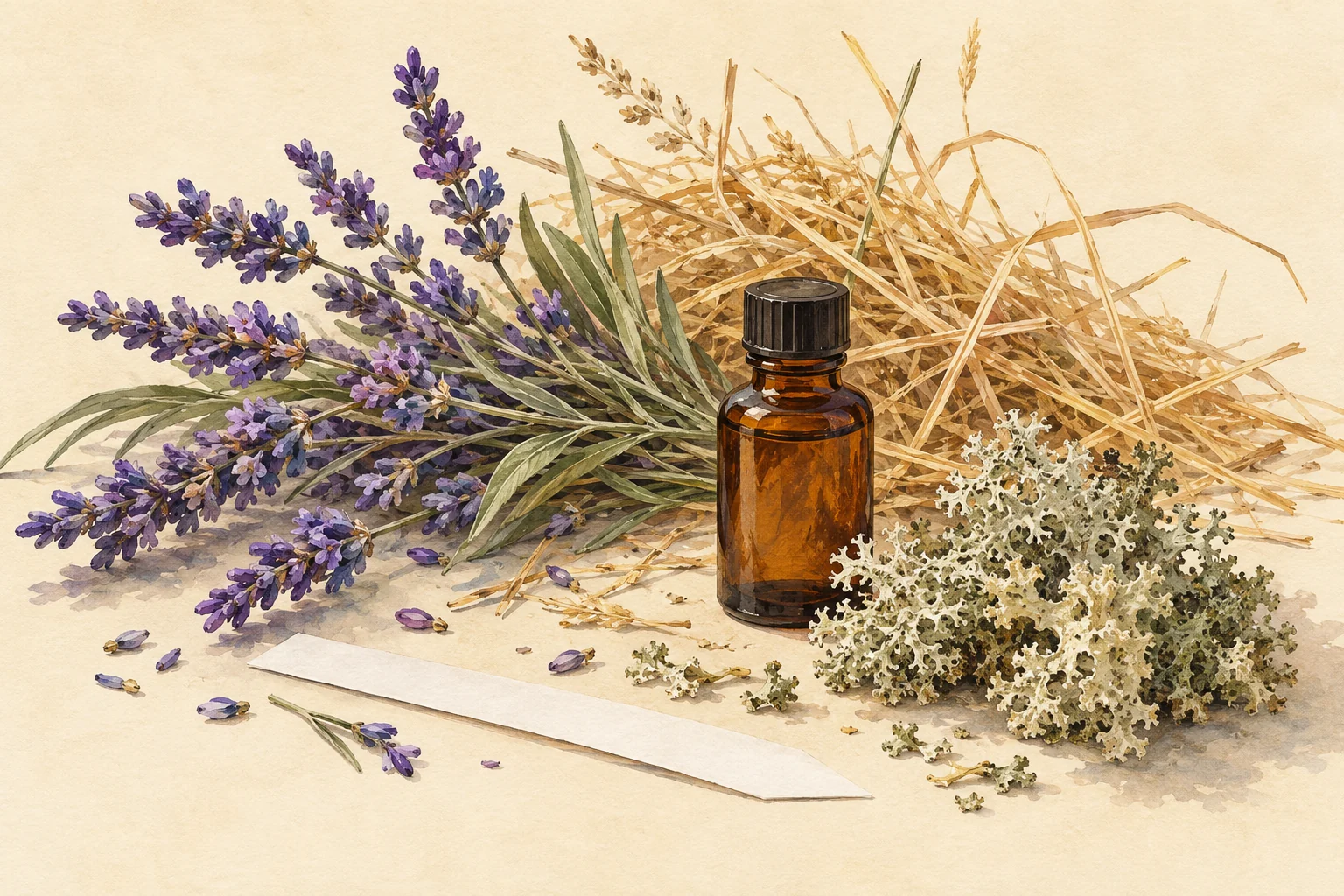

A fougère accord is a useful study in contrast: aromatic lavender character, the sweet hay-like aspect of coumarin and a mossy background. Thinking about those relationships helps explain the structure, but a three-part sketch should not be mistaken for a complete perfume or a fixed historical formula.
Professional classifications place those materials within a broader palette. Daniel Boubat’s Fragrances Classification presentation, slide 18, includes lavender, geranium and coumarin alongside bergamot, patchouli and oakmoss. The aim here is to understand the core contrast before adding more detail.
What each side of the accord asks you to notice
| Part of the study | Question to investigate | What to identify first |
|---|---|---|
| Aromatic or lavender character | Is the fresh aromatic impression clear enough for the intended style? | The exact lavender oil, supplied base or individually constructed lavender accord. |
| Coumarinic character | How much sweet hay-like character supports the aromatic side before the balance moves away from the brief? | Coumarin itself, a specified stock, or a different material contributing a related impression. |
| Mossy character | Does the background create useful contrast, or become the main feature? | The exact oakmoss extract, named aroma chemical or proprietary moss replacer. |
The questions are a study framework, not reported test results. For coumarin’s material character, Perfumers Apprentice describes a warm, sweet, herbaceous profile with a hay-like aspect in dilution. Your observations should still use the words you actually perceive.
A familiar example, without treating its note list as a formula
Houbigant’s description of its current Fougère Royale brings together bergamot and lavender, a geranium-led floral-spicy heart, and a mossy, patchouli and coumarinic background. It illustrates how the family extends beyond a small teaching accord.
That description does not reveal ingredient quantities, and the current fragrance is described as a reworked version of the historic composition. Use it to understand an olfactory direction, not to infer a recipe. Our guide to ingredient lists and formulas explains a related distinction.
Choose one version of each material role
Before comparing ratios, decide what the names in your formula mean. “Lavender”, “tonka” and “moss” are not sufficiently precise input names. Record the supplier, full product name, grade, any dilution and its carrier. For natural materials, keep the supplied botanical and extraction information with the record.
If a formula specifies a lavender oil, replacing it with your own linalool/linalyl acetate blend creates a new version. Those two materials can be relevant to studying a lavender direction, but their names do not establish equivalence to a complete oil. See linalool vs linalyl acetate.
Similarly, tonka bean absolute contributes more than a quantity of coumarin. Do not calculate a substitution from the word “tonka” alone. The exact supplied material and its composition matter; coumarin vs tonka bean absolute covers that comparison.
Oakmoss and a moss replacer create different studies
A natural oakmoss extract, Veramoss and a proprietary oakmoss replacer are distinct inputs. For example, IFF’s Veramoss product profile identifies a particular aroma chemical with a mossy character. A similar odour direction is a reason to compare materials, not a conversion factor between them.
If you want to investigate a replacer, keep the original reference and identify the new product in a separate formula. Establish suitable evaluation conditions for each. Matching their bottle weights or stock percentages does not prove that you have matched their perceived intensity, composition or suitability for use.
Oakmoss also has specific restrictions and specifications. “Low atranol” is not permission to use any amount. Consult the official oakmoss Standard and verify the current requirements for the exact material and intended finished product. A composition exercise should not rely on an old forum percentage or an abbreviated bottle label.
Study the aromatic-to-coumarinic balance first
Choose a documented reference study with suitable preparation and evaluation instructions. Follow the material suppliers’ handling requirements, use appropriate ventilation and protection, keep flammable solvents away from ignition sources and keep unassessed trials off skin. Use suitable smelling-strip evaluation rather than smelling from stock bottles. Where the preparation is incomplete, begin by reading and planning the comparison.
A focused first question might be: “Can I retain the aromatic character while making the sweet hay-like aspect less prominent?” This is an example of a brief, not a claim that a particular ratio will achieve it.
- Keep the reference unchanged. Give it a version identifier and preserve its complete quantities.
- Plan one exchange between the aromatic and coumarinic contributions while leaving the chosen moss material unchanged. Record both sides of the exchange.
- If stocks have different strengths, calculate their active-material and carrier contributions before treating the trial as a simple ratio change.
- Compare at the same evaluation concentration, sample age, application method and elapsed observation points.
- Write separate observations for aromatic character, sweetness and mossy character, followed by an overall judgement against the brief.
An increase and a decrease in a fixed-total formula together define the experiment. “Less coumarin” is an incomplete record if you cannot say what replaced it. For the arithmetic, see active material in stocks; for the comparison record, see comparing formula trials.
Then ask whether the mossy contrast is doing useful work
Once you can explain your preferred aromatic/coumarinic balance, hold their relative relationship steady for a separate moss-focused comparison. Define how any change is balanced in the total formula and account for the carrier. This second study asks about the role of the background rather than changing the whole palette at once.
| What you notice | What to investigate next |
|---|---|
| The sweet aspect dominates the intended freshness. | Revisit the aromatic/coumarinic comparison before adding another fresh material. |
| The mossy character becomes the main subject. | Check the exact product, stock and quantity, then consider a separate lower-contribution version. |
| The accord is clear alone but disappears in a larger perfume. | Compare it inside that complete formula. More accord changes every component it contains. |
| An extra material makes the blend more attractive but less recognisable as the intended fougère. | Decide whether to keep the original brief or deliberately change direction; record that choice. |
None of these observations identifies a fault automatically. The goal is a decision you can defend from a comparison, including the decision that your first version better fits the brief.
When to add bergamot, geranium or other detail
Expand the palette when you can name what the simpler study lacks. A citrus opening, a more floral centre or a woodier background is a clearer objective than “make it more professional”. Choose one objective and keep a version without the addition.
If the next material is bergamot, record the exact quality instead of treating expressed, FCF and other designations as interchangeable. See the bergamot specification guide. Review the complete formula’s relevant contributions and requirements rather than assessing an added material in isolation.
From a learning accord to a larger formula
You do not need to finish a perfume to finish this exercise. A useful outcome is being able to describe the chosen aromatic material, explain the sweet/mossy balance and identify the next question. Keep the study separate from its later use in a complete composition; our accord guide explains how those records connect.
PerfumeLab can help organise percentage-based formulas, batch sizes and dilutions. Keep your evaluation notes alongside the version record so a preferred ratio has a reason behind it. Explore PerfumeLab.
Before skin use or supply to others, the finished product needs appropriate safety and regulatory assessment. Restrictions apply to the intended application, and IFRA conformity does not replace that assessment. See IFRA’s official guidance.
[…] you were not initially paying attention to. For a study centred on coumarinic character, the fougère accord guide sets that role alongside lavender and mossy […]