
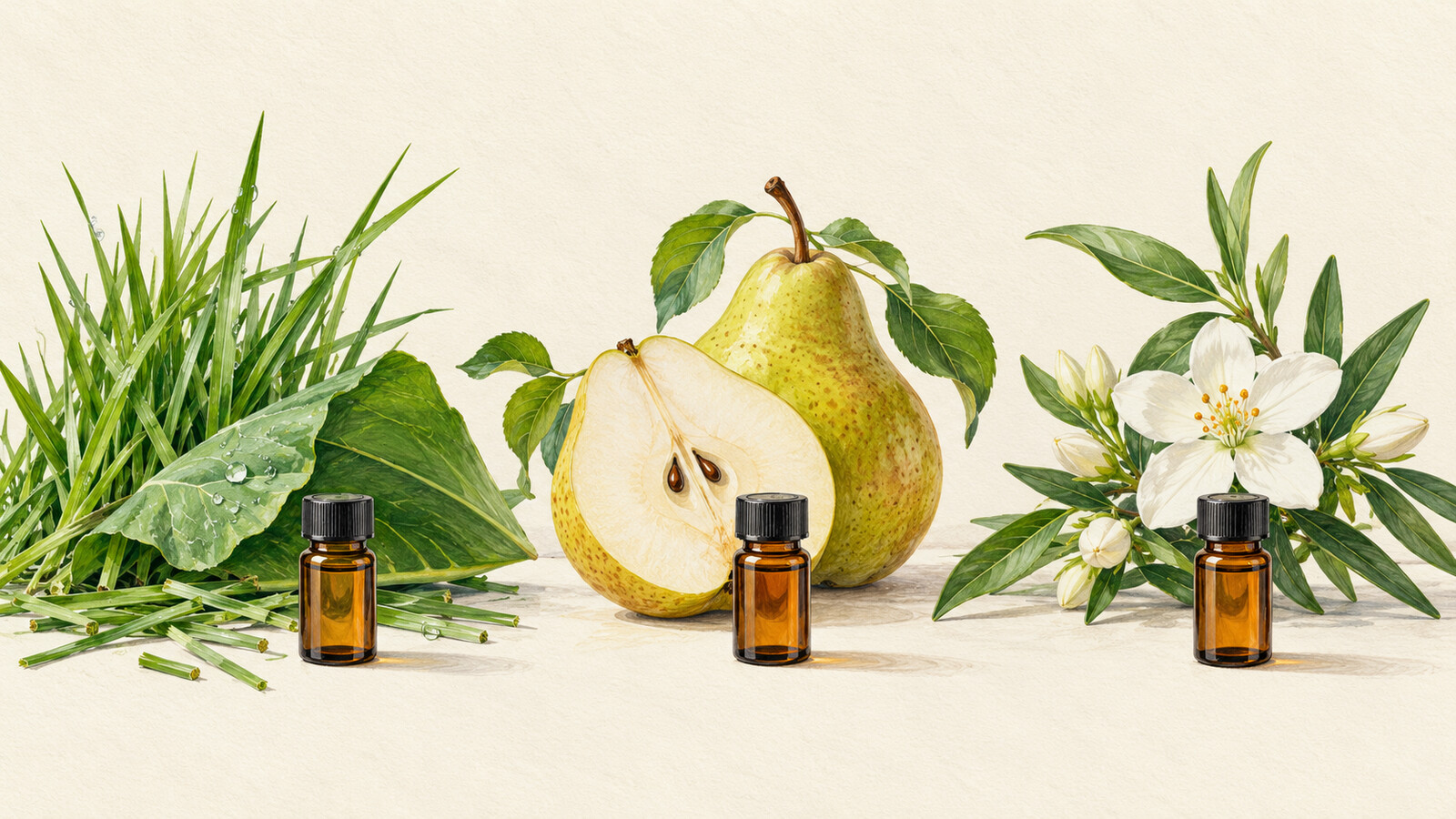

A green note can suggest cut grass, crisp fruit or leaves around a flower. Cis-3-hexenol, cis-3-hexenyl acetate and cis-3-hexenyl salicylate offer different ways into that territory: grassy freshness, fruity green sharpness and a more persistent floral-green effect. ZEON distinguishes those characters in its green-note ingredient range.
If a formula calls for one and you own another, treat the change as a new trial. The names are related, but they describe separate materials. Choosing between them starts with the effect you want, then follows that effect through the composition rather than judging only the first smell.
The quick comparison
| Material | Identity | Character to investigate |
|---|---|---|
| Cis-3-hexenol Also called leaf alcohol | CAS 928-96-1 An alcohol | Fresh grass and leafy green impact |
| Cis-3-hexenyl acetate | CAS 3681-71-8 An acetate ester | Sharper fruity green character |
| Cis-3-hexenyl salicylate | CAS 65405-77-8 A salicylate ester | Floral green character with a balsamic aspect |
The character descriptions follow ZEON’s range overview. The identity references are NHU’s cis-3-hexenol and cis-3-hexenyl acetate listings, and IFF’s Hexenyl Salicylate CIS-3 page. They are starting descriptions, not results from a PerfumeLab comparison.
Cis-3-hexenol: start with the grassy accent
ZEON describes leaf alcohol as intensely green and grassy, with a fresh effect in the top note. It specifically mentions its use in delicate floral fragrances such as muguet and lilac. That makes it a useful candidate to investigate when the missing detail is a recognisable leafy accent around a flower. ZEON: cis-3-hexenol.
A practical question for a trial is: does this addition make the floral idea feel more leafy, or does the grass impression become the main subject? Write down that distinction. “More green” alone will not tell you whether the change helped the perfume.
The word alcohol identifies the material’s chemical family here. Leaf alcohol is a fragrance ingredient, not another name for the ethanol used as a perfume carrier. For another example of why an alcohol and its related ester need separate records, see linalool vs linalyl acetate.
Cis-3-hexenyl acetate: explore the fruity side of green
The acetate offers a different question: would a fruit-associated green opening suit the idea better than an overtly grassy accent? ZEON’s aroma chemicals catalogue associates it with apple and green banana, and describes its role in fresh top notes. NHU also lists it for top-note use in fruity fragrances in its product description.
Use those associations to guide what you look for, not to dictate what you must smell. In a floral trial, for example, ask whether the acetate creates a useful fresh-fruit accent or takes attention away from the flower. In a fruit accord, ask whether the green aspect gives the intended contrast or makes the fruit seem less ripe than you wanted. These are proposed evaluation questions, not tested formula claims.
Cis-3-hexenyl salicylate: follow the floral green effect later
IFF describes its Hexenyl Salicylate CIS-3 as a mild but tenacious green material and highlights its usefulness when reconstructing floral absolutes. It lists substantivity above 48 hours. That combination matters: a less forceful initial impression does not necessarily mean a less persistent contribution. IFF ingredient compendium.
This makes the salicylate a candidate when your question is about keeping a floral-green aspect in the later evaluation, rather than simply making the opening greener. Compare the character as well as the remaining intensity. A lasting trace is only useful if it belongs in the composition.
Do not turn supplier tenacity into a wear-time promise
ZEON’s catalogue gives an instructive comparison on smelling blotters: one day for cis-3-hexenol, two to three hours for the acetate, and more than two weeks for the salicylate. Those are the manufacturer’s published blotter observations for its products, not measurements of your formula or a promise of skin longevity. The catalogue does not supply a complete evaluation protocol alongside those entries. ZEON catalogue, printed pages 9, 11 and 13.
The useful lesson is to keep checking after the opening. Avoid building an evaporation ranking from the words “alcohol” and “ester” alone. Also avoid treating IFF’s substantivity figure and ZEON’s blotter result as a controlled comparison between suppliers: the published descriptions do not establish a shared test method.
Keep the full name, grade and stock strength
Do not save all three under “cis-3” or “green material”. Keep the full chemical name, supplier, product code, grade and lot with the ingredient record. The cis-3 part also belongs in the name; shortening it to “hexenyl acetate” removes useful identity information.
Purity and stock dilution answer different questions. For example, NHU lists a purity of at least 98.0% for its cis-3-hexenyl acetate, product code XLTZ01. That describes the supplied product specification; it does not say that someone has prepared a 98% evaluation stock in a solvent. Record any stock you prepare separately, including its solvent and concentration basis. NHU: product XLTZ01.
A grade or source change should stay visible even when the main chemical name is unchanged. The supplier description is orientation; your observations belong beside the exact bottle and preparation you evaluated. A material smell reference gives those observations a useful home.
Set up a comparison that answers one question
- Choose the job. Write a short brief such as “add a leafy accent to this floral accord” or “keep a green floral aspect at the later observation”.
- Keep a control. Preserve the original formula and compare it with separately identified variants. Start with one candidate per variant before exploring combinations.
- Document what changes. Record actual masses, stock strengths and how you balanced the formula total. Equal stock mass is not equal material mass when the stock strengths differ; equal material mass does not guarantee equal perceived strength.
- Use consistent conditions. Keep preparation age, evaluation medium and observation times comparable. Follow the handling guidance for each exact supplied product. Use blotters for this comparison, not skin; dilution alone does not establish skin safety.
- Describe before deciding. Note grassiness, fruit character, floral balance and what remains later. Then decide which variant best answers the brief.
No single dosage or evaluation dilution is prescribed here. Select appropriate conditions from the material’s current documentation and your evaluation procedure. These are bench-study ideas, not ready-to-wear formulas. For the record-keeping side, use the guide to comparing perfume formula trials.
Keep the green idea and the formula together
Choose the material for the contribution you want to investigate: cis-3-hexenol for the grassy accent, the acetate for a fruity green direction, or the salicylate for a floral-green effect worth following later. Then let the actual comparison decide what belongs in your perfume.
PerfumeLab lets you organise formulas by percentage and work with batch sizes and dilutions. Keep a clearly named formula for each variation so the next trial starts from a record rather than a guess. Explore PerfumeLab on the App Store.
[…] green material. If your question concerns freshly cut-grass effects rather than violet foliage, the comparison of cis-3-hexenol and its related esters is a better starting […]