
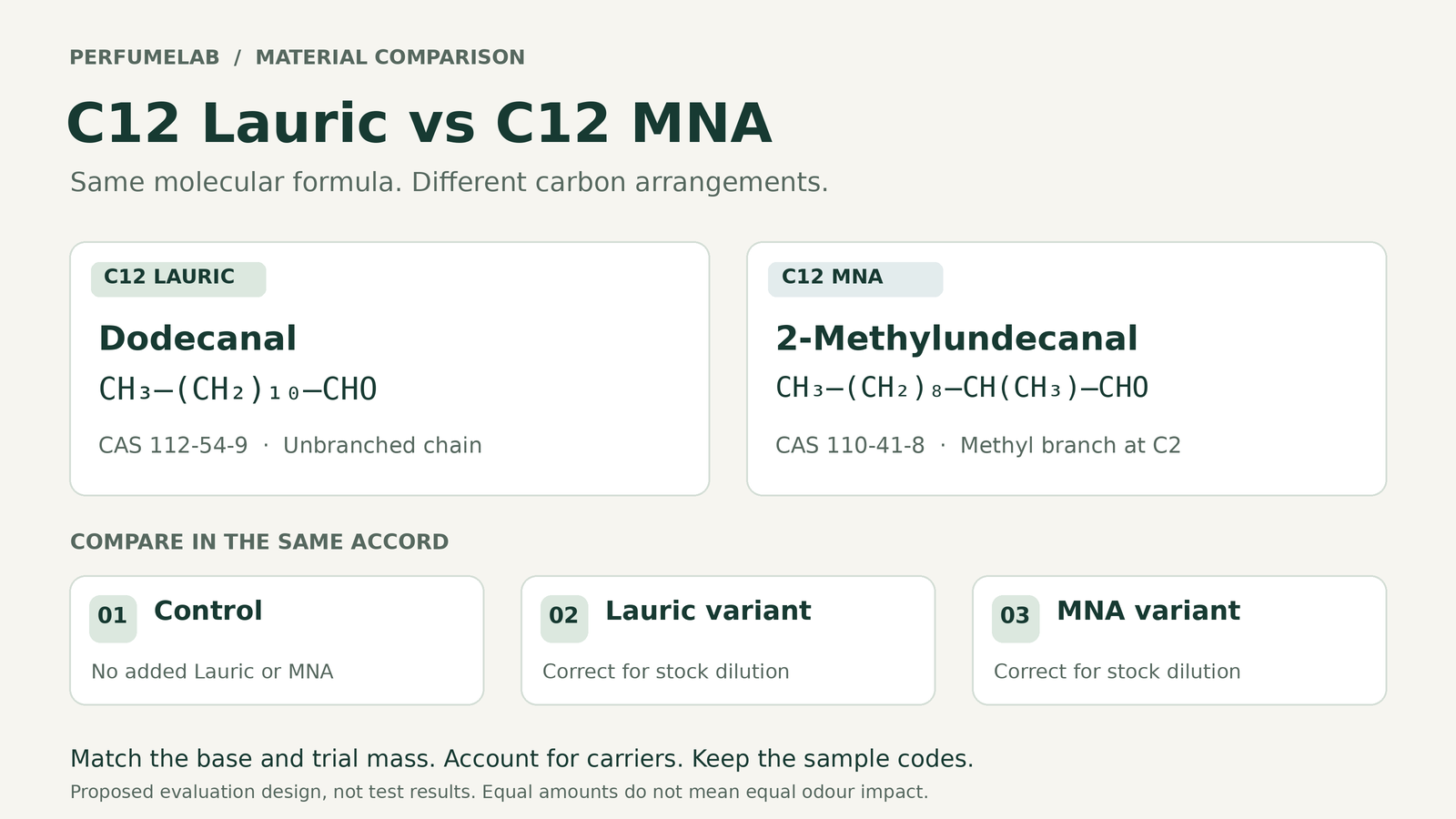

A bottle labelled “Aldehyde C12” needs a closer look. C12 Lauric is dodecanal; C12 MNA is 2-methylundecanal. They share a molecular formula, but they are different ingredients. The distinction matters when you buy a material, copy a formula or try to change an aldehydic effect. Sigma-Aldrich’s Lauric listing and dsm-firmenich’s MNA listing identify the two separately.
The useful comparison is not simply which one smells stronger. You want to know what each does to the same formula, at a documented amount, using bottles whose grade and dilution you understand. Here is how to make that comparison without treating the names as interchangeable.
C12 Lauric and C12 MNA at a glance
| Detail | Aldehyde C12 Lauric | Aldehyde C12 MNA |
|---|---|---|
| Chemical identity | Dodecanal, also sold as lauric or lauryl aldehyde | 2-Methylundecanal; MNA refers to methyl nonyl acetaldehyde |
| CAS number | 112-54-9 | 110-41-8 |
| Carbon arrangement | Unbranched twelve-carbon chain | Eleven-carbon main chain with a methyl branch at carbon 2 |
| Supplier description to investigate | Kao describes a waxy, herbal and clean floral character | dsm-firmenich describes fresh citrus and ozonic qualities, with ambery and incense nuances |
| First labelling check | Confirm Lauric or Lauryl, CAS number, supplier grade and any dilution | Confirm MNA, CAS number, supplier grade and any dilution |
Identity and odour references: Kao’s C12 Lauryl specification, dsm-firmenich’s MNA product page and NIST’s 2-methylundecanal record. Both molecules have the formula C12H24O. Their different connectivity makes them structural isomers, not two grades of the same molecule.
What should you look for when smelling them?
For Lauric, a useful starting question is whether it adds a waxy or clean floral impression to your accord. Kao’s description points in that direction. Associate Allied Chemicals Europe instead emphasises an assertive, fatty aldehydic character. These are supplier descriptions of their products, not results from a side-by-side test. Kao specification; AAC Europe’s C12 Lauric page.
For MNA, investigate whether the citrus freshness and incense-related character described by dsm-firmenich are useful in your formula. The manufacturer also positions it as a material that adds brightness and a lasting clean impression. That gives you a hypothesis to test, rather than a promise that every floral, citrus or woody accord will improve with it. dsm-firmenich’s MNA description.
Write your own observations before comparing them with those descriptions. “The floral part became easier to pick out” is more useful than copying “bright” into a notebook. So is “the waxy impression covered the citrus”. Record the result even when it does not match the description you expected.
Check the grade, dilution and carrier before comparing
The chemical name does not tell you everything about the bottle. Kao’s published C12 Lauryl sheet specifies a minimum purity of 97% by GLC. Sigma-Aldrich’s W261505 Lauric product is listed at an assay of at least 95% and contains α-tocopherol as a stabiliser. These are product-specific specifications, not competing definitions of dodecanal. Obtain the current documents for your supplier and batch rather than assuming that either example describes your purchase. Kao specification; Sigma-Aldrich W261505.
- Identity: record the full name and CAS number. Do not shorten both ingredients to “C12” in a formula.
- Commercial grade: record the supplier, product code, batch and stated purity or assay. “Neat” describes the absence of a deliberate stock dilution; it does not guarantee analytical purity of 100%.
- Stock dilution: if a seller or your own label gives a percentage, establish what it means. A percentage by weight and one by volume are not the same specification.
- Carrier: write down the actual solvent or carrier, such as ethanol or dipropylene glycol (DPG), if present. A stabiliser in a raw material is different from a carrier used to make a stock solution.
- Condition: record when the bottle and stock were prepared or opened, and follow that product’s storage instructions. Resolve an unexplained change in appearance or odour before relying on it for a comparison.
Equal weights of two stocks represent equal nominal amounts of supplied raw material only if both have the same raw-material concentration by mass. If you need help with that distinction, see how to account for material in stock dilutions. Keep stock concentration separate from the supplier’s assay: a minimum GLC purity specification is not an exact, batch-specific mass fraction.
A controlled comparison in one accord
The following is a proposed evaluation plan, not a tested formula or a recommended dose. Choose suitable evaluation concentrations from your supplier’s current guidance and your handling assessment. Use blotters for this exercise, not skin; consult the safety data for the exact products and solvents you will handle.
1. Set one question
Choose a simple accord you already understand that contains neither Lauric nor MNA. For example, ask: “Can either aldehyde make the opening feel cleaner without hiding the floral character?” Decide what would count as a useful change before mixing. Avoid changing the floral materials or adding another new ingredient during this comparison.
2. Compare the materials separately first
Evaluate appropriately prepared samples on separate, clearly labelled blotters, alongside the carrier alone. Keep the application method consistent. Note the initial character and what remains later. This gives you a reference for recognising each material when you return to the accord.
3. Prepare a control and two variants
| Trial | Purpose | Change from the shared base |
|---|---|---|
| Control | Shows the accord without either aldehyde | No added Lauric or MNA; use carrier to make up the target trial mass |
| Lauric | Tests your C12 Lauric product | Add the documented amount, correcting for its stock dilution |
| MNA | Tests your C12 MNA product | Use the same nominal raw-material amount, correcting for its stock dilution |
Keep the quantities of all other fragrance ingredients and the total trial mass constant. Account for the carrier introduced by each stock. Use a common suitable carrier where possible; if the supplied stocks use different carriers, match those carrier contributions across the aldehyde variants or record the difference as a limitation. Document the control’s carrier composition too, so any carrier-related difference remains visible.
This first pass compares equal nominal masses of the supplied raw materials, not necessarily equal masses of chemically pure aldehyde. A purity-corrected comparison needs suitable batch data. It also does not compare equal perceived strength: one variant may be much more noticeable at the chosen level. That observation is a reason for a second trial, not a universal potency ranking.
4. Smell at the same times and keep the names hidden
Give the samples neutral codes and keep the key separate. Apply them to the same type of blotter in the same way. An example note-taking schedule is immediately after application, 15 minutes, one hour, four hours and the following day. Those are suggested observation points, not claims about either material’s lifespan. Take breaks between comparisons and record each sample before revealing its identity.
At each point, answer three questions: what changed from the control, did it help the brief, and did it introduce anything unwanted? “More noticeable” and “better” should be separate entries. Repeat the comparison before relying on a small difference.
5. Adjust each material on its own merits
If one variant has an interesting character but dominates the accord, make a lower-level version within the applicable guidance. Keep the control and original trial for comparison. Optimising each material separately answers a more useful second question: which version best serves this formula?
Can you substitute Lauric for MNA?
You can investigate it as a reformulation, but a same-weight substitution should not be treated as an equivalent replacement. First correct for any difference in stock dilution. Then compare the changed formula with the original and a no-added-aldehyde control, using the same evaluation method.
If the formula only says “Aldehyde C12”, ask its author or supplier which material and stock were intended. A number without Lauric, MNA or a verified CAS identity leaves a real ambiguity. Guessing the ingredient first and adjusting the amount later makes the result harder to interpret.
Keep a record you can repeat
Save the full ingredient names, supplier grades, stock strengths, carriers, weighed amounts, batch sizes and sample codes with each version. Keep the observations and the next question beside those records. In PerfumeLab for iPhone and iPad, you can organise your formulas and ingredients; use distinct names for the control, Lauric and MNA versions so the comparison stays clear.
For the MNA side of the exercise, continue with our Aldehyde C12 MNA formulation guide. The aim is a repeatable decision about your own accord, rather than a rule that one C12 aldehyde is always the better choice.
This is an educational comparison. A blotter study does not establish a safe finished-product concentration. Check current supplier documentation, applicable IFRA Standards and the requirements for your intended product before any skin use or sale.