

A good first perfume accord study leaves you with something you can explain: what you expected, what you noticed and what you want to test next. Choose one small study and stay with it long enough to understand the materials, rather than collecting recipes you have not evaluated.
PerfumeLab’s Fragrance U includes lessons, material guides and interactive Accord Lab studies, introduced in version 2.16. The learning path below is a study plan to use alongside those resources, not an in-app course sequence. See the current PerfumeLab App Store listing.
What are you trying to learn from an accord?
An accord brings several scented components into a recognisable combined impression. Studying one helps you connect individual materials with the character they create together. The Society of Scent’s perfumery glossary describes this as a unified odour impression.
For a first study, use a narrow question: “Which part of this accord gives it the character I recognise?” You do not need to create a finished perfume, reproduce a commercial fragrance or agree with every description in the lesson.
1. Choose one study and write a prediction
Start with one Accord Lab study available in your version of PerfumeLab. Prefer a study whose material identities and purpose you can follow. Read the explanation and consult the relevant material guides before deciding whether to do any physical work.
In a notebook, write the intended effect in one sentence. Then list the materials and give each a tentative role: main character, supporting facet or contrast. These are your working hypotheses, not rules. “I do not know yet” is more useful than copying a description you cannot explain.
If you do not own the materials, you can still complete this reading stage. Make a short list of unanswered questions. Do not substitute a similarly named ingredient just to finish the exercise.
2. Check the materials before opening a bottle
A digital example does not by itself establish a safe physical exercise. Before handling materials, identify the exact supplier product, grade, stock strength and solvent. Obtain its current safety data sheet and follow the supplier’s instructions for evaluation and handling. If the study lacks preparation details, keep it a reading exercise until you have suitable guidance.
The SDS explains hazards, safe handling and storage, exposure controls and protective equipment. Use it to plan ventilation, suitable protection, spill response and disposal; keep flammable solvents away from ignition sources. See OSHA’s guide to SDS contents. There is no single evaluation dilution that is appropriate for every material.
Keep this beginner exercise off skin. Do not taste materials or smell directly from stock bottles. Paper blotters provide a more controlled way to evaluate a material, as explained in Perfumers Apprentice’s scent-strip guidance. Blotters do not remove the need for safe handling.
3. Meet the materials before judging the blend
For a physical study supported by appropriate preparation instructions, evaluate the individual materials on separately labelled blotters. Keep wet ends apart and record the product, dilution, solvent and application time. Use a consistent application method and take breaks rather than repeatedly smelling an unclear sample.
Use ordinary words first. “Dry pencil shavings,” “sweet and powdery” or “green and sharp” are useful observations if that is what you perceive. Add an association, an intensity impression and a note about how the smell changes. Avoid filling every blank with the supplier’s vocabulary.
Return to the same labelled strips at recorded elapsed times. Choose practical checkpoints and use the same ones when you later compare trials. These are observation times, not a universal timetable for top, heart and base notes. For a fuller record, see how to build a smell reference for your materials.
4. Study the reference accord before changing it
If your chosen lesson provides a complete, suitable physical preparation, follow that reference before improvising. Record the actual quantities and all supplied dilutions. A stock solution and the same-named neat material are different inputs; replacing one with the other changes what you make.
Compare the accord with your individual-material observations. Ask: Which character is easiest to recognise? Which material is harder to pick out? Has a new impression emerged? Record observations separately from explanations. “The blend seems softer” is an observation; “material B causes the softness” is a hypothesis that still needs testing.
A useful first result may be an unanswered question. Do not add more ingredients simply because the reference is unfamiliar. Check material identities, preparation and records before assuming the formula needs improvement.
5. Plan one comparison you can interpret
Once you understand the reference, choose one change suggested by the lesson or a qualified tutor. Write down your prediction before making it. Preserve the reference and give the variation a separate identifier.
Changing one ingredient in a fixed-total formula also requires a balancing change. Record exactly what increased and what decreased; otherwise, “more of material A” hides part of the experiment. Keep evaluation concentration, solvent, sample age, blotters and observation times comparable. Our guide to comparing two perfume formula trials covers the recordkeeping.
If you cannot yet prepare and assess a suitable variation, stop at the prediction. Planning a clear comparison is worthwhile learning. An app’s description or analysis is not a substitute for smelling the actual preparation.
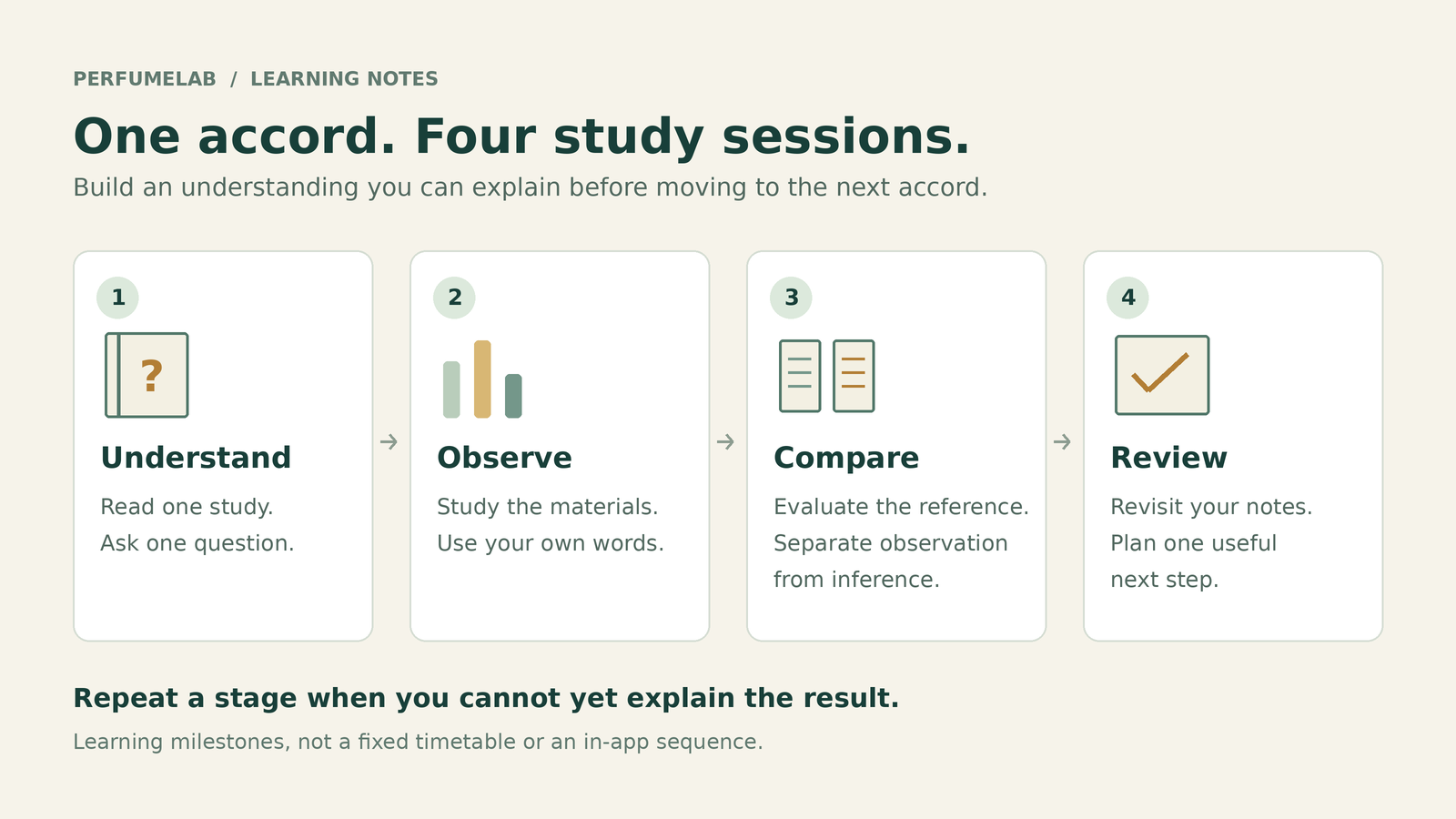
A learning path for your next four sessions
- Session 1: Understand. Read one study and its material information. Finish with one question and a list of anything you need to verify.
- Session 2: Observe. When suitable physical guidance and materials are available, build individual-material observations. Finish with descriptions in your own words.
- Session 3: Compare. Evaluate the reference accord against those observations. Finish with a distinction between what you noticed and what you inferred.
- Session 4: Review. Revisit the reference, then plan or assess one documented variation. Finish with a reason to keep, reject or repeat it.
These are milestones, not a four-day deadline. Repeat a stage when you cannot explain its result. Move to another accord when you can identify the exact inputs, describe the reference and name a useful next question.
Keep a short study record
- Study title, source and date.
- Question and prediction.
- Exact material identities, supplier products, stock strengths and solvents.
- Reference and variation identifiers, preparation details and actual quantities, if made.
- Observation times, what you perceived and what remains uncertain.
- Next action: repeat, investigate one material or test a clearly specified change.
Use a notebook alongside the app for these observations. PerfumeLab supports percentage-based formulas, batch sizes, concentrations and dilutions, with formula sheets exportable as PDFs. Keep the experimental record clear enough that you can return to the same question later.
Ready to begin? Explore PerfumeLab and choose one Fragrance U lesson or Accord Lab study. Start with a question you genuinely want to answer.
Before any skin use or supply to others, the complete product needs appropriate safety and regulatory assessment. IFRA restrictions concern the intended finished-product use; a certificate of conformity does not replace a safety assessment. PerfumeLab’s IFRA information is reference-only. Verify official requirements and applicable regulations, as explained in IFRA’s guidance on using the Standards.