
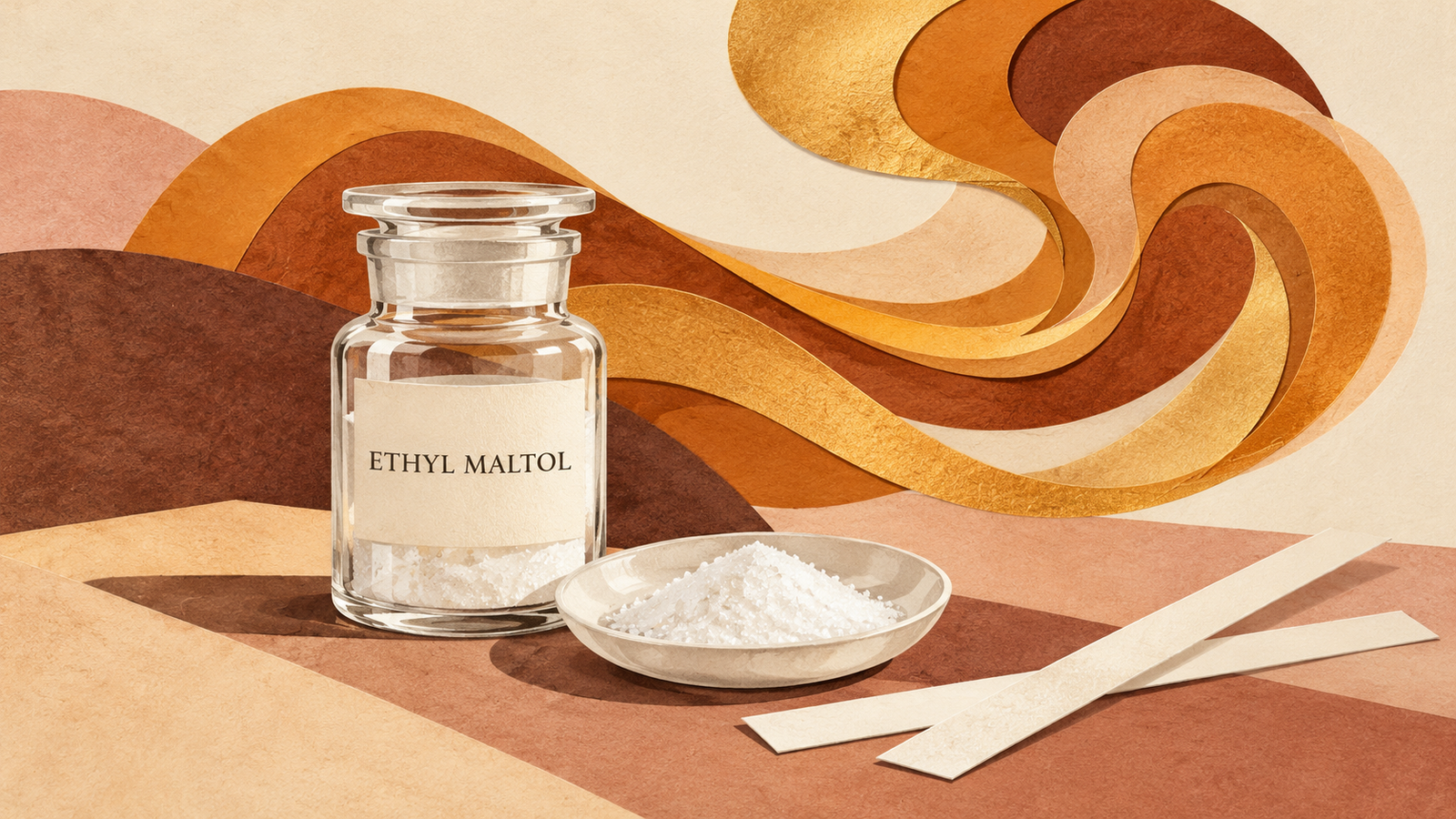

Ethyl Maltol can be a deliberate sweet accent, but “sweetener” is too vague a name for a formula line. Identify the material and its supplied form so the effect you evaluate can be connected to what you weighed.
Start with a specific product description
Advanced Biotech’s specification for Natural Ethyl Maltol, product 1905, describes a crystalline powder with a caramel odour. It identifies CAS 4940-11-8. That is product-specific information; the word “Natural” also belongs to that supplied grade’s documentation rather than every product sold as Ethyl Maltol.
A supplier description gives you something concrete to look for during evaluation in the accord. Ask whether the change reads as caramel, a more general sweetness, or a character you did not intend. Do not replace those observations with a fixed claim that a particular percentage always produces the same effect.
Count the material inside the stock
If the formula uses a stock, include the carrier and documented strength in its name. The weighed stock is not all Ethyl Maltol: multiply its mass by the stock’s mass fraction to find the named-material contribution.
That distinction matters when comparing two versions. Changing from crystals to a prepared stock while retaining the same numeric line changes the amount of Ethyl Maltol as well as adding carrier. Recalculate the complete formula before judging the sensory difference.
Keep the comparison focused
Preserve the reference accord and choose one question—for example, whether a sweet accent is still distinct from the floral part. Record the actual additions and evaluate both versions under the same conditions.
The Advanced Biotech sheet includes specific storage and solubility information. Use current technical and handling documents for your own grade before choosing a stock preparation; a food/flavour description or a familiar stock concentration does not by itself establish skin-product suitability.
For the maths, use the finished-product contribution guide; for the intended use, see the IFRA category guide.
PerfumeLab on the App Store helps you keep formula versions organised. Use its IFRA information as a reference alongside official documents and the assessment of your actual product.