
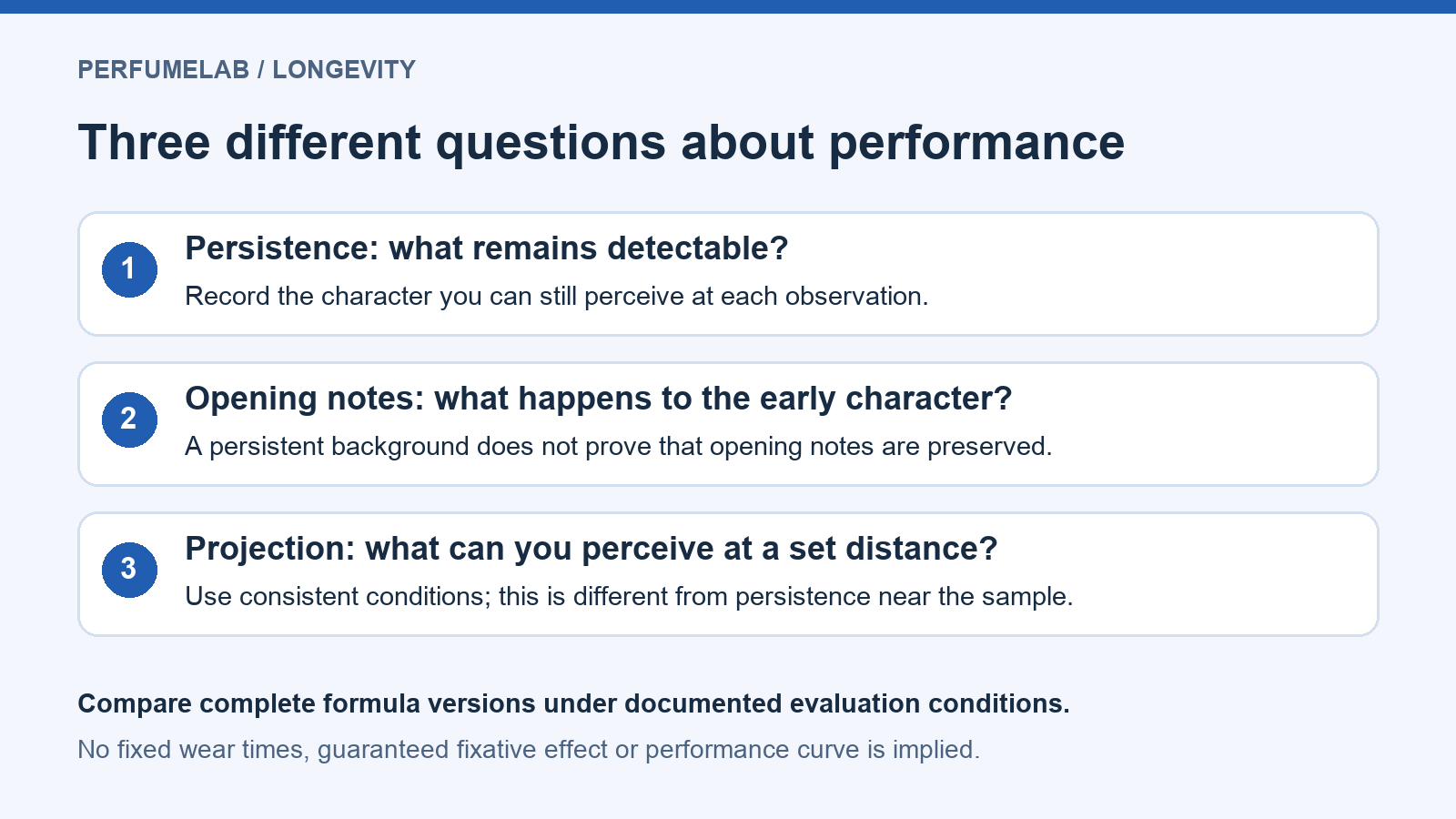

A perfume can make a strong first impression and then seem to fade sooner than you intended. Before changing the formula, define what you want to remain detectable and how you will compare the trials.
A persistent background odour, preservation of an opening note and noticeable projection are different goals. Record which one you are evaluating rather than treating them as a single performance score.
Volatility is one part of the picture
Research on fragrance evaporation examines both molecular properties and the conditions of application, including skin properties. A complete perfume cannot be assigned a reliable wear time from a simple list of top, heart and base notes.
Use those note labels to describe the composition, then evaluate its development under documented conditions. This article does not establish a universal number of minutes, hours or days for any material or perfume.
Evaluate persistent character in the complete formula
Changing the balance of materials may change what remains perceptible later. Whether that change improves the perfume depends on the intended character and the observations from the actual trial.
There is no verified professional-formula percentage or minimum proportion of base materials established here. Do not assume that adding more of a persistent material will preserve every other note or improve projection.
Compare defined concentrations without promising wear times
Changing concentration changes the mixture being evaluated. Prepare comparable, documented trials and record their actual concentrations and application conditions.
This article does not establish that doubling concentration produces a particular number of extra hours, or that a named perfume strength guarantees longevity.
Molecular properties and evaluation conditions
Molecular and skin properties can influence fragrance evaporation. Molecular weight alone is not a sufficient rule for predicting the wear time of a complete perfume.
Use appropriate material information and controlled evaluation of the actual composition, rather than treating a single molecular property as a guaranteed performance score.
Test a fixative claim in the complete formula
Research on controlled fragrance mixtures shows that ingredient interactions can change evaporation profiles. This does not establish that every material described as a fixative extends every other note in every formula.
Compare a documented original and revised formula under suitable consistent conditions. Record both the detectable character and the tested concentration; persistent background odour and preservation of a specific opening note are different observations.
PerfumeLab provides formula analysis, AI-assisted insights, and volatility, longevity and projection tools to help you explore formula structure and balance. These tools can inform your experiments; they do not guarantee a fragrance’s wear time, stability or performance. You can compare versions of a formula and use your own testing alongside the app’s analysis.
Sources
Study of molecular and skin properties in fragrance evaporation
Study of ingredient interactions in fragrance evaporation
PerfumeLab’s IFRA information is provided for reference only. Verify requirements against official IFRA documentation and applicable regulations; the app does not replace professional regulatory review.