
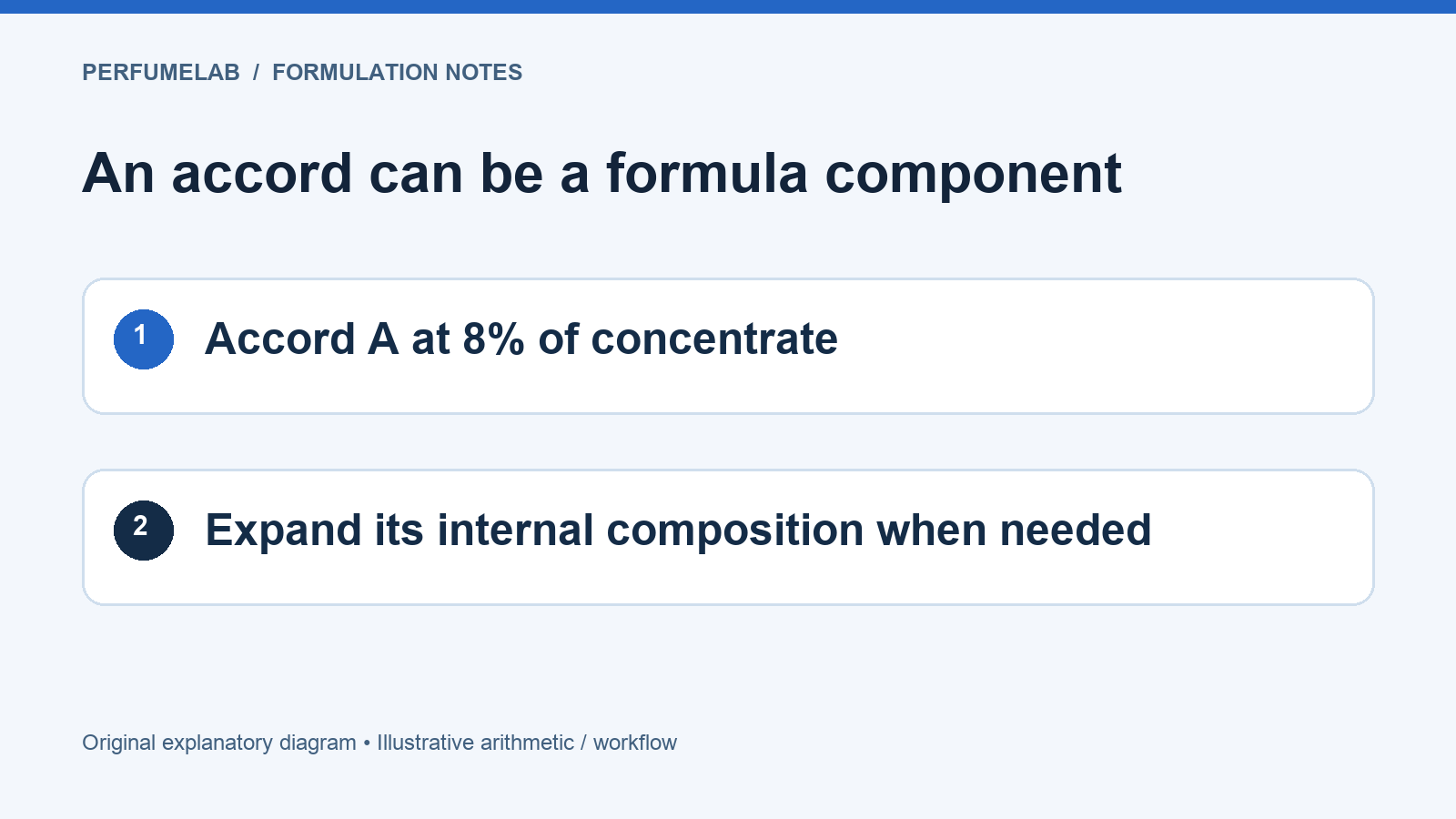

An accord is a blend studied or used for a particular effect. A perfume formula can contain that accord alongside other materials. The distinction becomes practical when you need to know what is actually inside the complete composition.
Treat the accord as a versioned mixture
Give the accord its own formula, strength basis and version. “Amber accord” is a creative description, not a sufficiently precise ingredient identity. If the accord changes, any perfume using it may change too.
Expand the blend when you need the detail
All percentages in this example are by mass. Imagine a fictional accord consisting of A at 60% and B at 40%. If you use that accord at 8% of a concentrate, it contributes 4.8% A and 3.2% B to the concentrate. If the same concentrate also contains A directly, add the contributions together when examining the complete composition.
Using that concentrate at 20% in a finished product gives 0.96% A and 0.64% B from the accord alone. These letters and numbers illustrate the arithmetic; they are not a perfume recipe or use limits.
Compare an accord in context
A blend that seems balanced by itself may behave differently inside a larger composition. Keep the first trial simple enough that you can identify what the accord contributes, then make a documented revision rather than repeatedly changing the master blend without version notes.
Preserve both views: the compact formula showing the accord as one line, and the expanded composition needed for detailed calculations. For a purchased proprietary base, obtain the appropriate supplier evidence rather than inventing an internal recipe. That lets you organise creatively without losing track of the information needed to understand the complete formula.