
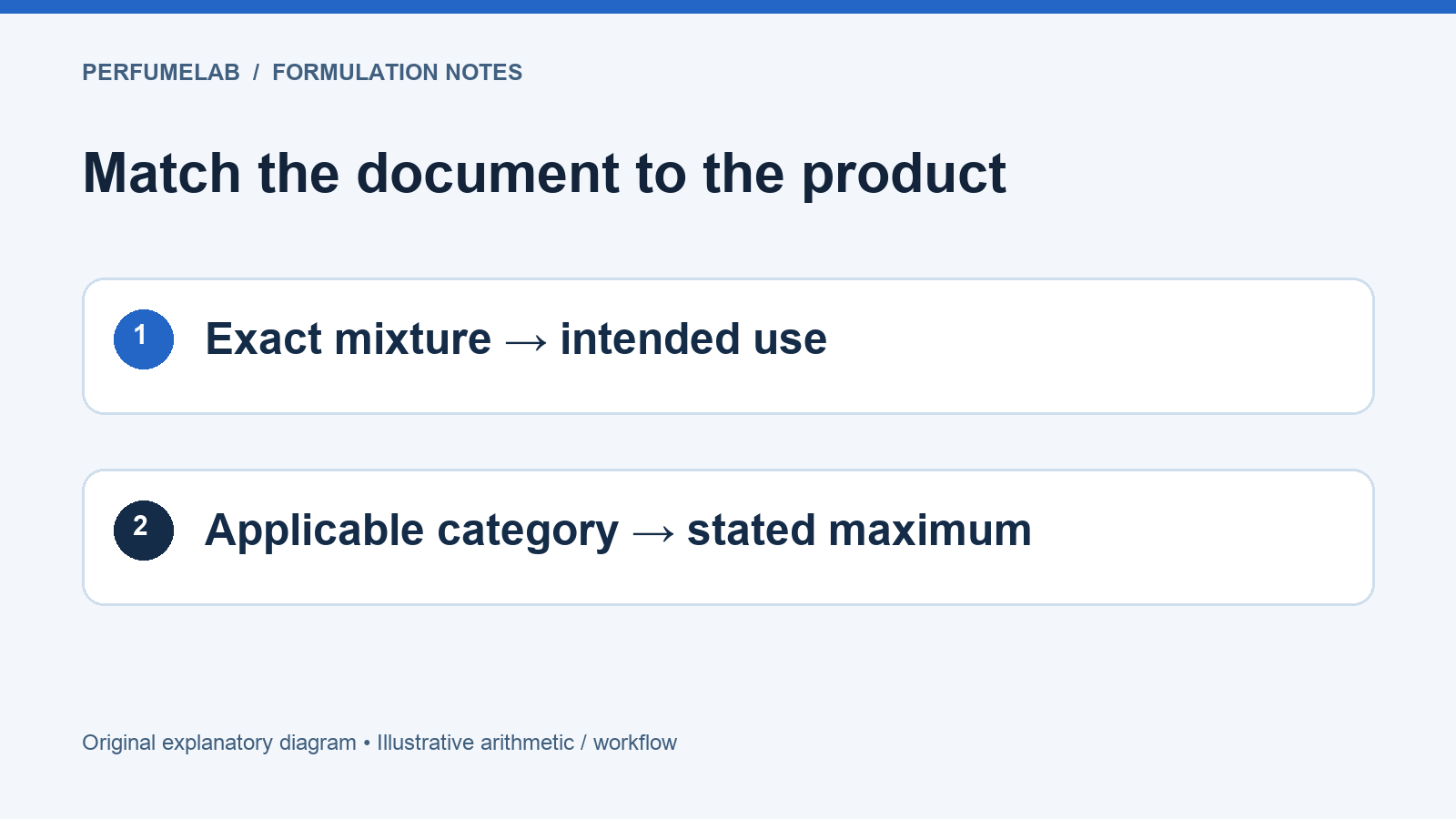

Start by matching the document to the exact fragrance mixture you bought. A certificate for a similarly named product or an earlier formulation may not describe the material in your bottle.
Check the document identity
Record the supplier, product identifier, issue date, stated amendment and any version information. Keep the document with the purchase or batch record. If the identity or date is ambiguous, ask the supplier before treating its figures as applicable.
IFRA explains that a Certificate of Conformity is prepared by the fragrance mixture manufacturer; IFRA does not issue it. The declaration concerns a specified intended use and does not replace a safety assessment.
Find the intended-use entry
Identify the appropriate category for the actual product using the current guidance. Read the relevant maximum use level and any qualifications on the document. Do not select a category because its number allows a larger dose.
For a fictional example, imagine a certificate stating a 4% maximum for the applicable use. In a 250 g finished batch, that corresponds to 10 g of that specific fragrance mixture. It is a ceiling under the stated declaration, not a recommendation to formulate at 4%, and not a raw-material restriction to transfer to an unrelated oil.
Ask a precise question when something is missing
A useful supplier enquiry is: “Does this document cover product code X, version Y, for this intended use and concentration?” Include your product description rather than asking only whether the oil is “IFRA approved”.
If your work involves blending several fragrance mixtures or adding raw materials, do not assume that separate certificates automatically establish conformity for the new combined mixture. The new composition needs the appropriate review.
Save the evidence used for the decision, including the document version and proposed use level. That makes a later formulation change easier to check and prevents an old certificate becoming an unexplained number in a spreadsheet.