
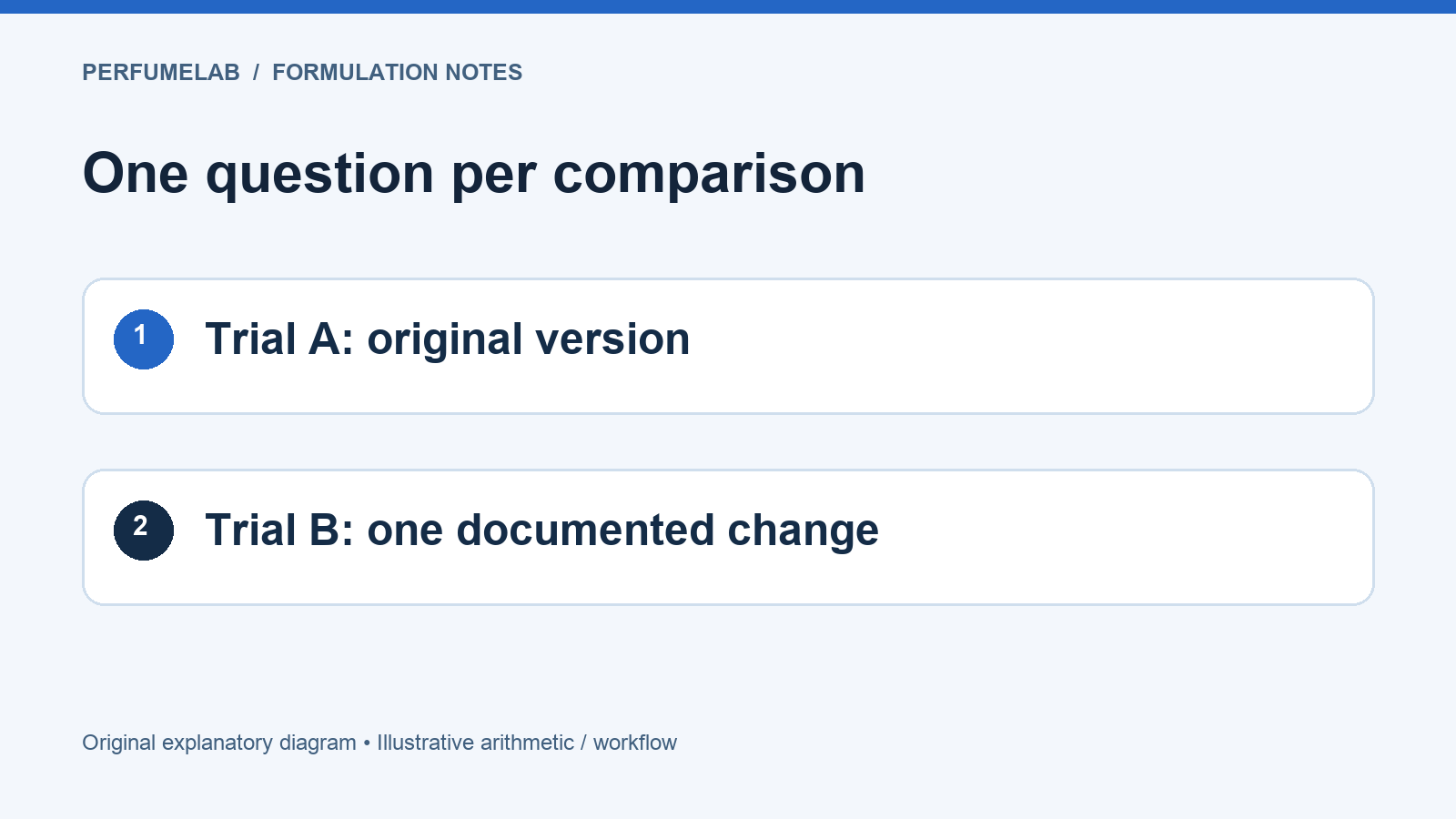

A useful comparison begins with a question. “Does this change reduce the sweetness in the opening?” is testable. “Is the new version better?” is so broad that almost any observation can seem to answer it.
Change one thing you can describe
Keep an untouched record of the original formula. Duplicate it, make a defined adjustment and write down the reason. If you change three ingredients, the concentration and the carrier together, the result may be interesting, but it will be difficult to explain.
The adjustment also needs a balancing method. Adding a line to an already complete formula changes the total unless you deliberately reduce another line or renormalise the mixture. Record which method you used, because that choice affects every comparison that follows.
Keep the evaluation conditions alike
Use the same test concentration, preparation method, sample age and evaluation medium where practical. Code the samples A and B so the version name does not constantly remind you which result you hoped to prefer. Record the evaluation times in advance.
For example, a worksheet might ask about the opening, the balance after one hour and the remaining character later in the day. These are chosen observation points, not a claim about how long a perfume should last. Write specific descriptions before assigning a preference.
Separate observation from explanation
“B seemed sweeter at one hour” is an observation. “The new ingredient caused the sweetness” is an interpretation. If other variables changed, the explanation is uncertain. A repeat trial can help you decide whether the difference is reproducible.
Keep a small retained reference sample when your procedures and storage conditions allow it. Include actual masses and any preparation deviations in the record; a target sheet alone cannot explain an accidental extra addition.
A successful comparison does not have to produce a winner. Discovering that a change made little useful difference can save the next round of work. The value is a record that tells you what to try next, rather than a collection of bottles whose differences you can no longer reconstruct.
[…] Keep the original reference and avoid changing several other ingredients at the same time. The formula-trial comparison guide explains how to retain a useful […]