
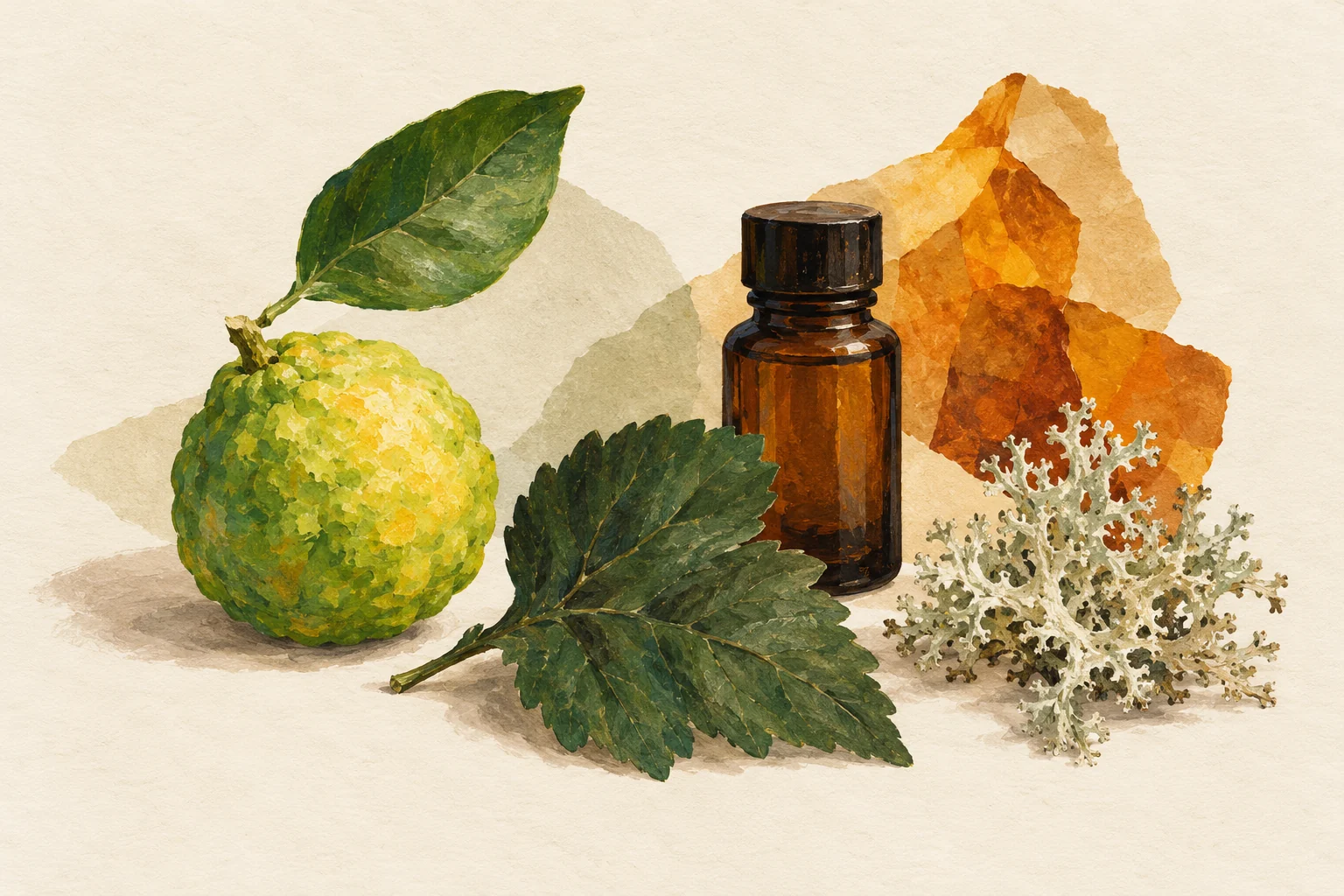

A chypre accord is a useful way to study contrast: a bright citrus impression against a darker, mossy and resinous foundation. The task is not simply to put four famous ingredients into a bottle. It is to decide how those facets should relate, then observe whether your chosen materials produce that relationship.
This guide is an educational planning framework, not a tested perfume recipe or a claim that a blend is ready for skin. Begin with documented materials and appropriate handling and evaluation instructions. If you are new to accord work, start with the first accord-study learning path.
What makes an accord chypre?
In his fragrance-classification presentation, Daniel Boubat identifies bergamot, patchouli, cistus-labdanum and oakmoss as the characteristic combination, and links the family name to Coty’s Chypre of 1917. The same classification recognises several directions within the family, including green, fruity, woody and leathery chypres. It is a framework for discussing character, not a universal formula. Source: Fragrances Classification, chypre section.
For a first study, write a narrower target than “make a chypre”. For example: “A clear citrus opening that leads into a dry mossy impression, with resinous warmth that does not dominate.” That is a proposed creative brief, not a reported result. It gives you a reason to keep or reject the next change.
Give each material a question to answer
- Bergamot: what kind of brightness? Record the exact supplied quality, not just “bergamot”. Compare what you actually perceive at the beginning and as the study develops. Expressed, distilled and processed qualities should not silently share one formula identity. See the guide to bergamot specifications.
- Labdanum: how much resinous warmth? IFF describes its labdanum resinoid in ambery and balsamic terms, with smoky, leathery and animalic facets. Use that manufacturer description as a starting vocabulary, then document your own supplied material. A resinoid, absolute and diluted stock must not be treated as identical bottle contents. Source: IFF Labdanum Resinoid.
- Patchouli: what kind of woody depth? The product grade matters here too. IFF’s Patchouli Heart N.3 is produced using fractional distillation; its profile is not evidence that every patchouli oil smells the same. If you change from a whole oil to a fractionated grade, label that as a material change rather than a minor spelling correction. Source: IFF Patchouli Heart N.3.
- The mossy component: what supplies the contrast? Identify whether you have an oakmoss extract, a named aroma chemical or a compounded moss base. Those are different material categories, even when the supplier uses similar scent language.
Is Veramoss the same as oakmoss?
No. IFF identifies Veramoss as methyl 2,4-dihydroxy-3,6-dimethylbenzoate and describes an oakmoss-like, earthy and soft woody profile with a phenolic aspect. That supports exploring it for a mossy effect; it does not make it chemically identical to an oakmoss extract. Source: IFF Veramoss.
A mossy molecule, a natural extract and a commercial replacement base can each lead to a different study. Do not assume a one-for-one replacement by weight, or that every product sold as an oakmoss substitute has the same composition. First decide whether you want to compare identities, quantities or the overall effect. Changing all three at once makes the result difficult to interpret.
Plan a reference and one deliberate contrast
Keep the first comparison small enough that you can describe it clearly. The following is a proposed study design, not a formula or a record of completed testing.
- Reference A: retain the exact composition and material grades from a documented educational reference that you can handle and evaluate appropriately. Record where that reference came from and the full concentration basis.
- Variation B: change one chosen facet, such as the relative contribution of the mossy component. Record the exact new masses and any carrier adjustment needed to keep the total consistent.
- Later comparison C: after understanding B, examine a different mossy material or patchouli grade in a separate series. Do not also introduce a new floral accord and a new bergamot quality.
Changing a component while keeping the total constant necessarily changes something else. If carrier replaces part of an ingredient stock, say so. If you renormalise all remaining ingredients instead, their amounts change together. Neither method should be described as a perfectly isolated chemical experiment. Keeping formula trials comparable helps make the bookkeeping explicit.
Record evaluation concentration, solvent, blotter type, application method, sample age and observation times. Use coded samples if practical. Ask the same questions at each observation: Is citrus still recognisable? Does the mossy impression feel distinct? Is the resinous facet supporting the brief or taking over? These are prompts for your observations, not predictions of what every reader will smell.
Do not confuse the family with a finished perfume
A small study can teach a contrast without being complete, pleasant or suitable for wearing. Once the relationship is useful, a floral, fruity or leathery direction becomes a separate creative question. Add that direction in a new version so you can still return to the simpler reference.
Labdanum also appears in ambery studies, but sharing an ingredient does not make two accords equivalent. Compare the purpose of the material here with the labdanum, benzoin and vanillin amber study. The intended balance matters more than the presence of one familiar name. The distinction between an accord and a complete perfume formula is worth preserving.
Oakmoss and bergamot need more than a historical recipe
Historical use is not a present-day safety assessment. The linked IFRA oakmoss Standard addresses both restrictions and extract specifications, and accounts for combined oakmoss and treemoss use. A label such as “low atranol” is not permission for unrestricted use. Verify the exact extract, current applicable Standards and supplier documentation for the intended product. Source: IFRA Oakmoss extracts Standard.
The linked IFRA Standard for expressed bergamot addresses phototoxicity and the relevance of furocoumarin information. Do not transfer a conclusion from one bergamot quality to another, or assume that a processed quality removes every safety consideration. Recheck the current requirements before any intended skin use. Source: IFRA Bergamot oil expressed Standard.
Any applicable limit must be interpreted on the correct composition basis; an accord percentage is not automatically a finished-product percentage. See concentrate versus finished product. IFRA conformity alone does not replace a complete product safety assessment or applicable legal requirements.
The useful outcome
Finish the session with a precise observation and a next question, not simply “needs more oakmoss”. A note such as “B was less resin-dominant at the later observation, but the opening was also different” gives the next trial a purpose. Preserve the reference, exact material identities and changed masses. That is how a chypre study becomes reusable knowledge rather than another untraceable bottle.