
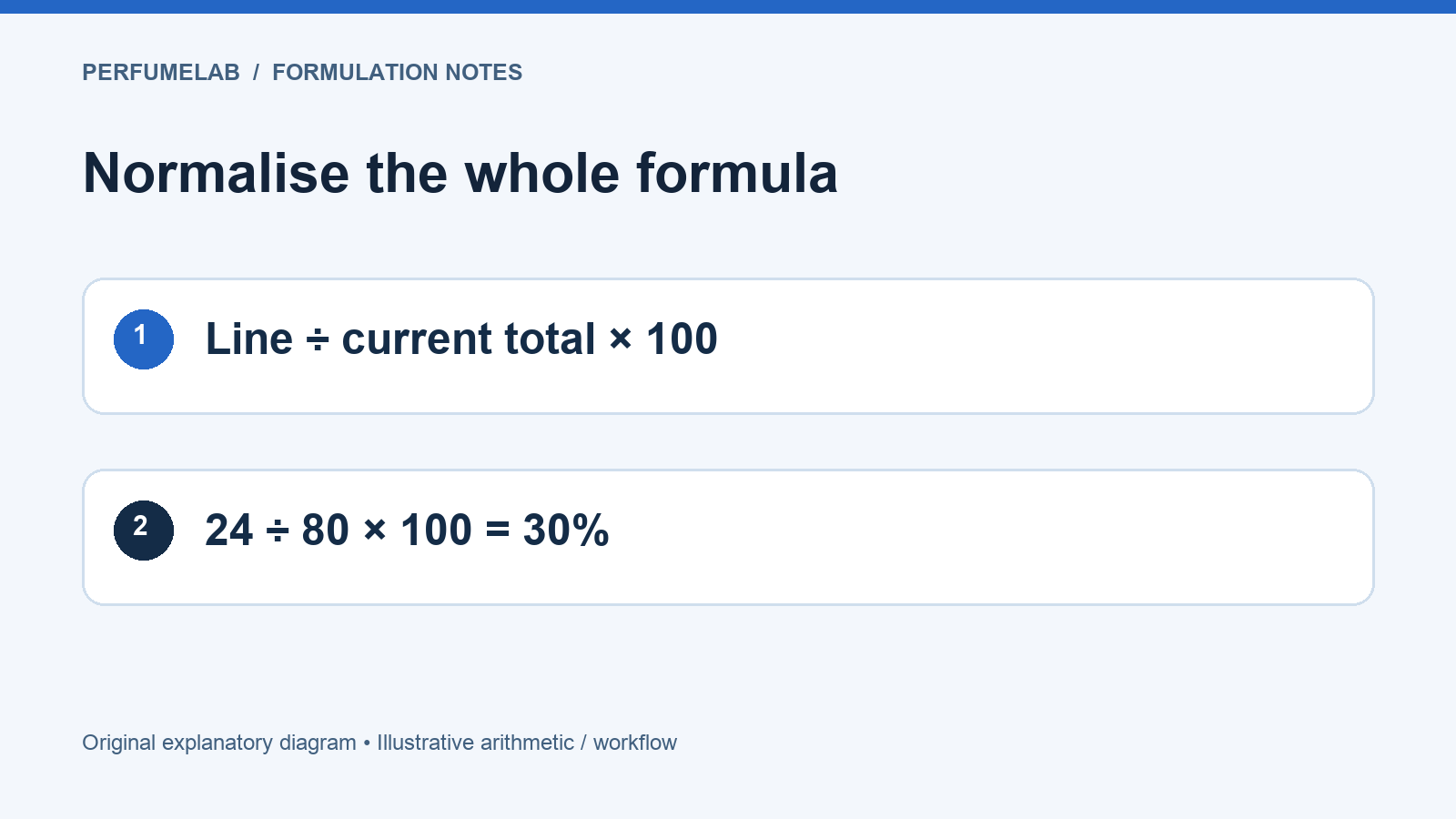

If a working formula totals 80 parts, divide each line by 80 and multiply by 100 to express the same ratios as percentages. Normalising changes the way you write the formula; it does not change its relative composition.
A three-line example
Take A at 40 parts, B at 24 parts and C at 16 parts. The total is 80. The percentages are 50%, 30% and 20%. All three lines sum to 100%, and their ratio remains 5:3:2.
Do not add the missing 20 parts to one ingredient unless you intend to change the formula. That would create a new composition. Likewise, if a copied list totals only 80 because a line was lost, normalising conceals the omission instead of fixing it. Check completeness first.
When the numbers are already masses
The same calculation converts an actual trial to percentages. If your weighed trial contains 4.0 g, 2.4 g and 1.6 g, divide each by the 8.0 g total. Keep the original masses as the batch record and save the normalised percentages as a linked formula version.
Include carriers and stock solutions on the chosen basis. If you decide to produce an active-material view, separate the carriers explicitly rather than dropping them and continuing to label the result “as weighed”.
When you want to add something new
Suppose a formula already totals 100% and you want a new ingredient at 2% of the revised total. One deliberate option is to reduce every existing line to 98% of its former value, leaving 2% for the addition. A 30% line then becomes 29.4%. That is a reformulation choice, not ordinary normalisation.
Whichever method you use, keep a version note explaining it. After rounding, check the total and inspect the smallest lines. A neat-looking 100% at the bottom of a sheet is useful only when the ingredient identities, strengths and ratios above it still describe the trial you meant to make.
[…] is different from normalising a known formula to 100%: a known ratio sheet begins with specified ingredients and amounts. Making an analytical table add […]