

If you want to compare a lighter and stronger version of your perfume, use measured concentrations rather than relying on the names eau de toilette and eau de parfum. For your own trials, “15% w/w, formula version 4” is more useful than “EDT”.
Make a fair pair
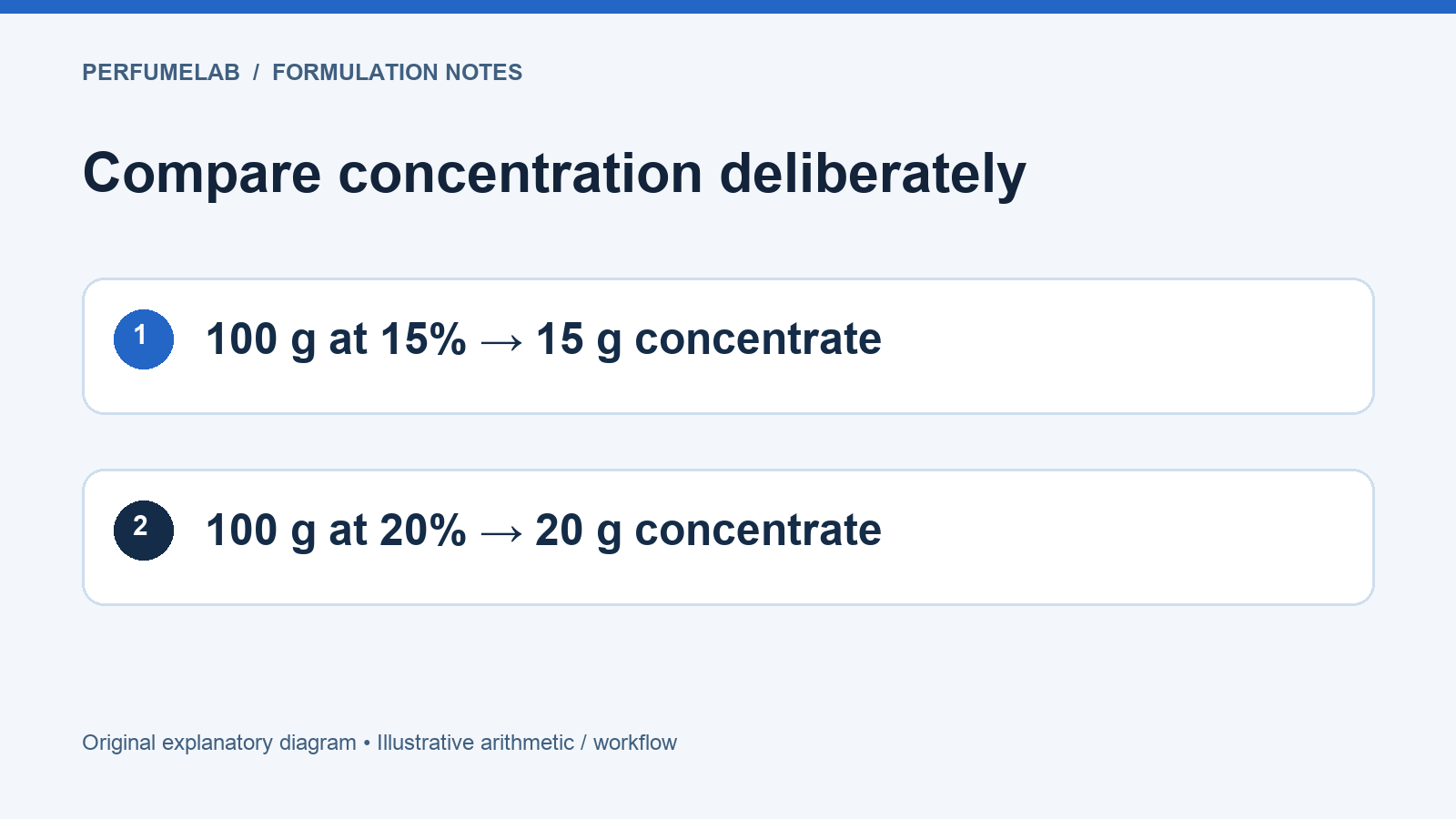
For a simple calculation, a 100 g trial at 15% uses 15 g concentrate and 85 g carrier. At 20%, it uses 20 g concentrate and 80 g carrier. These are chosen test points, not official definitions of EDT and EDP, and they are not suitable concentrations for every composition.
Use the same concentrate version and carrier specification for both tests. If you change the formula at the same time, you will not know whether a difference came from the concentration or from the revised composition.
Recheck the formula at each level
Increasing the concentrate fraction increases the finished-product contribution of its constituents. A material at 2% of the concentrate contributes 0.30% at a 15% use level and 0.40% at a 20% use level. This example explains exposure arithmetic; neither number is a safety limit.
Do the relevant assessment for the intended use before deciding that the stronger version is appropriate. A name on a label does not establish conformity or suitability.
Evaluate more than strength
Use equal application conditions and coded samples. Record the opening, the balance at chosen later times, clarity and any changes during storage. Do not decide from one sniff that the higher concentration is better: the creative question may be whether it still has the contrast and texture you wanted.
Keep the concentrate identifier, actual dilution masses and preparation date beside your observations. If one version becomes the preferred direction, save it as a distinct product trial. That preserves a useful distinction between changing a fragrance formula and choosing how that formula is presented in a finished product.