
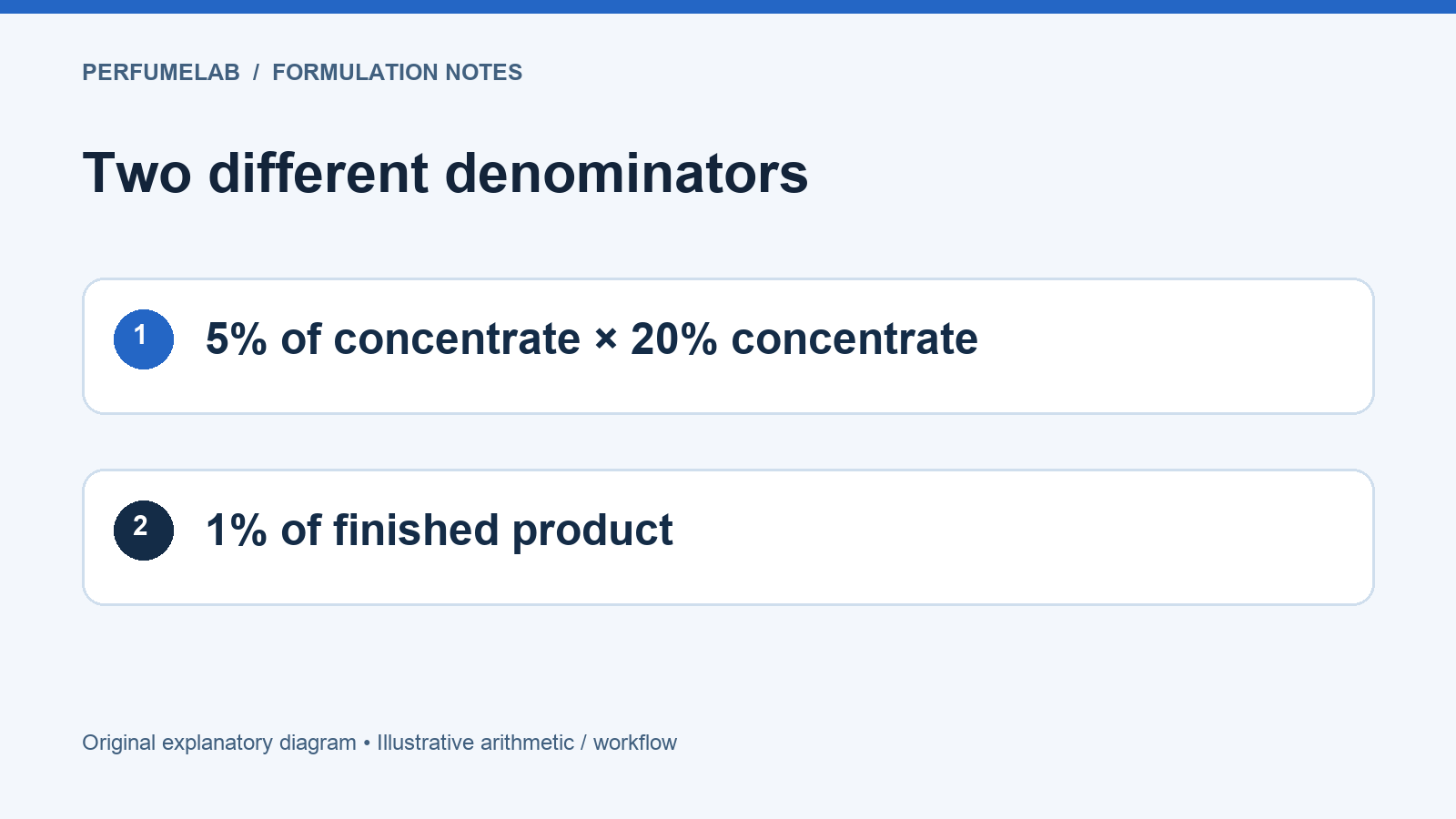

An ingredient at 5% of a concentrate becomes 1% of a finished perfume when that concentrate is used at 20% by weight. Both percentages are correct. They describe different totals.
Put the basis beside the number
“Five per cent bergamot” is incomplete without saying what the five per cent refers to. It could mean a concentrate, a diluted test, a purchased base or the complete product. Before comparing formulas, write the denominator explicitly.
For a simple illustration, make 100 g of finished product using 20 g concentrate and 80 g carrier. An ingredient making up 5% of the concentrate contributes 1 g, because 20 × 0.05 = 1. That 1 g is 1% of the complete 100 g product. This is an arithmetic example, not a bergamot use recommendation.
Watch the stock solutions
The calculation above treats the ingredient line as neat material. If the line is actually a 10% stock, its active contribution is another ten times smaller. Five per cent of that stock in the concentrate, used at 20% in the finished product, contributes 0.1% active material overall.
This is why a formula sheet needs more than an ingredient name and a number. Preserve the stock strength and carrier, then state whether the headline concentration includes those carriers or describes aromatic content alone.
Use the right value for the next decision
When translating a quantitative IFRA restriction, use the finished-product basis specified by the Standard. Check the applicable Standard and product category before using that percentage in an IFRA calculation.
For a sensory comparison, also record the tested concentration. A concentrate evaluated on one day and a 20% dilution evaluated on another are different test conditions, even if the formula has not changed.
A useful final check is to ask: “Percentage of what?” If the answer cannot be read directly from the sheet, add it before sharing or scaling the formula.