

One of the most common frustrations in perfume formulation is creating something that smells excellent at first — but disappears far too quickly.
You spray it, it opens beautifully, and then within an hour it’s gone.
Meanwhile, other perfumes remain detectable for 12 hours or more.
Longevity isn’t random. It’s controlled by a combination of ingredient chemistry, formula structure, and concentration.
Once you understand what actually affects it, you can design formulas that last much longer.
Longevity Is Primarily Controlled by Volatility
Every fragrance material evaporates at its own rate.
Some evaporate within minutes. Others can remain on skin for days.
These are broadly grouped into:
Top notes – highly volatile, short-lived
Heart notes – moderate evaporation
Base notes – slow evaporation, longest lasting
If your formula contains too many fast-evaporating materials and not enough slow ones, longevity will be poor regardless of how strong it smells initially.
This is one of the most frequent beginner mistakes.
Base Materials Are the Foundation of Longevity
Materials with low volatility anchor a fragrance.
Common long-lasting materials include:
• Ambroxan
• Iso E Super
• Musks (Galaxolide, Habanolide, Exaltolide)
• Patchouli
• Vetiver
• Sandalwood materials
• Labdanum
These materials evaporate slowly and remain detectable for many hours.
Without enough of them, the fragrance fades quickly.
A typical professional formula may contain 40–60% base materials.
Beginners often use far less.
Concentration Matters, But Only to a Point
Increasing concentration can improve longevity, but it’s not a complete solution.
For example:
An Eau de Toilette at 10% concentration may last 4 hours.
The same formula at 20% may last 6–8 hours.
But if the formula itself lacks durable materials, increasing concentration only helps slightly.
Structure is more important than strength.
Molecular Weight and Vapour Pressure Play a Role
Heavier molecules evaporate more slowly.
Materials with:
• Higher molecular weight
• Lower vapour pressure
tend to last longer on skin.
This is why many woody, amber, and musk materials have strong longevity.
Light citrus molecules evaporate extremely quickly in comparison.
Even at high percentages, citrus notes rarely last long on their own.
Fixatives Help Slow Evaporation
Fixatives don’t “freeze” a fragrance, but they can slow evaporation.
They work by:
• Reducing volatility of surrounding materials
• Providing a persistent background
• Improving overall structure
Common fixatives include:
• Musks
• Ambroxan
• Benzoin
• Labdanum
• Iso E Super
These materials extend the life of other notes.
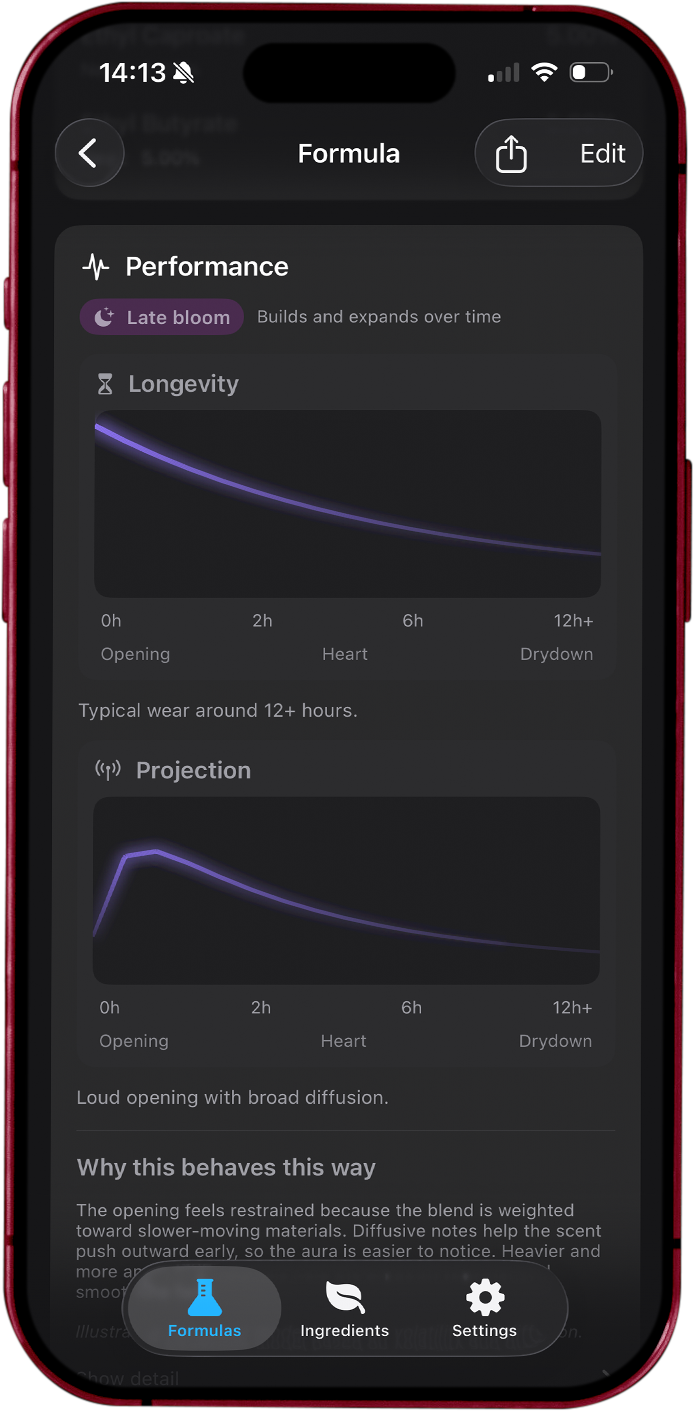
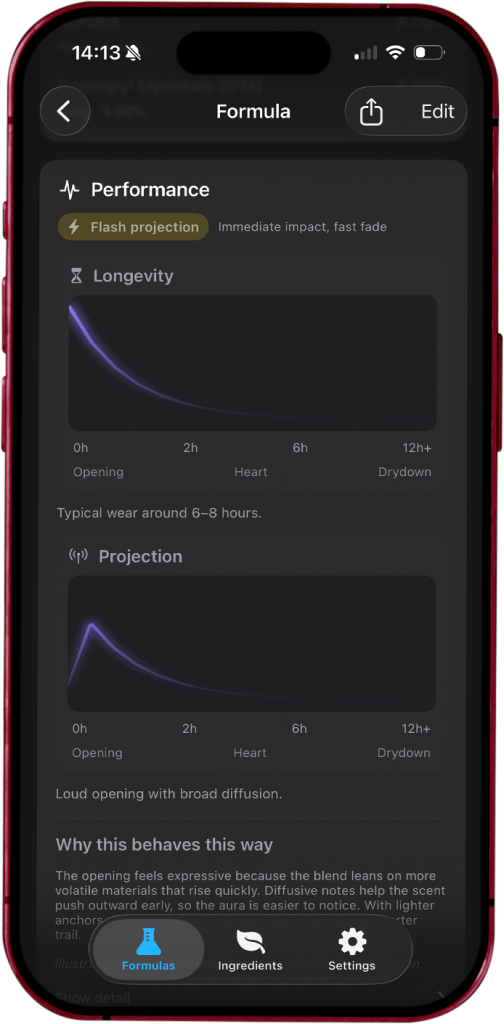
Understanding longevity and projection purely by smell can be difficult, especially when testing multiple versions of a formula. Small percentage changes to base materials can significantly alter how a fragrance performs over time, but these effects aren’t always obvious immediately. PerfumeLab allows perfumers to visualise predicted longevity and projection curves as they build a formula, helping identify weak structures and improve performance deliberately. It also provides AI-driven recommendations based on the formula’s composition, suggesting adjustments that can strengthen longevity, balance volatility, or improve diffusion. By tracking ingredient percentages, evaporation profiles, and performance data in one place, it becomes much easier to design fragrances that not only smell good initially, but remain stable and detectable throughout their full wear time.