

If you’re formulating perfume seriously, at some point you run into IFRA limits.
And this is usually where things get confusing.
You see numbers like 0.3%, 0.6%, Category 4, Category 12… and suddenly your beautifully structured formula feels like it’s under legal attack.
The truth is, IFRA compliance isn’t complicated — but it is precise. And most hobbyists get it slightly wrong without realising.
This guide walks through exactly how to calculate IFRA limits in a perfume formula, step by step, with real examples.
What IFRA Actually Regulates
IFRA (International Fragrance Association) sets maximum usage levels for certain fragrance ingredients in different product categories.
These limits are based on toxicological data and skin exposure risk.
For fine fragrance (what most independent perfumers are making), you are typically working under:
Category 4 – Fine Fragrance / Hydroalcoholic products applied to skin
Each restricted ingredient has a maximum permitted percentage in the finished product.
That last part is important.
It’s not the percentage in your concentrate.
It’s the percentage in the finished perfume once diluted.
That’s where many mistakes start.
Step 1: Identify the IFRA Limit for the Ingredient
Let’s say you’re using Cinnamal.
The IFRA Standard states (example figure):
Maximum 0.1% in Category 4
This means that in your final perfume (after dilution), cinnamal cannot exceed 0.1%.
Not in the oil concentrate — in the finished product.
Step 2: Understand Your Dilution Strength
Most perfumes are diluted to somewhere between:
15% (Eau de Parfum lower range)
20%
25%
Let’s assume you are making a 20% concentration.
That means:
20% fragrance concentrate
80% alcohol
Now the maths begins.
Step 3: Convert IFRA Limit to Concentrate Level
If the finished product cannot exceed 0.1%, and your perfume is 20% concentrate, then the maximum allowed in your concentrate must be higher — because it will be diluted down.
Here’s how to calculate it:
Maximum in finished product ÷ concentration level
So:
0.1% ÷ 0.20 = 0.5%
This means your concentrate can contain up to 0.5% cinnamal.
Because once diluted at 20%, the final product will contain 0.1%.
That’s the core calculation.
It’s simple once you see it, but surprisingly easy to misapply.
Step 4: Check Your Actual Formula
Now imagine your 100g concentrate contains:
0.8g Cinnamal
That equals 0.8%.
If you dilute this to 20%, the finished product will contain:
0.8% × 0.20 = 0.16%
Which exceeds the 0.1% IFRA limit.
So even though your concentrate looks fine, the finished product would not be compliant.
That’s why you always calculate based on final concentration.
Common Mistakes When Calculating IFRA Limits
Here are the errors I see most often:
• Confusing concentrate percentage with finished product percentage
• Forgetting to account for dilution strength
• Assuming IFRA limits apply to accords rather than raw materials
• Using outdated IFRA Amendment data
• Not checking if an ingredient has multiple restrictions
Another subtle issue is stacking restricted materials that share allergenic compounds. It’s not always obvious, and beginners often overlook that interaction.
What If You Change Concentration Strength?
Let’s say you increase from 20% to 25%.
Your allowable concentration changes.
Using the same 0.1% IFRA limit:
0.1% ÷ 0.25 = 0.4%
So now your concentrate must not exceed 0.4%.
As you increase strength, your margin narrows.
This is why strong extrait-style formulas often need reformulating to remain compliant.
A Practical Workflow for Small Perfumers
If you’re working manually:
Identify IFRA Category (usually 4)
Check the latest IFRA Amendment for your ingredient
Note the max permitted percentage
Divide by your dilution strength
Adjust formula if needed
Recalculate if you change concentration
Do this for every restricted ingredient.
It doesn’t take long once you’re used to it, but it is methodical work.
Why Digital Calculation Tools Matter
Once your formula contains 40, 60, even 100 materials, manual IFRA checking becomes error-prone.
Especially when:
You tweak percentages frequently
You experiment with concentration strength
You create multiple versions
Modern formulation software can automatically:
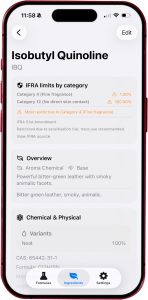
Track ingredient IFRA limits
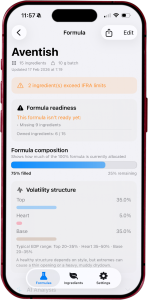
Calculate compliance at different concentrations
Flag exceedances instantly
Which removes a lot of the friction from creative work.
If you’re formulating regularly, it’s worth using a structured system rather than spreadsheets.
Final Thoughts
IFRA compliance isn’t there to restrict creativity — it exists to ensure safety and consistency.
Once you understand how to translate limits from finished product to concentrate level, the calculations become straightforward.
The key is precision.
If you’re serious about perfume formulation, you should treat IFRA calculation as part of the creative process, not an afterthought.
And if you’re building complex formulas or testing multiple dilution strengths, using a dedicated digital formulation tool can save a surprising amount of time.
If you’d like to streamline IFRA checking and performance modelling in one place, you can explore PerfumeLab here: