
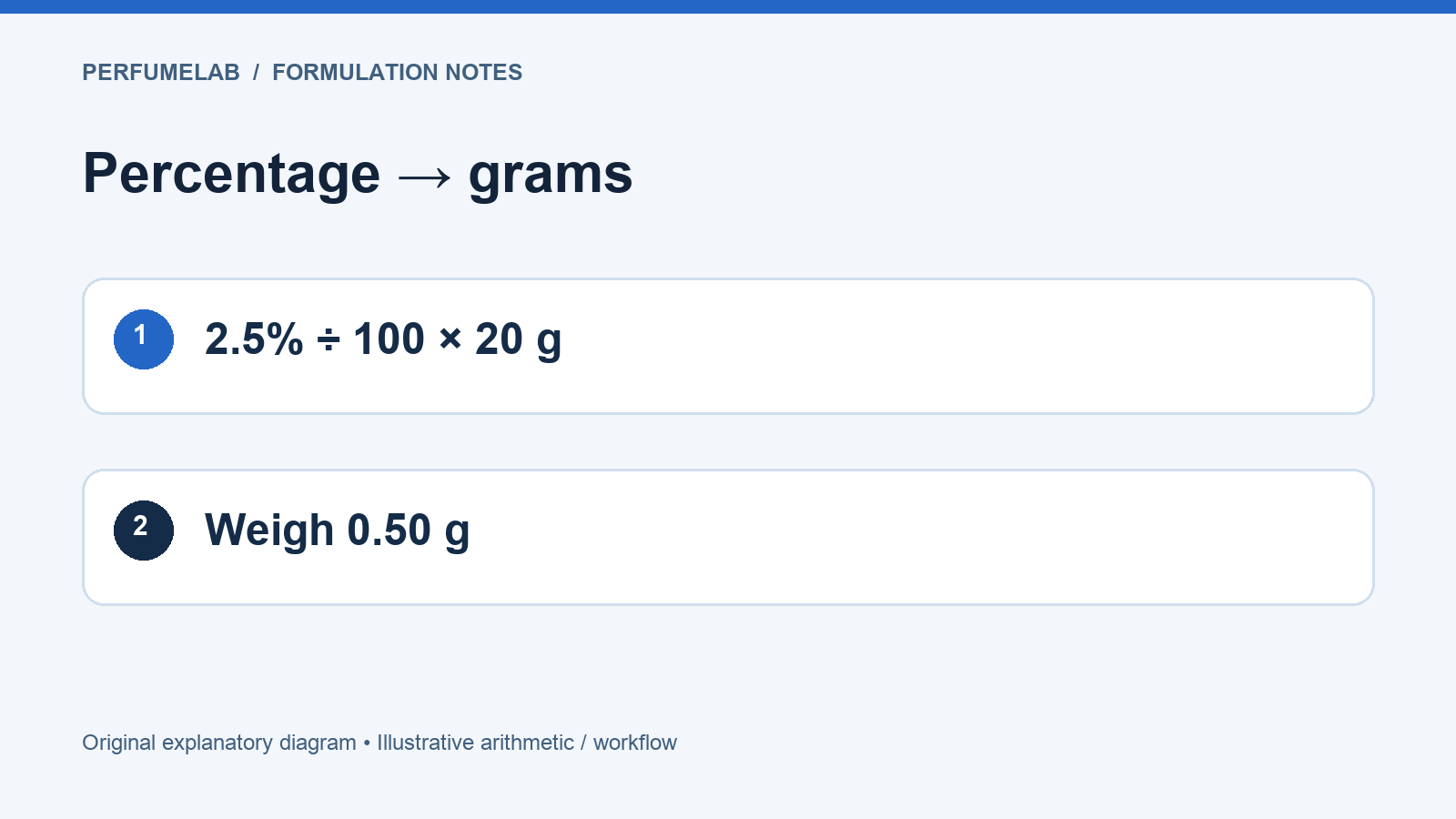

A line reading “2.5%” tells you a proportion. To weigh it, you also need the mass of the batch. For a 20 g batch, that line becomes 0.50 g: divide the percentage by 100, then multiply by 20.
Start with one clearly defined batch
Decide whether the formula describes a fragrance concentrate or the finished perfume. A 20 g concentrate and a 20 g bottle containing diluted concentrate are different calculations. Write that basis above the ingredient list before touching the balance.
Use this equation for every line:
Ingredient mass in grams = batch mass in grams × ingredient percentage ÷ 100.
For an arithmetic-only example, take a formula containing A at 60%, B at 30% and C at 10%. In a 20 g batch the targets are 12 g, 6 g and 2 g. They total 20 g. The letters are placeholders, not a perfume recipe or a recommendation to use particular materials at those levels.
Working through a whole formula? Enter your percentages and choose a batch size in PerfumeLab to calculate the target weights. Get PerfumeLab for iPhone and iPad. Free to download, with in-app purchases.
Check the small line before choosing a batch size
A 0.05% line in 20 g is 0.010 g. Whether you can weigh that reliably depends on the balance and your method. A display showing three decimal places does not by itself prove that a 0.010 g addition is dependable. Use the balance specification and appropriate checks, or design a documented stock dilution that makes the addition practical.
Avoid rounding the percentages before calculating the masses. Keep the working precision, then decide how to weigh each target. If rounding changes the batch, record the actual additions instead of silently treating targets as measurements.
What a percentage line does not tell you
“B at 10%” might mean 10% of a purchased stock solution. If that stock contains 10% aromatic material, the active contribution is only 1% of the batch. Preserve the stock strength and solvent in the ingredient name.
Once you have weighed the trial, compare the actual total with the intended total. The next useful step is a batch record containing both figures, so the formula you evaluate is the formula you actually made.