
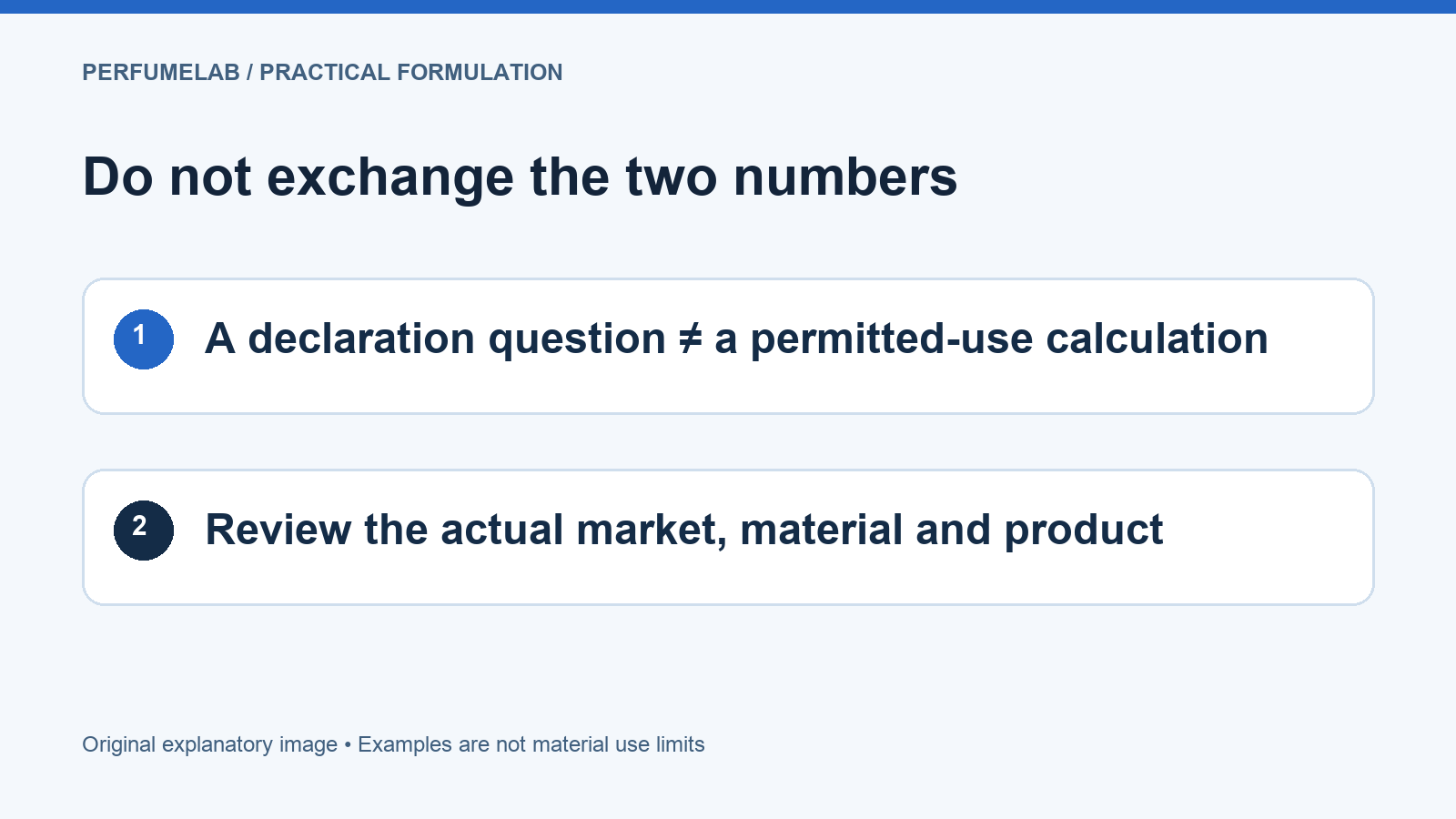

A fragrance-allergen declaration requirement and an IFRA material restriction are not interchangeable numbers. A label question concerns what information must be communicated under the applicable rules; an IFRA check concerns conformity with the relevant Standards for the intended use.
Start by naming the decision
Are you deciding what to declare on a finished product label, calculating a restricted constituent's contribution, or checking a material specification? Each question needs the appropriate source information. Putting the word “allergen” beside a spreadsheet value does not identify which decision that value supports.
IFRA explains that its Standards do not remove the need to comply with applicable regulations. The European Union's fragrance-allergen labelling amendment is an example of a separate regulatory source. Requirements also depend on the actual market and product context; an article cannot make one universal labelling rule cover every sale.
Keep the supporting information distinct
A useful record identifies the exact material or fragrance mixture, relevant composition information, intended product use and final concentration. Then link the documents and calculations supporting each decision.
Do not turn a supplier's declaration-related constituent figure into a safe-use recommendation. Likewise, an IFRA conformity document does not automatically supply a complete finished-product ingredient label. Missing information should be resolved rather than silently borrowed from a document prepared for another purpose.
Consider all relevant sources of a constituent
A named substance may arrive directly and through complex materials. Where that contribution matters to a particular assessment, the direct formula line alone may be incomplete. Use suitable evidence for the materials you actually have, and preserve the basis of the calculation.
The same arithmetic can support different reviews, but the decision criteria remain different. A result that answers one question should not be described as proving every other requirement has been met.
Do not infer individual tolerance from paperwork
A conformity or labelling conclusion is not a promise that every person will tolerate a fragrance. Avoid broad statements such as “below the declaration threshold, therefore allergy-free”. This article supplies no diagnostic advice, numeric thresholds or permission to apply raw materials to skin.
Before commercial labelling or release, consult the current requirements and appropriate review for the actual product and market. Keep the document versions with the formula record. The practical lesson is to ask a precise question first, then use evidence intended to answer it rather than treating every safety-related percentage as the same kind of limit.