

If you add too much of an ingredient, stop and record the actual mass before doing anything else. Whether the trial can be used, reworked or should be set aside is a separate decision from the arithmetic.
Reconstruct the composition
Imagine a fictional 10 g worksheet containing A at 5 g, B at 4.5 g and C at 0.5 g. You accidentally add 0.6 g C. If the other additions were exact, the actual total is 10.1 g and C is about 5.94% of that total, rather than the intended 5%.
Do not change the record to the target value. The difference between intended and actual is exactly the information needed to understand the sample you evaluate.
One mathematical option is a larger proportional batch
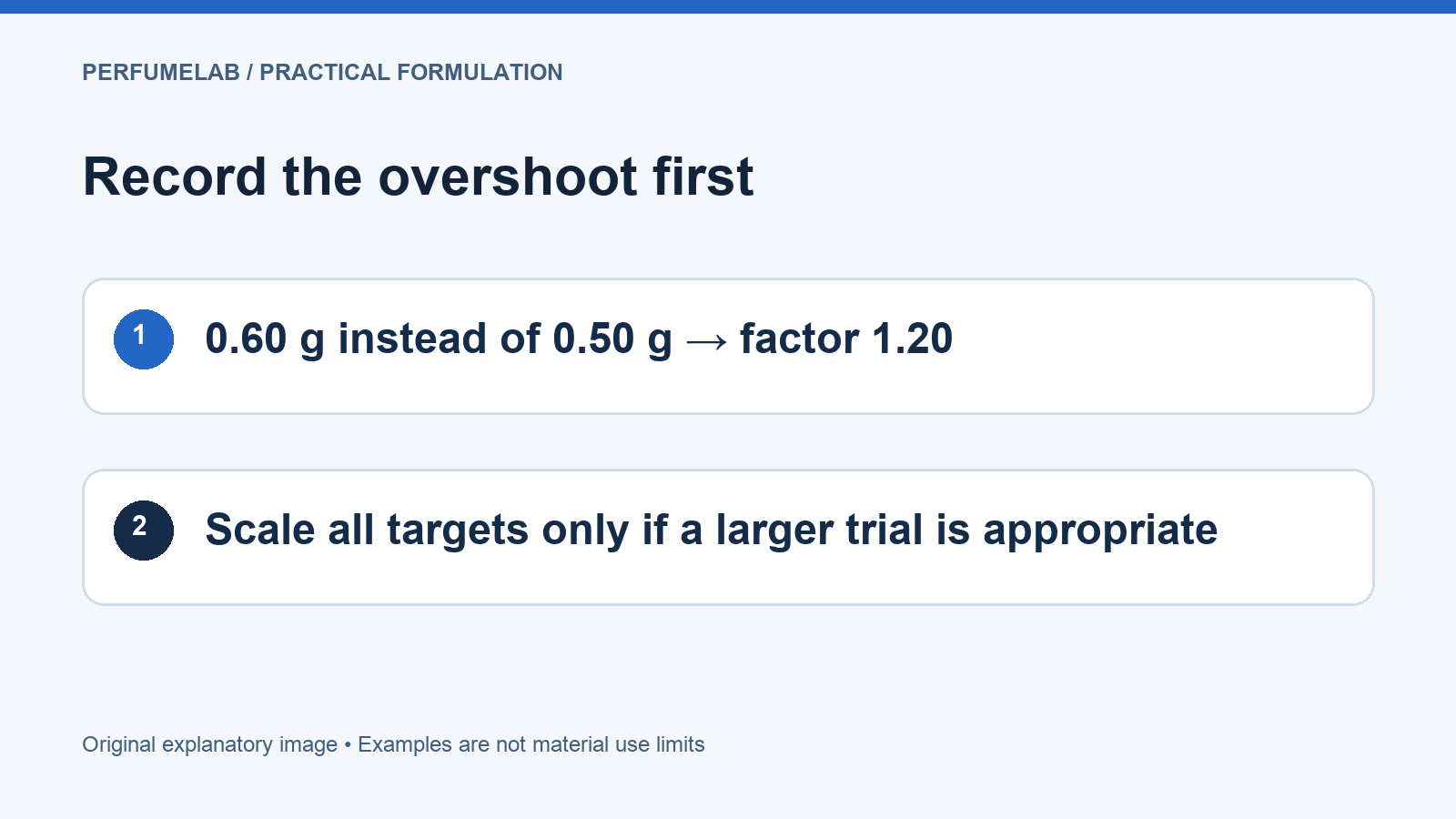
The overshot C amount is 0.6 ÷ 0.5 = 1.2 times its target. A composition preserving the original proportions at that factor would contain 6.0 g A, 5.4 g B and 0.6 g C: 12 g total.
If only C was overshot and the stated other masses are correct, that would require another 1.0 g A and 0.9 g B. The calculation does not establish that reworking this particular material mixture is suitable, safe or practical. These are unnamed arithmetic placeholders, not a fragrance recipe or permission to continue a real batch.
Check the whole situation before adding more
A larger trial may exceed your planned quantity or equipment capacity. Other lines may also have weighing deviations. The material identity, stock strength or preparation sequence may be uncertain. In those cases, a neat proportional answer on paper does not resolve the underlying problem.
Simply removing some mixed liquid will not selectively remove the ingredient that was overshot. Adding carrier alone creates a different concentration and does not restore the original relative proportions of A, B and C.
Preserve the decision trail
Keep the original target sheet, actual additions and any proposed rework calculation. If a revised trial is made under an appropriate procedure, give it a distinct batch identity and record the final composition and method. Recheck the relevant requirements rather than assuming an earlier assessment automatically covers it.
Sometimes the useful outcome is a documented experimental variant; sometimes the appropriate decision is not to use the batch. Accurate records let you make that decision on evidence instead of trying to hide the error with an unmeasured extra addition.