
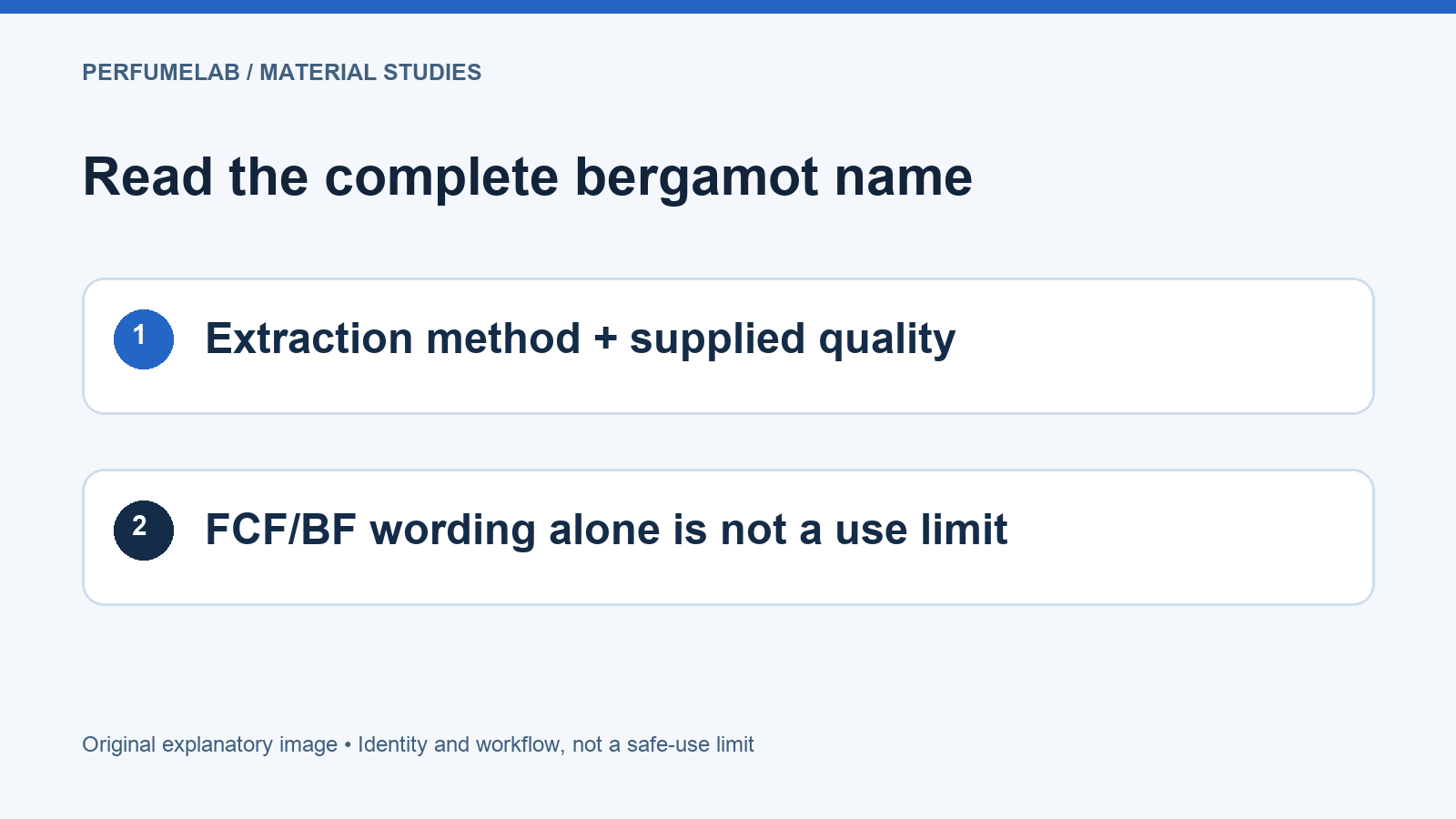

A bottle labelled “bergamot” is not a complete specification. The extraction method, processing and supplied quality matter when you compare its character or assess it for an intended product.
Do not use a shorthand as the whole identity
Terms such as expressed, distilled, FCF and BF give you information to investigate. They should lead you to the actual supplier specification, not replace it. For example, Perfumer's Apprentice lists a bergamot essential oil as a BF quality. The exact current specification is still needed before making a material-specific decision.
FCF generally means furocoumarin-free; BF means bergapten-free. Bergapten is one furocoumarin, so do not assume the two labels specify identical analytical profiles. Confirm the supplier’s specification and any residual-content limits for the exact product. Expression extracts citrus oil mechanically. Distillation can also be a subsequent processing step: IFF describes one bergamot quality as cold-pressed and then molecularly distilled. Extraction method and subsequent processing are therefore not necessarily mutually exclusive labels.
Keep the phototoxicity question specific
Bergamot-related phototoxicity assessment cannot be reduced to “natural oil bad, FCF safe”. The relevant material specification, intended use, final concentration and other contributing materials need to be considered under the applicable guidance.
This article supplies no universal permitted percentage. It also does not establish that a processed quality has no other hazards, constituent requirements or suitability questions. Resolving one issue does not answer every question about a finished product.
Compare the creative effect separately
If you replace one quality with another, keep the change as a new formula version. Use the full supplied names and the same evaluation conditions. Note the effect in the blend rather than assuming that two bergamot products must give the same opening. The chypre accord study gives bergamot a specific comparison context alongside labdanum and mossy materials.
A useful comparison sheet has columns for supplier/product, extraction or processing information, stock strength, amount used and observed effect. Keep the relevant technical documents linked to each entry. This is particularly helpful when a familiar product is unavailable and an alternative is offered under a similar short name.
Ask the supplier a precise question
Instead of “Is your bergamot safe?”, identify your product type and ask for the applicable specification and conformity information for the exact quality. Include the stock or supplied dilution if relevant.
The answer should support a decision about that material in that product. A two- or three-letter suffix is useful information on a label, but it is not the complete decision.
Sources
Perfumer’s Apprentice: Bergamot Essential Oil BF
[…] Bergamot: what kind of brightness? Record the exact supplied quality, not just “bergamot”. Compare what you actually perceive at the beginning and as the study develops. Expressed, distilled and processed qualities should not silently share one formula identity. See the guide to bergamot specifications. […]