
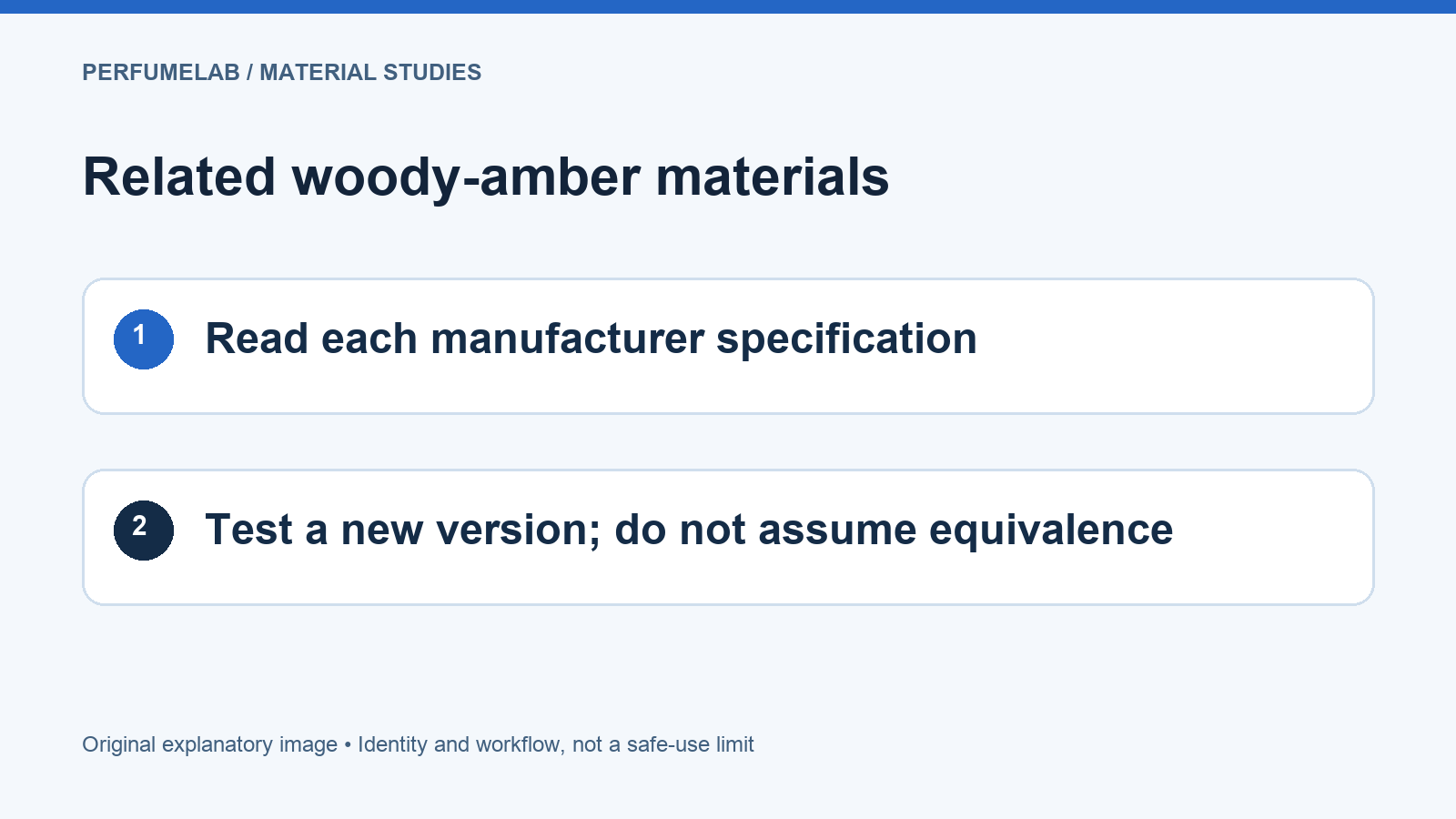

Iso E Super and Timbersilk sit in a related woody-amber area, but a similar chemical description does not make the supplied products interchangeable in every perfume. If you swap one for the other, keep the change visible in the formula version.
What the manufacturer establishes
IFF publishes separate ingredient profiles for Iso E Super and Timbersilk. Both use woody-amber descriptions, and their chemical identities belong to the same broad material context. Separate product profiles are a reason to check the grade and specification, rather than reducing the purchase decision to a shared scent-family word.
This comparison does not assign an exact isomer percentage to either product or claim a fixed potency ratio. Those details require the relevant current technical evidence. A CAS reference is useful identity information, but it may not describe every aspect of a commercial grade that matters to a perfumer.
Start with the line in your actual formula
Does it call for a named IFF product, a supplier's equivalent, or an unspecified woody-amber material? Is it neat or diluted? If the original identity is unclear, record that uncertainty before testing alternatives. Otherwise, a supplier change can disappear from the paperwork while remaining audible in the fragrance.
Use the complete names in your library. Avoid renaming both bottles “Iso E” simply to make the ingredient list shorter. That saves a few characters at the expense of knowing which version you made.
Compare a deliberate replacement
Keep the original trial as a reference. Make a new version using a documented replacement amount and the same final test concentration. Matching the original mass can be a starting comparison only when appropriate to the materials and their documentation; it is not evidence of equal sensory strength or safety.
Evaluate the balance at more than one point. Note whether the change affects the apparent woodiness, fullness or relationship with the surrounding accord. These are questions to investigate, not guaranteed differences asserted for every blend.
Keep creative and technical decisions together
A replacement that smells promising still needs the relevant material and finished-product checks. Do not transfer a numeric use limit from an old library entry without confirming that it covers the supplied material and intended use.
The useful outcome is not a universal winner. It is a clear decision for one formula, supported by the exact product identity, the changed amount and the resulting observations. That record is what lets you repeat the choice when you reorder materials months later.