
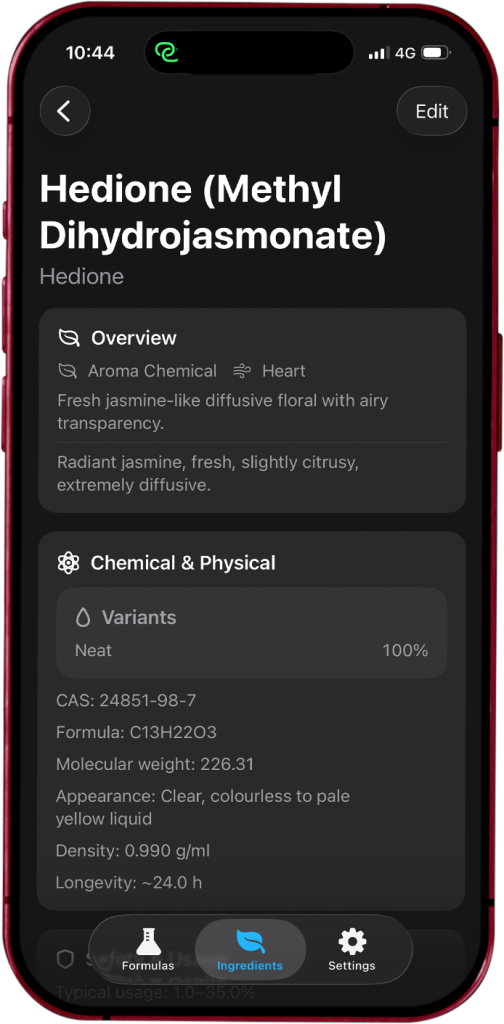
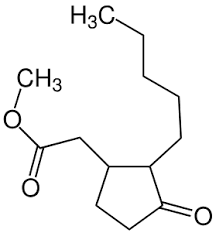
Hedione is one of the most important aroma chemicals in modern perfumery. It appears in thousands of professional formulas and is especially known for its role in improving diffusion and creating a natural floral radiance.
Despite its relatively subtle scent, Hedione can have a significant impact on how a fragrance performs and feels.
Understanding how much to use — and why — is essential when building balanced formulas.
What Hedione Actually Smells Like
Hedione has a light, transparent floral character, often described as:
• Jasmine-like
• Fresh and airy
• Slightly citrus-floral
• Soft and diffusive
On its own, it may smell understated. But in a formula, it enhances brightness and openness.
It is particularly effective at making fragrances feel more natural and less dense.
Typical Usage Range in Perfume Formulas
Hedione is commonly used between:
5% and 35% of the formula
This wide range surprises many beginners.
At lower levels (5–10%), it adds subtle lift and smoothness.
At moderate levels (10–20%), it significantly improves diffusion and helps floral notes feel more realistic.
At higher levels (20–35%), it becomes a major structural component, contributing strongly to the overall character.
Some modern fragrances use even higher percentages.
Why Hedione Is Used at High Percentages
Unlike many floral materials, Hedione is very stable and safe to use at substantial concentrations.
It has:
• Low allergenic potential
• Generous IFRA limits
• Excellent chemical stability
This allows perfumers to use it more freely than many natural jasmine materials.
Always verify current IFRA standards when formulating.
Hedione Improves Projection More Than Longevity
Hedione is not primarily a fixative.
Instead, it improves how a fragrance radiates into the air.
This effect is sometimes described as increasing the “volume” of a fragrance without making it heavier.
It enhances the perception of surrounding materials.
This makes it especially useful in modern compositions designed to feel transparent but noticeable.
It Blends Exceptionally Well With Many Materials
Hedione works particularly well with:
• Citrus materials (bergamot, lemon)
• Floral materials (rose, jasmine, neroli)
• Woody materials (Iso E Super, sandalwood)
• Amber materials
It smooths transitions between notes and reduces harshness.
This makes it valuable both in floral accords and in more abstract compositions.
Beginner Mistake: Using Too Little
Many beginner formulas include Hedione at only 1–3%.
At that level, its structural benefits are limited.
Increasing usage to 8–15% often produces a noticeable improvement in openness and realism.
This is especially true in floral and fresh fragrances.
When to Use Lower Amounts
Lower levels may be appropriate when:
Creating dense oriental fragrances
Building heavy resinous bases
Working with already diffusive materials
Too much Hedione can sometimes make a formula feel overly airy.
Balance is important.
When Higher Usage Makes Sense
Higher percentages work well in:
Fresh floral fragrances
Modern woody fragrances
Citrus-floral compositions
Minimalist formulas
Many contemporary fragrances rely heavily on Hedione to achieve their characteristic transparency.
Testing Different Percentages
The effect of Hedione depends heavily on the surrounding formula.
Testing variations at 5%, 10%, and 20% can reveal how it influences performance.
Tracking changes systematically makes this much easier.
Small adjustments can have significant impact.
Hedione is one of the most useful materials available to perfumers.
Typical usage ranges from 5% to 35%, depending on the desired effect.
It improves projection, enhances realism, and helps unify formulas.
Understanding how to use it properly is an important step in developing professional-quality fragrances.
PerfumeLab allows perfumers to track ingredient percentages and visualise how structural materials influence projection and performance, while also providing AI recommendations to help refine formula balance.
You can explore PerfumeLab here: