

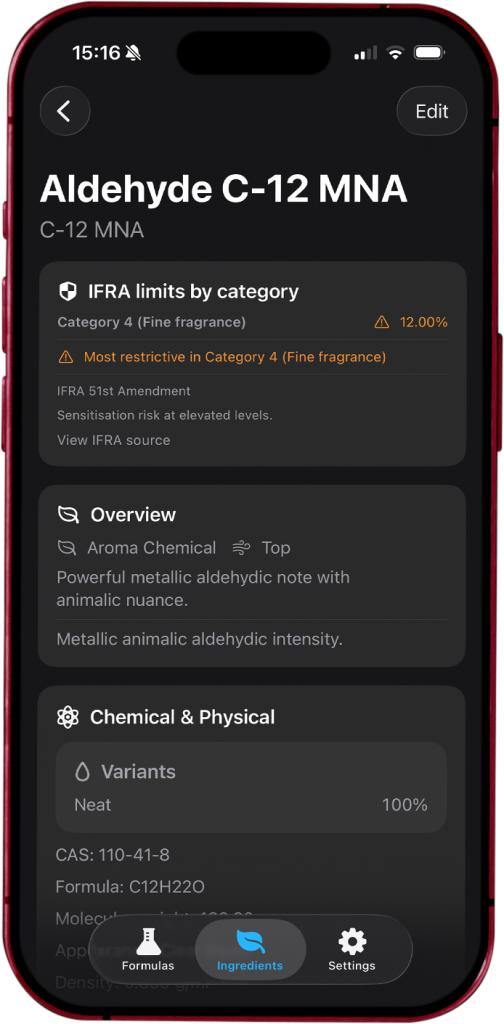
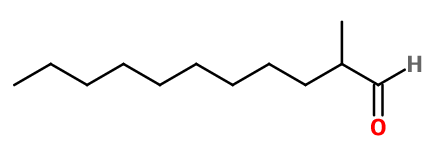
Aldehyde C-12 MNA is one of the most important aldehydes in perfumery. It provides a powerful fresh, waxy, citrus-metallic character and is essential in many classic and modern fragrances.
Aldehydes are extremely strong materials, and even tiny amounts can dramatically change a formula. They are often used to create lift, sparkle, and diffusion.
Because of their strength, aldehydes are typically used at very low percentages.
What Aldehyde C-12 MNA Smells Like
Aldehyde C-12 MNA has a distinctive scent.
It smells:
waxy
citrus-like
clean
metallic
slightly soapy
It contributes to the “sparkling” effect in many perfumes.
It is especially important in:
aldehydic fragrances
floral perfumes
fresh fragrances
classic perfumes
It helps fragrances smell more diffusive and professional.
Typical Aldehyde C-12 MNA Usage Percentage in Perfume
Aldehyde C-12 MNA is typically used between:
0.01% and 0.5% of the fragrance formula
Most commonly:
0.02% to 0.2%
Typical ranges:
0.005–0.02%
Adds subtle lift and freshness.
0.02–0.1%
Common range for improving diffusion.
0.1–0.3%
Clearly noticeable aldehydic character.
0.3–0.5%
Strong aldehydic effect.
Higher levels are rarely used.
Aldehyde C-12 MNA is almost always diluted to 1% or 10% before use.
What Happens at Low Percentages (0.005–0.05%)
At low levels, it improves the overall brightness of a fragrance.
It helps:
increase projection
add sparkle
enhance freshness
It may not be consciously noticeable.
What Happens at Medium Percentages (0.05–0.2%)
This is the most common usage range.
It contributes clearly to the character of the fragrance.
It creates:
clean lift
diffusive projection
classic aldehydic freshness
Many commercial perfumes use aldehydes in this range.
What Happens at High Percentages (0.2–0.5%)
At higher levels, it becomes a dominant note.
This is common in:
aldehydic floral fragrances
classic perfume styles
Excessive amounts can smell harsh or soapy.
Aldehyde C-12 MNA’s Role in Fragrance Structure
It is primarily a top note, although its effect on diffusion lasts longer.
Its main functions include:
increasing projection
adding sparkle
enhancing freshness
improving diffusion
It blends especially well with florals, citrus, and musks.
Example Aldehyde C-12 MNA Usage in a Formula
Example aldehydic floral formula:
Bergamot – 10%
Linalool – 6%
Hedione – 20%
Aldehyde C-12 MNA (1% solution) – 2%
Iso E Super – 18%
Galaxolide – 12%
Coumarin – 2%
Other materials – 30%
This creates lift and freshness in the opening.
IFRA Limits and Safety Considerations
Aldehyde C-12 MNA is typically used at extremely low levels and is usually well within IFRA limits.
Accurate dilution and measurement are important due to its strength.
Always refer to supplier IFRA documentation.
Common Mistakes When Using Aldehyde C-12 MNA
Using too much
This can create harsh or unpleasant smells.
Not diluting before use
Pure aldehydes are difficult to measure accurately.
Avoiding aldehydes entirely
Small amounts greatly improve fragrance quality.
What percentage of Aldehyde C-12 MNA should be used in perfume?
Most perfumes use between 0.02% and 0.2%.
Very small amounts are sufficient.
Is Aldehyde C-12 MNA a top, middle, or base note?
It is primarily a top note, contributing to freshness and lift.
What popular perfumes use aldehydes?
Aldehydes are a defining feature of classic fragrances such as Chanel No. 5, White Linen, and Arpège. They create the sparkling, diffusive opening.
Why are aldehydes used in perfume?
They improve projection, freshness, and overall diffusion.
Should Aldehyde C-12 MNA be diluted?
Yes. It is typically diluted to 1% or 10% before use.
Can Aldehyde C-12 MNA be overdosed?
Yes. Excessive amounts can smell harsh, metallic, or soapy.